


 Abstract
 HTML
HTML Reference
 Related
 PDF
PDF


-
The strange axial-vector mesons offer interesting possibilities for the study of quantum chromodynamics in the non-perturbative regime. Due to the presence of a strange quark with mass greater than the up and down quark masses, SU(3) symmetry is broken so that the
$ ^3P_1 $ and$ ^1P_1 $ states mix with each other to construct the mass eigenstates,$ \bar{K}_1(1200) $ and$ \bar{K}_1(1400) $ , by the mixing angle$ \theta_{\bar{K}_1} $ [1]. The mixing angle$ \theta_{\bar{K}_1} $ plays a crucial role in determining the theoretical calculations, such as the helicity form factors and branching fractions (BFs) for semileptpnic D-meson decays into strange axial-vector mesons [2−4].Semileptonic charm decays, induced by the quark-level process
$ c\to se^+\nu_e $ , are predominantly mediated by pseudoscalar (K) and vector ($ K^*(892) $ ) mesons, i.e., contain a kaon and at most one pion in the final-state hadronic systems [5, 6]. However, semileptonic charm decays to higher-multiplicity final states are expected to proceed predominantly via the axial–kaon system [7] and are therefore strongly suppressed. The$ D\to \bar{K}\pi\pi e^+\nu_e $ decays provide a unique opportunity to study the properties and interactions of$ \bar{K}_1(1270) $ and$ \bar{K}_1(1400) $ mesons in a clean environment, without any additional hadrons in the final states. Such studies can lead to a better determination of$ \theta_{\bar{K}_1} $ , as well as more precise measurements of the masses and widths of the$ \bar{K}_1 $ mesons, all of which currently carry large uncertainties [8]. Furthermore, by exploiting the measured properties of$ D\to \bar{K}_1(1270) \ell^+\nu_\ell $ and$ B\to \bar{K}_1(1270)\gamma $ decays, the photon polarization in$ b\to s\gamma $ can be determined without considerable theoretical ambiguity [9, 10]. Charge-conjugate decays are implied throughout the paper.The BFs of
$ \bar K_1(1270) $ decays to different two-body final states of$ \bar K\rho,\ \bar K^{*}_0(1430)\pi,\ \bar K^*(892)\pi,\ \bar K \omega, \bar Kf_0(1370) $ reported by the Particle Data Group (PDG) [8] are mostly based on a study of the$ K^-\pi^+\pi^- $ system conducted in a$ K^- p\to K^-\pi^-\pi^+ p $ scattering experiment in 1981 [11], combined with a recent BESIII measurement of the branching ratio$ {\cal B}(\bar K(1270)\to\bar K^*(892)\pi)/{\cal B}(\bar K(1270)\to\bar K\rho) $ in the$ D_s^+\to K^-K^+\pi^+\pi^0 $ decay [12]. All these BFs possesses large uncertainties, that lead to$ \sim $ 20% uncertainties on the$ \bar K_1(1270)\to \bar K \pi\pi $ BFs [13], becoming a bottleneck for precise BF measurements on any decays with$ \bar K_1(1270) $ as intermediate particles.Although not used by the PDG for the BF averages, there are still a number of other measurements on the
$ \bar K_1(1270) $ decays. Based on an amplitude analysis of the decay$ B^+\to J/\psi K^+\pi^+\pi^- $ , the Belle collaboration found the BFs of$ \bar{K}_1(1270)\to \bar{K}\rho, \bar K\omega $ , and$ \bar{K}^*(892)\pi $ to be generally consistent with the PDG averages within two standard deviations, while the measured BF of$ \bar{K}_1(1270)\to K_0^*(1430)\pi $ is significantly smaller [14]. Later measurements of the BF ratio$ \alpha\equiv\dfrac{{\cal{B}}(\bar{K}_1(1270)\to \bar K^*\pi)}{{\cal{B}}(\bar{K}_1(1270)\to \bar{K}\rho)} $ , where$ {\cal{B}}(\bar{K}_1(1270)\to \bar K^*\pi)={\cal{B}}(\bar{K}_1(1270)\to \bar{K}^*(1430)\pi) $ $ +{\cal{B}}(\bar{K}_1(1270)\to \bar{K}^*(892)\pi) $ , yield different results depending on the decay channels used [15−18], whereas they are expected to be identical under the narrow width approximation for the$ \bar{K}_1(1270) $ meson assuming$ CP $ conservation in strong decays [19].The BESIII collaboration, through performing separate studies of the four hadronic systems
$ K^-\pi^+\pi^- $ [20],$ K^-\pi^+\pi^0 $ [21],$ K_S^0\pi^+\pi^- $ and$ K_S^0\pi^-\pi^0 $ [22], reported the first observations of semielectronic D-meson decays involving a$ \bar{K}_1(1270) $ and measured their BFs based on the assumed$ \bar{K}_1(1270) $ decays. In addition, quite recently, an amplitude analysis of the$ D^0\to K^-\pi^+\pi^-e^+\nu_e $ and$ D^+\to K^-\pi^0\pi^-e^+\nu_e $ decays has been performed [23] with the larger$ \psi(3770) $ dataset corresponding to an integrated luminosity of$ 20.3\; \text{fb}^{-1} $ . The measured BFs are summarized in Table 1. In light of these measurements, in this work, a model-independent method is proposed to determine the BFs of$ \bar{K}_1(1270) $ decays through a simultaneous analysis of signal yields from the four decay modes$ D^0\to K^-\pi^+\pi^-e^+\nu_e $ ,$ D^+\to K^-\pi^+\pi^0e^+\nu_e $ ,$ D^0\to K^0_S\pi^-\pi^0e^+\nu_e $ , and$ D^+\to K^0_S\pi^+\pi^-e^+\nu_e $ . With this method, the feasibility of measuring BFs of$ {\cal{B}}(\bar{K}_1(1270)\to \bar K^*\pi) $ ,$ {\cal{B}}(\bar{K}_1(1270)\to \bar{K}\rho) $ and$ {\cal{B}}(\bar K_1(1270)\to \bar K\pi\pi) $ , based on the current 20.3$ {\rm{fb}}^{-1} $ $ \psi(3770) $ data sample from BESIII [24], is explored. The projected precisions on the BFs are also evaluated using pseudo-experiments.Decay mode Signal yield $ {\cal{B}}(D\to \bar K\pi\pi e^+\nu)\times 10^{-4} $ $ {\cal{B}}(D\to \bar{K}_1(1270)e^+\nu)\times 10^{-3} $ $ \int {\cal L}\text{d}t $ $ D^0\to K^-\pi^+\pi^-e^+\nu_e $ $ 109\pm13 $ $ (3.95\pm 0.41^{+0.31}_{-0.52} $ )$ (1.09\pm 0.13^{+0.09}_{-0.16} \pm0.12 $ )$ 2.93 \text{fb}^{-1} $ $ 731\pm 35 $ $ (3.20\pm 0.20\pm0.20) $ $ (1.02\pm 0.06\pm 0.06 \pm0.03 $ )$ 20.3 \text{fb}^{-1} $ $ D^+\to K^-\pi^+\pi^0e^+\nu_e $ $ 120\pm 13 $ $ (10.6\pm 1.2 \pm 0.8 $ )$ \left(2.30\pm 0.26^{+0.18}_{-0.21} \pm 0.25\right) $ $ 2.93 \text{fb}^{-1} $ $ 1270\pm 56 $ $ (12.70\pm 0.60 \pm 0.40 $ )$ \left(2.27\pm 0.11 \pm0.07 \pm 0.07\right) $ $ 20.3 \text{fb}^{-1} $ $ D^0\to K^0_S\pi^-\pi^0e^+\nu_e $ $ 17\pm5 $ $ (1.69^{+0.53}_{-0.46 }\pm0.15 $ )$ \left(1.05_{-0.28}^{+0.33} \pm 0.12 \pm 0.12\right) $ $ 2.93 \text{fb}^{-1} $ $ D^+\to K^0_S\pi^+\pi^-e^+\nu_e $ $ 20\pm6 $ $ (1.47^{+0.45}_{-0.40 }\pm0.14 $ )$ \left(1.29_{-0.35}^{+0.40} \pm 0.18 \pm 0.15\right) $ $ 2.93 \text{fb}^{-1} $ Table 1. Summary of the measured BFs and the corresponding integrated luminosities (
$ \int{\cal L}\text{d}t $ ) for four D-meson semileptonic decay modes reported in Refs. [20−23]. The first and second uncertainties are statistical and systematic, respectively. For the BFs of$ D\to \bar{K}_1(1270)e^+\nu_e $ decays, a third uncertainty arises from the assumed BFs of$ \bar{K}_1(1270) $ decays [8]. -
Table 1 lists the experimentally measured values of the BF
$ {\cal{B}}(D\to \bar{K}_1(1270)e^+\nu_e) $ , which depend on the assumed decay BFs of the$ \bar{K}_1(1270) $ . In these measurements [20−23], the BF$ {\cal{B}}(D \to \bar K\pi\pi e^+\nu_e) $ is expressed as the product of$ {\cal{B}}(D \to \bar{K}_1(1270) e^+\nu_e) $ and$ {\cal{B}}(\bar{K}_1(1270) \to \bar K\pi\pi) $ [25], where$ {\cal{B}}(\bar{K}_1(1270)\to \bar K\pi\pi) $ denotes the total BF for$ \bar{K}_1(1270) $ decays to$ K\pi\pi $ final states:$ {\cal{B}}(\bar{K}_1(1270)\to \bar K\pi\pi)= \sum\limits_{i}f_i{\cal{B}}^i(\bar{K}_1(1270)\to f), $
(1) where
$ f_i $ is the square of the Clebsch–Gordan coefficient corresponding to the$ i^{\text{th}} $ decay mode of$ \bar{K}_1(1270) $ :$ \bar{K}^*(1430)\pi $ ,$ \; \bar{K}^*(892)\pi $ ,$ \; \bar{K}\rho $ ,$ \; \bar K\omega $ . The last decay mode is neglected hereafter due to the smallness of the product$ {\cal B}(\bar{K}_1(1270)\to \bar K\omega)\times{\cal B}(\omega\to\pi^+\pi^-) $ . Regarding the completeness of the$ \bar K_1(1270) $ decays, we define the sum$ {\cal{B}}_{\text{3body}} $ as$ \begin{aligned}[b] {\cal{B}}_{\text{3body}} =\;& {\cal{B}}(\bar{K}_1(1270) \to \bar{K}\rho) + {\cal{B}}(\bar{K}_1(1270) \to \bar K^*\pi) \\ & + {\cal{B}}(\bar{K}_1(1270) \to \bar{K}f_0)\\\ =\;& 1-{\cal{B}}(\bar{K}_1(1270) \to \bar K\omega)=(0.89\pm0.02)\%, \end{aligned} $
(2) This is determined by
$ {\cal{B}}(\bar{K}_1(1270) \to \bar K\omega) $ [8].A transition variable, which is directly related to the BFs for different signal reconstruction modes and can be determined experimentally in a straightforward manner, is defined as:
$ \beta^{-1}\equiv1-\frac{{\cal{B}}(K^-_1(1270)\to K^-\pi^+\pi^-)}{{\cal{B}}(\bar{K}_1^0(1270)\to K^-\pi^+\pi^0)}. $
(3) Substituting Eq. (3) into the expression for α and defining the ratio
$ \delta_\alpha\equiv\dfrac{{\cal{B}}(\bar{K}_1(1270)\to \bar{K}f_0)}{{\cal{B}}(\bar{K}_1(1270)\to \bar{K}\rho)} $ , the BF ratio α can be expressed as:$ \alpha=\frac{3}{4}[\beta(1-3\delta_\alpha)-2] . $
(4) The BFs for
$ \bar{K}_1(1270) $ decays can then be expressed as:$ \begin{aligned}[b]&{\cal{B}}(K_1^-(1270)\rightarrow K^- \pi^+ \pi^-) = {\cal{B}}_{\text{3body}} \cdot \frac{3+4 \alpha+9\delta_\alpha}{9(1+\alpha+\delta_\alpha)}\\ =\;&\frac{4}{3}{\cal{B}}_{\text{3body}}\cdot\frac{\beta-3\delta_\alpha\beta+3\delta_\alpha-1}{(3\beta-9\delta_\alpha\beta+4\delta_\alpha-2)},\\[-10pt] \end{aligned} $
(5) $ \begin{aligned}[b]&{\cal{B}}(\bar{K}_1^0(1270)\rightarrow K^- \pi^+ \pi^0) ={\cal{B}}_{\text{3body}} \cdot \frac{6+4 \alpha}{9(1+\alpha+\delta_\alpha)} \\ =\;&\frac{4}{3}{\cal{B}}_{\text{3body}}\cdot\frac{\beta-3\delta_\alpha\beta}{(3\beta-9\delta_\alpha\beta+4\delta_\alpha-2)}. \end{aligned} $
(6) Since
$ \delta_\alpha $ depends on$ {\cal{B}}(\bar{K}_1(1270)\to \bar{K}\rho) $ , it is necessary to remove this dependence to make the measurement model-independent. To better quantify the associated uncertainty, we introduce the shorthand$ r_{f_0}=\frac{{\cal{B}}(\bar{K}_1(1270)\to \bar{K}f_0)}{{\cal{B}}_{\text{3body}}-{\cal{B}}(\bar{K}_1(1270)\to \bar{K}f_0)}=(3.5\pm2.3) $ % [8] into Eq. (4):$ \begin{aligned}[b] \alpha =\;&\frac{3}{4}[\beta(1-r_{f_0}(1+\alpha)-2]\\ \ \ =\;&\frac{3(\beta-3r_{f_0}\beta-2)}{9r_{f_0}\beta+4}=\frac{3\beta-2}{9r_{f_0}\beta+4}-1, \end{aligned} $
(7) This leads to an updated expression for
$ \delta_\alpha $ :$ \delta_{\alpha}=r_{f_0}(1+\alpha)=\frac{r_{f_0}(3\beta-2)}{9r_{f_0}\beta+4}. $
(8) By eliminating α in favor of
$ \delta_\alpha $ , the BFs$ {\cal{B}}(K^-_1(1270)\rightarrow K^{-} \pi^{+} \pi^{-}) $ and$ {\cal{B}}(\bar{K}^0_1(1270)\rightarrow K^{-} \pi^{+} \pi^0) $ in Eqs. (5-6) can be expressed as:$ \begin{aligned}[b]&{\cal{B}}(K_1^-(1270)\rightarrow K^- \pi^+ \pi^-) \\ =\;&\frac{4}{3} {\cal{B}}_{\text {3body }} \cdot \frac{(\beta-1)(1-3 \delta_\alpha)}{3 \beta(1-3 \delta_\alpha)+4 \delta_\alpha-2} \\ =\;& \frac{4}{3} {\cal{B}}_{\text {3body }} \cdot \frac{(\beta-1)\cdot (4+6 r_{f_0})}{4(3\beta-2)(r_{f_0}+1)}, \end{aligned} $
(9) $ \begin{aligned}[b]&{\cal{B}}(\bar{K}_1^0(1270)\rightarrow K^- \pi^+ \pi^0) \\ =\;&\frac{4}{3} {\cal{B}}_{\rm 3body } \cdot \frac{\beta(1-3 \delta_\alpha)}{3 \beta(1-3\delta_\alpha)+4 \delta_\alpha-2} \\ =\;& \frac{4}{3} {\cal{B}}_{\text {3body }} \cdot \frac{\beta\cdot (4+6 r_{f_0})}{4(3\beta-2)(r_{f_0}+1)}. \end{aligned} $
(10) In Eqs. 9 and 10, the parameter β is the sole free parameter in the formulation, whereas
$ {\cal{B}}_{\text{3body }} $ and$ r_{f_0} $ depend on external inputs,$ {\cal B}(\bar K_1(1270)\to \bar K \omega) $ and$ {\cal B}(\bar K_1(1270)\to \bar K f_0(1370)) $ , from the PDG. The value of β can be determined directly from experimental data by fitting the corresponding signal yields. Once β is obtained, all other physical observables—including the BFs and related quantities—can be derived from it, as they are explicit functions of β. This framework thus provides a consistent and model-independent approach in which all derived parameters are fully constrained by the experimentally determined value of β. -
The BESIII collaboration has individually measured
$ D^0\to K^-\pi^+\pi^-e^+\nu_e $ ,$ D^+\to K^-\pi^0\pi^-e^+\nu_e $ ,$ D^0\to K^0_S\pi^0\pi^-e^+\nu_e $ and$ D^+\to K^0_S\pi^+\pi^-e^+\nu_e $ decays [20−22], with the double-tag method [26, 27] and the$ \psi(3770) $ dataset corresponding to an integrated luminosity of$ 2.93\; \text{fb}^{-1} $ . A combined analysis of the$ D^0\to K^-\pi^+\pi^-e^+\nu_e $ and$ D^+\to K^-\pi^0\pi^-e^+\nu_e $ decays has been performed [23] with the larger$ \psi(3770) $ dataset corresponding to an integrated luminosity of$ 20.3\; \text{fb}^{-1} $ . In this section, a sensitivity study is performed by simultaneously fitting across the four decay modes, to determine the BFs of$ \bar{K}_1(1270) $ decays, and the BF ratio α, at the same time.One-dimensional pseudo-datasets of
$ M_{\rm miss}^2 $ are generated for the decay modes of$ D^0\to K^-\pi^+\pi^-e^+\nu_e $ and$ D^{0,+}\to K_S^0\pi^-\pi^{0,+}e^+\nu_e $ . Here$ M_{\rm miss}^2 $ is the missing mass square$ M_{\rm miss}^2 \equiv E^2_{\rm miss}/c^4-|\vec p_{\rm miss}|^2/c^2 $ , with$ E_{\rm miss} $ and$ \vec p_{\rm miss} $ being the total energy and momentum of all missing particles in the event, respectively. For the decay mode of$ D^+\to K^-\pi^+\pi^0e^+\nu_e $ , as the distribution of$ U_{\rm miss}\equiv E_{\rm miss}-|\vec p_{\rm miss}|c $ was used instead for signal yield extraction in Ref [20], the signal and background shapes of$ M_{\rm miss}^2 $ from the mode of$ D^{0}\to K_S^0\pi^-\pi^{0}e^+\nu_e $ are used as approximations. The expected signal yields of the decays$ D^0\to K^-\pi^+\pi^-e^+\nu_e $ ,$ D^+\to K^-\pi^0\pi^-e^+\nu_e $ ,$ D^0\to K^0_S\pi^0\pi^-e^+\nu_e $ and$ D^+\to K^0_S\pi^+\pi^-e^+\nu_e $ , based on the$ 20.3\; \text{fb}^{-1} $ $ \psi(3770) $ data, are estimated with$ N(D\to \bar{K}\pi\pi e^+\nu_e) = 2N(D\bar D) \times \sum\limits_i{\cal{B}}_i^{\rm ST}\varepsilon^{i}_{\rm DT}\times {\cal{B}}(D \to \bar{K}\pi\pi e^+\nu_e) $
(11) where
$ N(D\bar D) $ denotes the total number of produced$ D\bar{D} $ pairs [24],$ {\cal{B}}_i^{\rm ST} $ is the BF of the$ i^{\rm th} $ tag mode, and$ \varepsilon_{i}^{\rm DT} $ is the double-tag efficiency. The sum runs over the same tag modes as in Refs. [20−22], and the values of$ \varepsilon_{i}^{\rm DT} $ are assumed to be identical to those in Refs. [20−22].The background events are generated using background probability density functions previously determined from Monte Carlo (MC) simulations in Refs. [21, 22]. The estimated yields of the combinatorial and
$ D\to \bar K\pi\pi\pi $ peaking backgrounds are scaled by a factor of seven to account for the smaller datasets used in Refs. [20−22].To extract the parameters of interest, a simultaneous unbinned maximum-likelihood fit is performed on the four pseudo-datasets. The probability density functions that model the signal and background components are adopted from Refs. [21, 22], where they were determined from MC simulations. During the fit, the signal and combinatorial background yields are allowed to float, while the peaking-background yields are fixed to their generated values.
To minimize systematic effects from common sources such as luminosity, tagging, and tracking efficiencies, the parameter β is expressed in terms of ratios of signal yields:
$ \beta_{D^0}^{-1} =1-\frac{{\cal{N}}(K^-\pi^+\pi^-e^+\nu_e)}{{\cal{N}}(K^-\pi^+\pi^0e^+\nu_e)} =1-\frac{{\cal{N}}(K^-\pi^+\pi^-e^+\nu_e)}{\dfrac{{\cal{N}}(K_S^0\pi^-\pi^0e^+\nu_e)}{{\cal{B}}(K_S^0\to \pi^+\pi^-)/2}}, $
(12) $ \beta_{D^+}^{-1} =1-\frac{{\cal{N}}(K^-\pi^+\pi^-e^+\nu_e)}{{\cal{N}}(K^-\pi^+\pi^0e^+\nu_e)} =1-\frac{\dfrac{{\cal{N}}(K^0_S\pi^+\pi^-e^+\nu_e)}{{\cal{B}}(K_S^0\to \pi^+\pi^-)/2}}{{\cal{N}}(K^-\pi^+\pi^0e^+\nu_e)}. $
(13) where
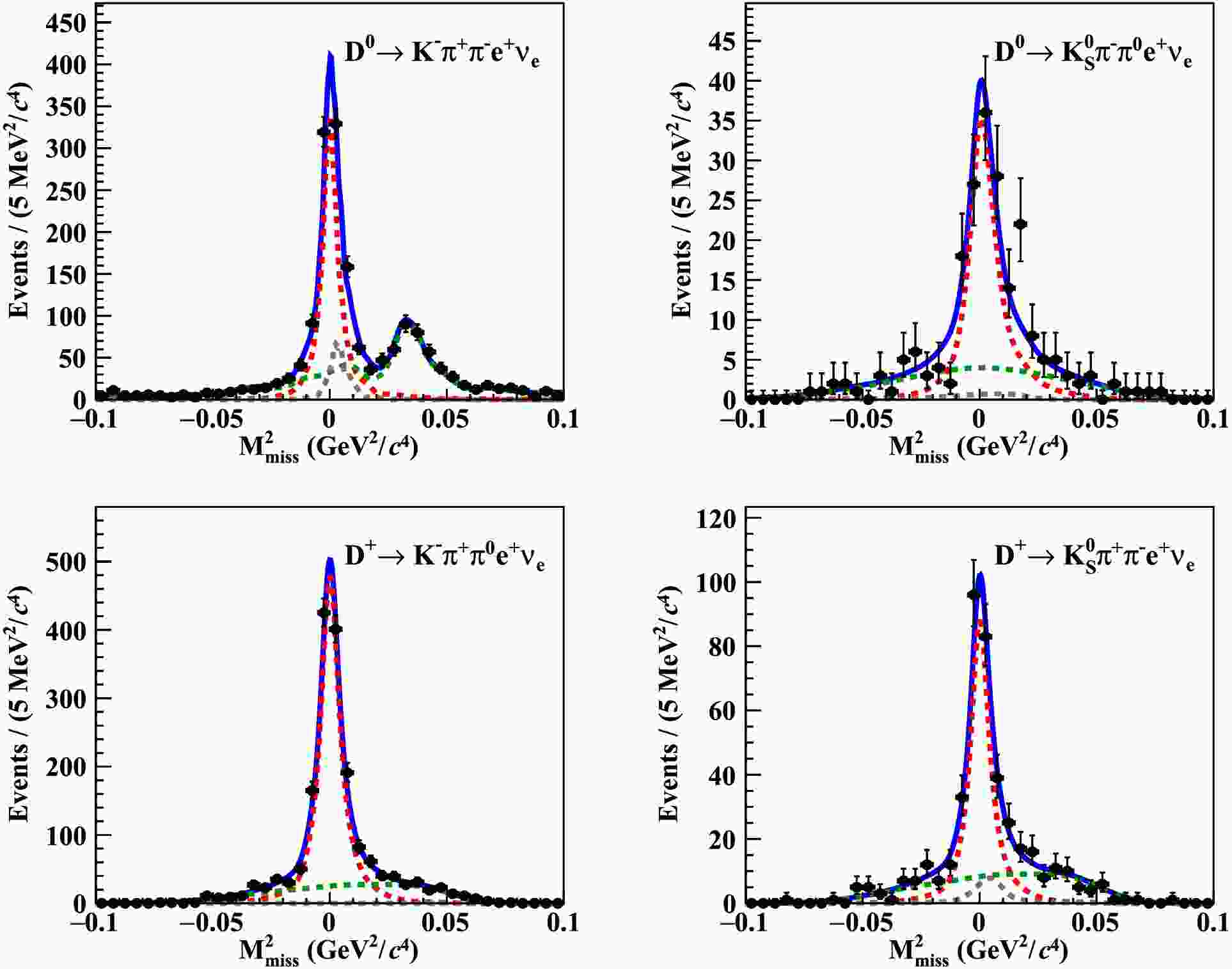
$ {\cal{N}} $ denotes the efficiency-corrected signal yield for each decay mode. Assuming$ \beta_{D^0}=\beta_{D^+} $ , the average value of β is extracted from a simultaneous fit to the pseudo-datasets for the four decay modes. The remaining observables are then determined using Eqs. 9 and 10. The one-dimensional fit projections onto the$ M^2_{\rm miss} $ distributions for the four decays are shown in Fig. 1 and the fit results are summarized in Table 2.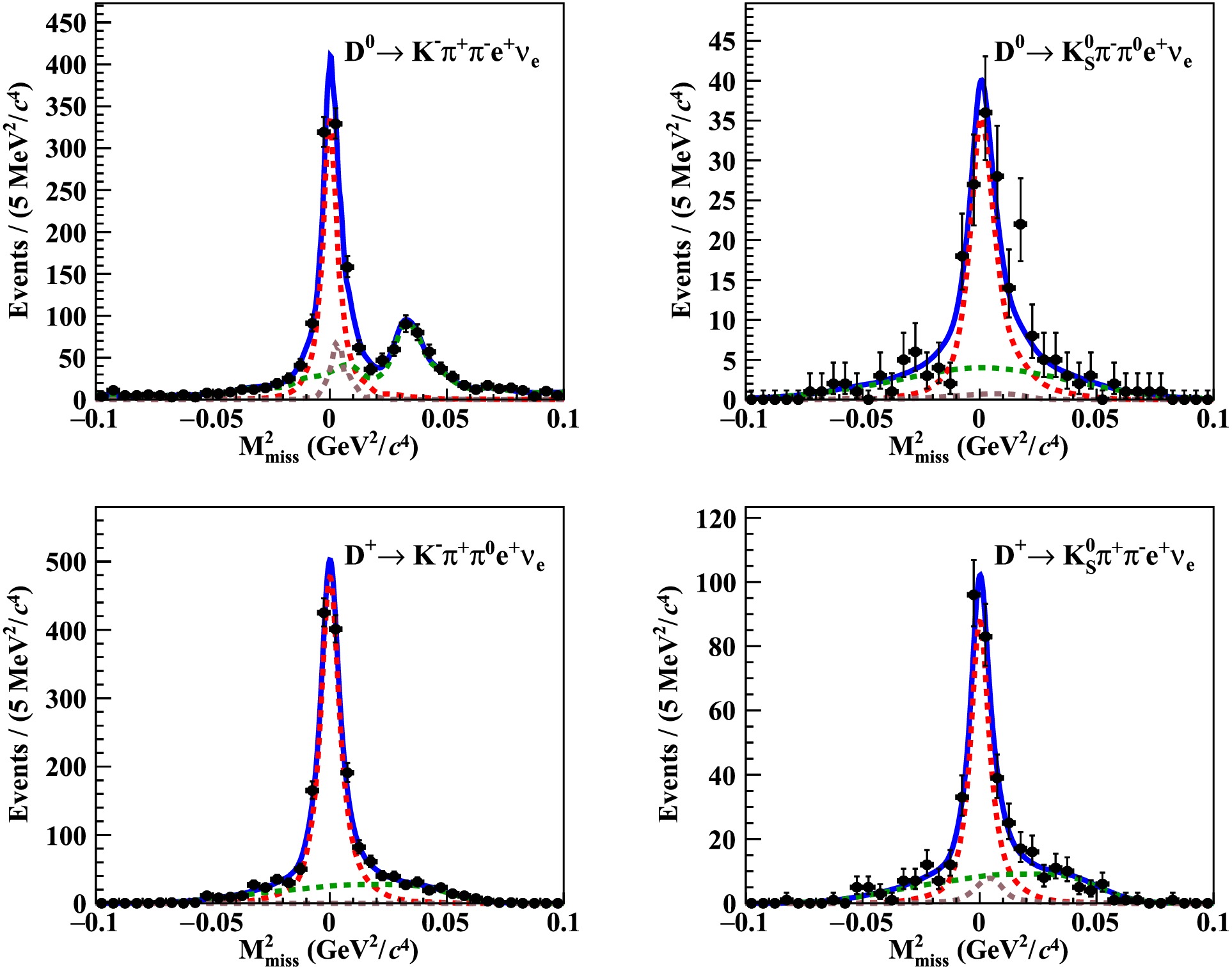
Figure 1. (color online) Simultaneous fit to the
$ M_{\rm miss}^2 $ distributions of the pseudo-datasets. Points with error bars show the pseudo-data; red dashed lines represent the signal shapes, green dashed lines the combinatorial background shapes, and brown dashed lines the peaking backgrounds from$ D\to \bar K\pi\pi\pi $ decays.Parameters Input Output BESIII results α [%] $ 20.3 $ $ 22.7\pm 15.0\pm 1.0\pm 0.6 $ $ 20.3\pm 2.1\pm 8.7 $ $ {\cal{B}}(\bar{K}_1(1270)\rightarrow \bar{K}^*(892)\pi) $ [%]$ 15.0 $ $ 16.5\pm 9.0\pm 0.7\pm 3.5 $ $ 19.5\pm 1.9\pm 5.2 $ $^ \star $ $ 10.9\pm1.2\pm3.0 $ $ ^\dagger $ $ {\cal{B}}(\bar{K}_1(1270)\rightarrow \bar{K}\rho) $ [%]$ 74.0 $ $ 72.5\pm 9.0\pm 0.7\pm 3.5 $ $ 71.8\pm 2.3\pm 23.9 $ $^ \star $ $ 79.3\pm 2.0\pm25.7 $ $^ \dagger $ $ {\cal{B}}(K_1^-(1270)\rightarrow K^{-} \pi^{+} \pi^{-}) $ [%]$ 31.3 $ $ 31.5\pm 1.1\pm 0.7\pm 0.4 $ $ 31.3\pm 0.9 $ $ {\cal{B}}(\bar{K}_1^0(1270)\rightarrow K^{-} \pi^{-} \pi^0) $ [%]$ 56.0 $ $ 55.7\pm 2.1\pm 1.3\pm 0.8 $ $ 56.0\pm 2.7 $ $ {\cal{B}}(D^0\to K_1^-(1270)e^+\nu_e) $ [$ \times 10^3 $ ]$ 1.02 $ $ 1.01\pm0.05\pm 0.02\pm 0.01 $ $ 1.02\pm0.06\pm 0.06\pm 0.03 $ $ {\cal{B}}(D^+\to \bar{K}_1^0(1270)e^+\nu_e) $ [$ \times 10^3 $ ]$ 2.27 $ $ 2.29\pm0.10\pm 0.05\pm 0.01 $ $ 2.27\pm0.11\pm 0.07\pm 0.07 $ $ \star $ From the channel of$ D^0\to K^-\pi^+\pi^-e^+\nu_e $ ;$ \dagger $ From the channel of$ D^+\to K^-\pi^+\pi^0 e^+\nu_e $ .Table 2. The measured values were obtained from a simultaneous fit to a single pseudo-dataset statistically matched to the 20.3
$ \rm fb^{-1} $ $ \psi(3770) $ dataset collected by BESIII. For each result (“Output”) reported here, the first uncertainty is statistical, the second is systematic, and the third arises from the external input on$ {\cal{B}}(\bar K_1(1270) \to \bar K\omega) $ [8]. The BESIII results [23] are listed for comparison.A total of 2000 pseudo-experiments are performed to assess potential biases introduced by the fit model. The resulting distribution of the pulls, defined as
$ \frac{\alpha_{\rm fit}-\alpha_{\rm nominal}}{\sigma_{\rm fit}} $ , where$ \alpha_{\rm fit} $ and$ \sigma_{\rm fit} $ denote, respectively, the fitted α central value and its uncertainty in each pseudo-experiment, is shown in Fig. 2 and is consistent with a normal distribution, indicating that the fit model is unbiased in determining α.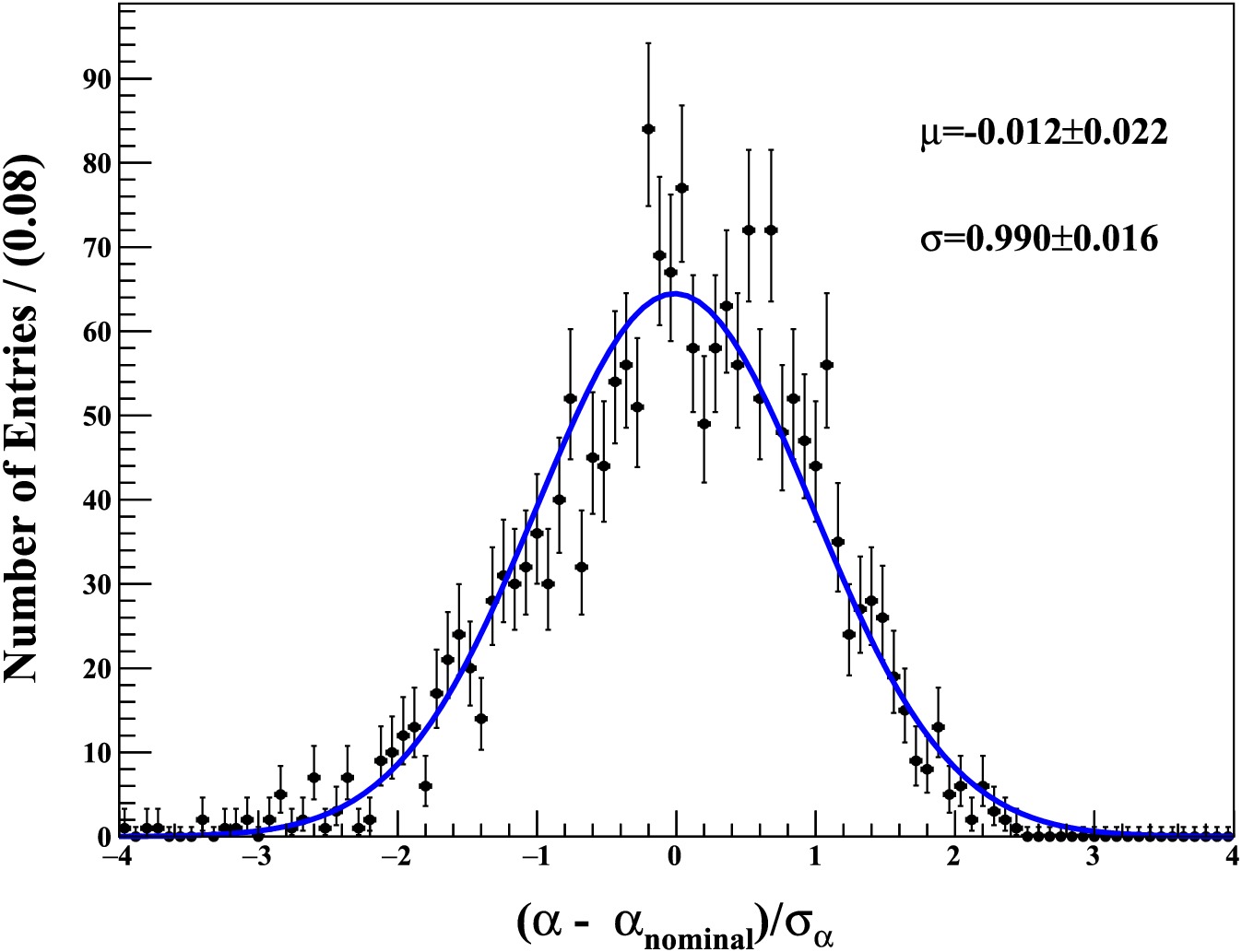
Figure 2. (color online) The α pull distribution is defined as the difference between the reconstructed value
$ \alpha' $ and the input value$ \alpha_{\rm nominal} $ , normalized by the estimated uncertainty$ \sigma_{\alpha} $ .Regarding potential sources of systematic uncertainty in the measurement, the double-tag method ensures that most tag-side uncertainties cancel. The uncertainties associated with the tracking and particle-identification efficiencies for
$ e^+ $ and charged pions largely cancel in the ratios defined in Eqs. 12 and 13. The uncertainties on the$ \pi^0 $ and$ K_S^0 $ reconstruction efficiencies are 1% [13, 28]. This systematic uncertainty is evaluated by applying Gaussian constraints to the efficiency parameters during the fit, yielding a relative uncertainty of 3.8%. Similarly, the uncertainty originating from the assumed input branching fractions ($ {\cal{B}}_{\rm 3\; body} $ and$ r_{f_0} $ ) is estimated by applying Gaussian constraints to these input parameters, contributing an additional 2.7%. Adding these independent sources in quadrature results in a conservative total estimate of 5%.Compared with BESIII's amplitude analysis based on the 20.3
$ {\rm{fb}}^{-1} $ $ \psi(3770) $ dataset [23], the expected statistical uncertainties on α and on the BFs for$ \bar{K}_1(1270)\to \bar{K}\rho,\bar K^*\pi $ in this work are larger, because this analysis does not exploit the full kinematic information of the$ D\to \bar K\pi\pi e^+ \nu_e $ decay (e.g., angular and$ q^2 $ distributions). Nevertheless, when systematic uncertainties are taken into account, this method achieves a significantly improved precision for$ {\cal B}(\bar{K}_1(1270)\to \bar{K}\rho,\bar K^*\pi) $ . With this method, the expected precision on the BFs for$ \bar{K}_1(1270)\to K^-\pi^{+,0}\pi^- $ is comparable to the BESIII results, while the input uncertainties on$ {\cal B}(D\to \bar{K}_1(1270) e^+\nu_e) $ are considerably reduced. -
In this work, a sensitivity study is performed to evaluate the feasibility of measuring the absolute branching fraction (BF)
$ {\cal{B}}(\bar{K}_1(1270)\to \bar K\pi\pi) $ and the ratio$ \alpha={\cal{B}}(\bar{K}_1(1270)\to \bar{K}^*\pi)/{\cal{B}}(\bar{K}_1(1270)\to \bar{K}\rho) $ . A model-independent approach to studying$ \bar{K}_1(1270) $ decays is proposed, in which signal yields are simultaneously extracted from the four$ K\pi\pi $ final states through a combined fit. The study demonstrates that a systematic uncertainty of approximately 5% can be achieved with the current$ \psi(3770) $ data sample (20.3$ {\rm{fb}}^{-1} $ ) from the BESIII experiment, providing a significant improvement over previous results [23].By not relying on specific signal decay models, the combined analysis yields substantially lower systematic uncertainties for
$ {\cal{B}}(\bar{K}_1(1270)\to \bar K^*\pi) $ ,$ {\cal{B}}(\bar{K}_1(1270)\to \bar{K}\rho) $ , and their ratio α, while providing a robust, model-independent validation of existing amplitude analysis results. Furthermore, these results lay the groundwork for high-precision probes of axial-vector meson structure and decay dynamics and will become increasingly advantageous with larger datasets from the Super Tau-Charm Factory, where the statistical uncertainties are expected to be reduced by at least one order of magnitude [29, 30].
Sensitivity study of $\bar{K}_1(1270)$ decay dynamics using four $D\to \bar{K}_1(1270)(\to \bar K\pi\pi)e^+\nu$ decay channels
- Received Date: 2026-01-23
- Available Online: 2026-06-01
Abstract: A sensitivity study of $ \bar{K}_1(1270) $ decay-mode measurements is performed using semileptonic D-meson decays. The BESIII experiment is used as a case study, in which a simultaneous analysis of $ \bar{K}_1(1270) $ decays to the four three-body final states $ K^-\pi^+\pi^- $, $ K^-\pi^+\pi^0 $, $ K_S^0\pi^+\pi^- $, and $ K_S^0\pi^-\pi^0 $ is presented, and a model-independent determination of $ {\cal{B}}(\bar{K}_1(1270)\to \bar K\pi\pi) $ that does not require detailed knowledge of intermediate resonant contributions is proposed.



 DownLoad: