


 Abstract
 HTML
HTML Reference
 Related
 PDF
PDF


-
The optical model (OM) represents a fundamental theoretical framework for the analysis of nuclear reactions. It provides a description of the complex nucleon-nucleus (NA) interaction, successfully reproducing elastic scattering data across a wide range of energies and target nuclei. The derivation of the optical model potential (OMP) from microscopic theories is a major research focus, owing to its ability to provide reliable predictions of nuclear reactions and develop a practical tool for predicting optical potentials of colliding systems for which the elastic scattering measurement is absent or difficult, such as unstable, exotic nuclei [1, 2]. Several models have been employed to develop a relativistic microscopic optical potential (RMOP) for investigating medium- and high-energy (NA) scattering. These models include frameworks based on the relativistic mean-field (RMF) [3, 4], relativistic Hartree-Fock (RHF) [5], and Dirac-Brueckner Hartree-Fock (DBHF) [6, 7] approaches.
Over the past decades, the RMF theory has received wide attention owing to its remarkable success in describing a wide range of nuclear properties. A key strength of the RMF theory is its ability to accurately reproduce the ground-state properties of spherical [8] and deformed nuclei [9] across the valley of stability using only a few parameters. Furthermore, its applicability has expanded beyond traditional nuclear structure to diverse areas of nuclear physics. Notably, the RMF theory has been successfully employed to determine the equation of state (EOS) of neutron stars [10], investigate shape coexistence phenomena [11, 12], calculate nuclear form factors for direct dark matter detection [13], explore the bubble structure of nuclei [14], determine cluster decay half-lives [15], and search for new effective interactions [16, 17].
For intermediate energies, a number of methods have been developed to calculate scattering observables (i.e., differential cross section and analyzing power). Among these, global Dirac phenomenology (DP) [18] and relativistic impulse approximation (RIA) [19-21] are the most successful approaches. In RIA, the construction of the RMOP involves a folding integral of free nucleon-nucleon (NN) scattering amplitudes with the scalar and vector nuclear densities of the target. While both scalar and vector (baryonic) density distributions are essential inputs, the scalar density cannot be obtained empirically. Its determination is inherently theoretical, relying on a pre-defined model for the ground-state wave functions. Usually, the ratios between the scalar and vector densities S/V are employed in the calculation by assuming a scalar density (
$ {\rho }^{S} $ ) of$ {\rho }^{S}=0.96\;{\rho }^{V} $ for [21] a vector density ($ {\rho }^{V} $ ). Within the RMF framework, the scalar density for spherical even-even nuclei can be calculated by solvingthe stationary Dirac-Hartree-Bogoliubov (DHB) equations,typically implemented in the DIRHB code [22].The eikonal approximation is an essential tool for modeling NN and nucleon-nucleus scattering at high energies. Its foundation is the dominance of forward scattering, which occurs when the incident particle's energy significantly exceeds the interaction potential. This approximation is formally related to the concept of an optical potential and is implemented by integrating along straight-line trajectories through the sum of the nuclear (including central and spin-orbit terms) and Coulomb potentials [23, 24]. The spin-orbit potential is particularly critical in these reactions, as it mediates the coupling between the projectile's spin and the target's orbital angular momentum. The inclusion of this potential in the eikonal phase has proven vital, demonstrating significant agreement between theoretical calculations and experimental data for nucleon-nucleus elastic scattering [25, 26]. Recent studies have extended eikonal methods to investigate spinning particles using scattering amplitudes [27, 28]. Typically, optical potentials in eikonal calculations are derived from folding models using effective interactions, such as the M3Y interaction or the t-ρρ approximation [24]. However, an optical potential derived from a relativistic microscopic approach has never been employed in this context.
This work aims to construct RMOPs for nucleon-nucleus scattering, derived from density distributions obtained through the self-consistent RMF theory with two sets of parametrizations: DD-ME2 and DD-PC1. The potentials comprise both real and imaginary parts of scalar and vector components. Performance is evaluated through a systematic study of elastic proton-nucleus scattering across seven target nuclei, 12C, 16O, 28Si, 40Ca, 58Ni, 90Zr, and 208Pb, within an incident energy range of 200 to 800 MeV. Calculations are performed within the RIA. Differential cross sections and analyzing powers are computed by solving the Dirac equation with the generated RMOP. The results are validated through a detailed comparison with those obtained from established DP optical potentials. The validity of the RMF approach is further examined by calculating nuclear densities for the calcium isotope chain 40,42,44,48Ca at 800 MeV, which are then used to generate the corresponding RMOPs. Finally, the RMOPs are employed within the eikonal approximation to compute the differential cross sections for proton elastic scattering from 12C, 28Si, and 40Ca over an energy range of 200 to 800 MeV while also examining the spin-orbit contribution.
The theoretical formalism is presented in Sec. II, which provides a brief description of the Dirac optical model (DOM), followed by the formulations of the microscopic (RIA-based) and DP optical potentials. The section also includes a description of the eikonal approximation. The results and corresponding discussion are presented in Sec. III. Finally, the key conclusions are summarized in Sec. IV.
-
The optical model (OM) represents a fundamental theoretical framework for the analysis of nuclear reactions. It provides a description of the complex nucleon-nucleus (NA) interaction, successfully reproducing elastic scattering data across a wide range of energies and target nuclei. The derivation of the optical model potential (OMP) from microscopic theories is a major research focus, owing to its ability to provide reliable predictions of nuclear reactions and develop a practical tool for predicting optical potentials of colliding systems for which the elastic scattering measurement is absent or difficult, such as unstable, exotic nuclei [1, 2]. Several models have been employed to develop a relativistic microscopic optical potential (RMOP) for investigating medium- and high-energy (NA) scattering. These models include frameworks based on the relativistic mean-field (RMF) [3, 4], relativistic Hartree-Fock (RHF) [5], and Dirac-Brueckner Hartree-Fock (DBHF) [6, 7] approaches.
Over the past decades, the RMF theory has received wide attention owing to its remarkable success in describing a wide range of nuclear properties. A key strength of the RMF theory is its ability to accurately reproduce the ground-state properties of spherical [8] and deformed nuclei [9] across the valley of stability using only a few parameters. Furthermore, its applicability has expanded beyond traditional nuclear structure to diverse areas of nuclear physics. Notably, the RMF theory has been successfully employed to determine the equation of state (EOS) of neutron stars [10], investigate shape coexistence phenomena [11, 12], calculate nuclear form factors for direct dark matter detection [13], explore the bubble structure of nuclei [14], determine cluster decay half-lives [15], and search for new effective interactions [16, 17].
For intermediate energies, a number of methods have been developed to calculate scattering observables (i.e., differential cross section and analyzing power). Among these, global Dirac phenomenology (DP) [18] and relativistic impulse approximation (RIA) [19-21] are the most successful approaches. In RIA, the construction of the RMOP involves a folding integral of free nucleon-nucleon (NN) scattering amplitudes with the scalar and vector nuclear densities of the target. While both scalar and vector (baryonic) density distributions are essential inputs, the scalar density cannot be obtained empirically. Its determination is inherently theoretical, relying on a pre-defined model for the ground-state wave functions. Usually, the ratios between the scalar and vector densities S/V are employed in the calculation by assuming a scalar density (
$ {\rho }^{S} $ ) of$ {\rho }^{S}=0.96\;{\rho }^{V} $ for [21] a vector density ($ {\rho }^{V} $ ). Within the RMF framework, the scalar density for spherical even-even nuclei can be calculated by solvingthe stationary Dirac-Hartree-Bogoliubov (DHB) equations,typically implemented in the DIRHB code [22].The eikonal approximation is an essential tool for modeling NN and nucleon-nucleus scattering at high energies. Its foundation is the dominance of forward scattering, which occurs when the incident particle's energy significantly exceeds the interaction potential. This approximation is formally related to the concept of an optical potential and is implemented by integrating along straight-line trajectories through the sum of the nuclear (including central and spin-orbit terms) and Coulomb potentials [23, 24]. The spin-orbit potential is particularly critical in these reactions, as it mediates the coupling between the projectile's spin and the target's orbital angular momentum. The inclusion of this potential in the eikonal phase has proven vital, demonstrating significant agreement between theoretical calculations and experimental data for nucleon-nucleus elastic scattering [25, 26]. Recent studies have extended eikonal methods to investigate spinning particles using scattering amplitudes [27, 28]. Typically, optical potentials in eikonal calculations are derived from folding models using effective interactions, such as the M3Y interaction or the t-ρρ approximation [24]. However, an optical potential derived from a relativistic microscopic approach has never been employed in this context.
This work aims to construct RMOPs for nucleon-nucleus scattering, derived from density distributions obtained through the self-consistent RMF theory with two sets of parametrizations: DD-ME2 and DD-PC1. The potentials comprise both real and imaginary parts of scalar and vector components. Performance is evaluated through a systematic study of elastic proton-nucleus scattering across seven target nuclei, 12C, 16O, 28Si, 40Ca, 58Ni, 90Zr, and 208Pb, within an incident energy range of 200 to 800 MeV. Calculations are performed within the RIA. Differential cross sections and analyzing powers are computed by solving the Dirac equation with the generated RMOP. The results are validated through a detailed comparison with those obtained from established DP optical potentials. The validity of the RMF approach is further examined by calculating nuclear densities for the calcium isotope chain 40,42,44,48Ca at 800 MeV, which are then used to generate the corresponding RMOPs. Finally, the RMOPs are employed within the eikonal approximation to compute the differential cross sections for proton elastic scattering from 12C, 28Si, and 40Ca over an energy range of 200 to 800 MeV while also examining the spin-orbit contribution.
The theoretical formalism is presented in Sec. II, which provides a brief description of the Dirac optical model (DOM), followed by the formulations of the microscopic (RIA-based) and DP optical potentials. The section also includes a description of the eikonal approximation. The results and corresponding discussion are presented in Sec. III. Finally, the key conclusions are summarized in Sec. IV.
-
The scattering of a nucleon in the mean field of the nucleus (target) can be described using the Dirac equation, which takes the form [29]
$ \begin{aligned}[b] \left(\dfrac{\hslash }{\mathrm{i}}\boldsymbol{\alpha }.\boldsymbol{\nabla}+ \beta \left\{m+{U}_{s}\left(\boldsymbol{r}\right)\right\}+ {U}_{V}\left(\boldsymbol{r}\right)\right.&\\[-2pt] \left.+\dfrac{\mathrm{i}\hslash }{2m}\beta \boldsymbol{\alpha }.\left\{\boldsymbol{\nabla} {U}_{T}\left(\boldsymbol{r}\right)\right\}\right)\psi \left(\boldsymbol{r}\right)&=E \psi \left(\boldsymbol{r}\right) , \end{aligned} $
(1) where
$ U_s\left(\boldsymbol{r}\right),U_V\left(\boldsymbol{r}\right),\mathrm{and}\, U_T\left(\boldsymbol{r}\right) $ are scalar, vector and tensor potentials, respectively. These three potentials are complex potentials [29].$ E=\varepsilon +M $ ,$ \varepsilon $ is the projectile energy in the CM system [30]. For even-even nuclei with zero spin, the scalar, vector, and tensor potentials are considered under the assumption of spherical symmetry. Only the scalar and vector potentials are included in calculations, whereas the tensor potential is neglected owing to the dominant scalar and vector terms [31].The scattering observables—specifically, the differential cross-section and analyzing power (Ay)—can be obtained by reducing the Dirac equation to an equivalent Schrödinger-like form. The four-component Dirac spinor ψ can be reduced to two coupled equations for the upper and lower spinor components and an equivalent Schrödinger-like equation can be obtained by eliminating the lower component. This equation can be written as [32]
$ \left[-\left\{\Delta +{K}^{2}\right\}+U_{\rm cen}^{\rm eff}\left(r\right)+U_{\rm so}^{\rm eff}\left(r\right)\boldsymbol{\sigma }.\boldsymbol{L}\right] \varphi \left(r\right)= 0 \, , $
(2) where
$ U_{\rm cen}^{\rm eff}\left(\boldsymbol{r}\right) $ and$ U_{\rm SO}^{\rm eff}\left(\boldsymbol{r}\right) $ are the effective central and effective spin-orbit potentials, respectively, and are written as$ \begin{aligned}[b]U_{\rm cen}^{\rm eff}=\;&\frac{3}{4}{\left[\frac{\nabla{D}_{T }\left(\boldsymbol{r}\right)}{{D}_{T }\left(\boldsymbol{r}\right)}\right]}^{2} - \frac{1}{2}\frac{\nabla{D}_{T }\left(\boldsymbol{r}\right)}{{D}_{T }\left(\boldsymbol{r}\right)} + \frac{1}{{\hslash }^{2}}\left\{2 E U_{V}^{o }\left(\boldsymbol{r}\right)\right.\\ &\left.+2m{U}_{s}\left(\boldsymbol{r}\right)-U_{V}^{o }{\left(\boldsymbol{r}\right)}^{2}+{U}_{s}{\left(\boldsymbol{r}\right)}^{2}\right\} ,\end{aligned} $
(3) $ U_{\rm SO}^{\rm eff}=\frac{1}{r}\frac{\mathrm{d}}{\mathrm{d}r}\left(\ln {D}_{T }\left(\boldsymbol{r}\right)\right), $
(4) where
$ {D}_{T }\left(\boldsymbol{r}\right)=\exp \left(\frac{{U}_{T}}{2m}\right)D\left(\boldsymbol{r}\right), $
(5) and
$ D\left(\boldsymbol{r}\right)=\left[E+m- U_{V}^{o }\left(\boldsymbol{r}\right)+{U}_{s}\left(\boldsymbol{r}\right)\right]. $
(6) -
The scattering of a nucleon in the mean field of the nucleus (target) can be described using the Dirac equation, which takes the form [29]
$ \begin{aligned}[b] \left(\dfrac{\hslash }{\mathrm{i}}\boldsymbol{\alpha }.\boldsymbol{\nabla}+ \beta \left\{m+{U}_{s}\left(\boldsymbol{r}\right)\right\}+ {U}_{V}\left(\boldsymbol{r}\right)\right.&\\[-2pt] \left.+\dfrac{\mathrm{i}\hslash }{2m}\beta \boldsymbol{\alpha }.\left\{\boldsymbol{\nabla} {U}_{T}\left(\boldsymbol{r}\right)\right\}\right)\psi \left(\boldsymbol{r}\right)&=E \psi \left(\boldsymbol{r}\right) , \end{aligned} $
(1) where
$ U_s\left(\boldsymbol{r}\right),U_V\left(\boldsymbol{r}\right),\mathrm{and}\, U_T\left(\boldsymbol{r}\right) $ are scalar, vector and tensor potentials, respectively. These three potentials are complex potentials [29].$ E=\varepsilon +M $ ,$ \varepsilon $ is the projectile energy in the CM system [30]. For even-even nuclei with zero spin, the scalar, vector, and tensor potentials are considered under the assumption of spherical symmetry. Only the scalar and vector potentials are included in calculations, whereas the tensor potential is neglected owing to the dominant scalar and vector terms [31].The scattering observables—specifically, the differential cross-section and analyzing power (Ay)—can be obtained by reducing the Dirac equation to an equivalent Schrödinger-like form. The four-component Dirac spinor ψ can be reduced to two coupled equations for the upper and lower spinor components and an equivalent Schrödinger-like equation can be obtained by eliminating the lower component. This equation can be written as [32]
$ \left[-\left\{\Delta +{K}^{2}\right\}+U_{\rm cen}^{\rm eff}\left(r\right)+U_{\rm so}^{\rm eff}\left(r\right)\boldsymbol{\sigma }.\boldsymbol{L}\right] \varphi \left(r\right)= 0 \, , $
(2) where
$ U_{\rm cen}^{\rm eff}\left(\boldsymbol{r}\right) $ and$ U_{\rm SO}^{\rm eff}\left(\boldsymbol{r}\right) $ are the effective central and effective spin-orbit potentials, respectively, and are written as$ \begin{aligned}[b]U_{\rm cen}^{\rm eff}=\;&\frac{3}{4}{\left[\frac{\nabla{D}_{T }\left(\boldsymbol{r}\right)}{{D}_{T }\left(\boldsymbol{r}\right)}\right]}^{2} - \frac{1}{2}\frac{\nabla{D}_{T }\left(\boldsymbol{r}\right)}{{D}_{T }\left(\boldsymbol{r}\right)} + \frac{1}{{\hslash }^{2}}\left\{2 E U_{V}^{o }\left(\boldsymbol{r}\right)\right.\\ &\left.+2m{U}_{s}\left(\boldsymbol{r}\right)-U_{V}^{o }{\left(\boldsymbol{r}\right)}^{2}+{U}_{s}{\left(\boldsymbol{r}\right)}^{2}\right\} ,\end{aligned} $
(3) $ U_{\rm SO}^{\rm eff}=\frac{1}{r}\frac{\mathrm{d}}{\mathrm{d}r}\left(\ln {D}_{T }\left(\boldsymbol{r}\right)\right), $
(4) where
$ {D}_{T }\left(\boldsymbol{r}\right)=\exp \left(\frac{{U}_{T}}{2m}\right)D\left(\boldsymbol{r}\right), $
(5) and
$ D\left(\boldsymbol{r}\right)=\left[E+m- U_{V}^{o }\left(\boldsymbol{r}\right)+{U}_{s}\left(\boldsymbol{r}\right)\right]. $
(6) -
The Dirac microscopic (DM) optical potential is constructed by the folding of scalar and vector nucleon densities with a realistic effective NN interaction. These potentials are subsequently employed in solving the Dirac equation to compute scattering observables [20]. The RIA was employed to model complex projectile-target nucleus interactions. This approach is a single-scattering approximation, which treats the scattering interaction by assuming that the projectile interacts with only one single target nucleon at a time and the interaction between the projectile and that single nucleon is identical to the interaction between two free particles. The interaction is assumed sudden and local; therefore, the nucleon does not have time to correlate strongly with its neighbors during the interaction. Therefore, the effects of the nuclear medium on this two-body interaction could be neglected except at a low energy where medium modifications from Pauli blocking are important [20]. Within the RIA, the optical potential consists of both direct and exchange components [33], which are given by [34, 35]
$ {U}^{L}\left(r;E\right)=U_{D}^{L}\left(r;E\right)+U_{X}^{L}\left(r;E\right), $
(7) where
$ U_D^L\left(r;E\right)=-\frac{4\pi\mathrm{i}p}{M}\int_{ }^{ }\mathrm{d}^3r'\rho^L(r')t_D^L(|r'-r|;E)\lambda_L , $
(8) $ U_X^L \left(r;E\right) = - \frac{4\pi\mathrm{i}p}{M} \int_{ }^{ } \mathrm{d}^3r'\rho^L(r,r')t_X^L(|r' - r|;E)j_o(p|r' - r|)\lambda_L , $
(9) The subscripts D and X denote the direct and exchange potentials, respectively. The parameter
$ {\lambda }_{L} $ refers to the Dirac matrices.$ {j}_{o } $ corresponds to the zeroth-order spherical Bessel function. The quantity$ {\rho }^{L}(r) $ indicates either scalar (S) or vector (V) densities, and$ {\rho }^{L}\left({r}', r\right) $ is the off-diagonal one-body density approximated as [33]$ {\rho }^{L}\left({r}',r\right)\approx {\rho }^{L}\left[\frac{1}{2}\left({r}'+r\right)\right]\left(\frac{3}{s{K}_{f}}\right){j}_{1}\left(s{K}_{f}\right) ,$
(10) where
$ s \equiv \left|r'-r\right| $ , and$ {K}_{f} $ is relevant to the baryon density by$ {\rho }_{B}\left(\dfrac{1}{2}\left({r}'+r\right)\right)=2K_{f}^{3}/3{\pi }^{2} $ . In RMF theories, the scalar density is a Lorentz-invariant quantity that characterizes the coupling of the scalar meson field. It gives rise to the attractive scalar potential and depends on the nucleon kinetic energy. By contrast, the vector density corresponds to the normal baryon density, which represents the coupling to the vector meson field and refers to the repulsive nuclear potential [9].$ t_{D}^{L} $ and$ t_{X}^{L} $ denote the direct and exchange interactions of the relativistic NN t-matrix, respectively [35]. The t-matrix in the RIA serves as the effective interaction between the incident projectile and a single bound nucleon. This t-matrix is determined by fitting its parameters to experimental proton-proton and proton-neutron scattering data over a wide range of energies and angles. It is typically expressed in a Lorentz-invariant form using Dirac operators. The ambiguities in the form of the NN interaction are resolved by using a pseudovector coupling for the pion. This choice is dictated by soft pion scattering and serves to greatly reduce both the strength and energy dependence of the real optical potential at low energies [20]. The microscopic optical potential is obtained by folding the nuclear density of the target with the NN$ t $ -matrix to incorporate the underlying NN interactions into the description of nucleon–nucleus scattering [36]. -
The Dirac microscopic (DM) optical potential is constructed by the folding of scalar and vector nucleon densities with a realistic effective NN interaction. These potentials are subsequently employed in solving the Dirac equation to compute scattering observables [20]. The RIA was employed to model complex projectile-target nucleus interactions. This approach is a single-scattering approximation, which treats the scattering interaction by assuming that the projectile interacts with only one single target nucleon at a time and the interaction between the projectile and that single nucleon is identical to the interaction between two free particles. The interaction is assumed sudden and local; therefore, the nucleon does not have time to correlate strongly with its neighbors during the interaction. Therefore, the effects of the nuclear medium on this two-body interaction could be neglected except at a low energy where medium modifications from Pauli blocking are important [20]. Within the RIA, the optical potential consists of both direct and exchange components [33], which are given by [34, 35]
$ {U}^{L}\left(r;E\right)=U_{D}^{L}\left(r;E\right)+U_{X}^{L}\left(r;E\right), $
(7) where
$ U_D^L\left(r;E\right)=-\frac{4\pi\mathrm{i}p}{M}\int_{ }^{ }\mathrm{d}^3r'\rho^L(r')t_D^L(|r'-r|;E)\lambda_L , $
(8) $ U_X^L \left(r;E\right) = - \frac{4\pi\mathrm{i}p}{M} \int_{ }^{ } \mathrm{d}^3r'\rho^L(r,r')t_X^L(|r' - r|;E)j_o(p|r' - r|)\lambda_L , $
(9) The subscripts D and X denote the direct and exchange potentials, respectively. The parameter
$ {\lambda }_{L} $ refers to the Dirac matrices.$ {j}_{o } $ corresponds to the zeroth-order spherical Bessel function. The quantity$ {\rho }^{L}(r) $ indicates either scalar (S) or vector (V) densities, and$ {\rho }^{L}\left({r}', r\right) $ is the off-diagonal one-body density approximated as [33]$ {\rho }^{L}\left({r}',r\right)\approx {\rho }^{L}\left[\frac{1}{2}\left({r}'+r\right)\right]\left(\frac{3}{s{K}_{f}}\right){j}_{1}\left(s{K}_{f}\right) ,$
(10) where
$ s \equiv \left|r'-r\right| $ , and$ {K}_{f} $ is relevant to the baryon density by$ {\rho }_{B}\left(\dfrac{1}{2}\left({r}'+r\right)\right)=2K_{f}^{3}/3{\pi }^{2} $ . In RMF theories, the scalar density is a Lorentz-invariant quantity that characterizes the coupling of the scalar meson field. It gives rise to the attractive scalar potential and depends on the nucleon kinetic energy. By contrast, the vector density corresponds to the normal baryon density, which represents the coupling to the vector meson field and refers to the repulsive nuclear potential [9].$ t_{D}^{L} $ and$ t_{X}^{L} $ denote the direct and exchange interactions of the relativistic NN t-matrix, respectively [35]. The t-matrix in the RIA serves as the effective interaction between the incident projectile and a single bound nucleon. This t-matrix is determined by fitting its parameters to experimental proton-proton and proton-neutron scattering data over a wide range of energies and angles. It is typically expressed in a Lorentz-invariant form using Dirac operators. The ambiguities in the form of the NN interaction are resolved by using a pseudovector coupling for the pion. This choice is dictated by soft pion scattering and serves to greatly reduce both the strength and energy dependence of the real optical potential at low energies [20]. The microscopic optical potential is obtained by folding the nuclear density of the target with the NN$ t $ -matrix to incorporate the underlying NN interactions into the description of nucleon–nucleus scattering [36]. -
Energy density functionals (EDFs) provide an accurate framework for modeling nuclear ground states and collective excitations. These functionals are implemented through self-consistent mean-field (SCMF) models formulated as functions of one-body nucleon density matrices, which are typically derived from a single product state of single-particle or quasiparticle states. The RMF theory is a distinct class of SCMF models based on relativistic (covariant) energy density functionals [22] in which nucleons interact through the exchange of mesons, scalar meson (σ), vector mesons (ρ and ω), and photons [37]. The isoscalar-scalar σ meson mediates the strong attractive force, the isoscalar-vector ω meson mediates the short-range repulsive interaction, and the isovector-vector ρ meson is responsible for interaction between nucleons with different spins [38].
The relativistic Lagrangian density of a nucleon-meson many body system is given by [39]
$ \begin{aligned}[b]\mathcal{L}=\;&{\overline{\psi }}_{i}\left(\mathrm{i}{\gamma }_{\mu }{\partial }^{\mu }-M\right){\psi }_{i}+\frac{1}{2} {\partial}^{\mu }\sigma {\partial}_{\mu }\sigma -\frac{1}{2} m_{\sigma }^{2}{\sigma }^{2}-\frac{1}{3}{g}_{2}{\sigma }^{3}\\ &-\frac{1}{4}{g}_{3}{\sigma }^{4} -{g}_{s}{\overline{\psi }}_{i}{\psi }_{i}\sigma -\frac{1}{4} {\Omega }^{\mu \upsilon }{\Omega }_{\mu \upsilon }+\frac{1}{2} m_{\omega }^{2}{V}^{\mu }{V}_{\mu }\\ &+ \frac{1}{4}{c}_{3}{\left({V}_{\mu }{V}^{\mu }\right)}^{2} - {g}_{\omega }{\overline{\psi }}_{i}{\gamma }^{\mu }{\psi }_{i}{V}_{\mu } - \frac{1}{4}{\boldsymbol{B}}^{\mu \nu }.{\boldsymbol{B}}_{\mu \nu }\\ &+\dfrac{1}{2}m_{\rho }^{2}{\boldsymbol{R}}^{\mu }.{\boldsymbol{R}}_{\mu }-{g}_{\rho }{\overline{\psi }}_{i}{\overset{\rightharpoonup }{\mathop{\tau}}}{\gamma }^{\mu }{\psi }_{i}{\boldsymbol{R}}^{\mu }\-\frac{1}{4} {F}^{\mu \upsilon }{F}_{\mu \upsilon }\\ &-e{\overline{\psi }}_{i}{\gamma }^{\mu }\frac{1-{\tau }_{3i}}{2}{\psi }_{i} {A}_{\mu } \end{aligned} $
(11) The terms
$ \sigma $ ,$ {V}_{\mu } $ , and$ {\boldsymbol{ R}_{\mu }} $ represent the fields for isoscalar-scalar (σ), isoscalar-vector (ω), and isovector-vector mesons ($\rho $ ), respectively. The term$ A_{\mu } $ denotes the electromagnetic field. The parameters$ {{m}}_{\sigma } $ ,$ {{m}}_{\omega } $ and$ {m}_{\rho } $ are the masses of σ, ω,$\rho $ mesons, respectively, and M is the nucleon mass [40]. The parameter$ {\tau }_{3\mathrm{i}} $ is defined as the third isospin component.$ {{g}}_{\sigma } $ ,$ {{g}}_{\omega } $ and$ {{g}}_{\rho } $ are the coupling constants for the three mesons. The field tensors are defined as follows [41]:$ \begin{aligned}[b]{\Omega }^{\mu \upsilon }= {\partial}^{\mu }{V}^{\nu }-{\partial}^{\nu }{V}^{\mu },\end{aligned} $
(12) $ {\overset{\rightharpoonup }{\mathop{B^{\mu \nu }}}}={\partial}^{\mu } {\overset{\rightharpoonup }{\mathop{R^{\nu }}}}-{\partial}^{\nu }{\overset{\rightharpoonup }{\mathop{R^{\mu }}}}, $
(13) $ {F}^{\mu \upsilon }={\partial}^{\mu }{A}^{\nu }-{\partial}^{\nu }{A}^{\mu }. $
(14) The RMF theory is categorized into two distinct representations, including (1) the DD-PC1 model [42], in which nucleons interact via contact couplings with density-dependent strengths [22], and (2) the DD-ME2 model [43], which maintains explicit meson mediation with density-dependent coupling parameters. These formulations are complementary approaches used to model nuclear interactions while preserving the essential relativistic structure of the theory. In the DD-ME2 model, the effective Lagrangian is constructed using four-fermion interactions that include isoscalar-scalar, isoscalar-vector, and isovector-vector terms [37]. The scalar and vector densities are defined as [22]
$ \begin{aligned}[b]{\rho }_{s}\left(r\right)=\sum \limits_{i=1}^{A}{\overline{\psi }}_{i}\left(r\right) {\psi }_{i}\left(r\right)\end{aligned}, $
(15) $ \begin{aligned}[b]{\rho }_{v}\left(r\right)=\sqrt{{j}_{\mu }{j}^{\mu }}\end{aligned} , $
(16) where
$ {j}_{\mu } $ and$ {j}^{\mu } $ are the isovector-vector current and the nucleon four-current, respectively.$ \begin{aligned}[b]{j}_{\mu }\left(r\right)=\sum {\overline{\psi }}_{i}\left(r\right){\gamma }_{\mu } {\psi }_{i}\left(r\right)\end{aligned} , $
(17) $ \begin{aligned}[b]{j}^{\mu }=\overline{\psi }{\gamma }^{\mu }\psi \end{aligned}. $
(18) The calculated scalar and vector nuclear densities are used as inputs to compute nucleon-nucleus scattering observables through the following chart [44].
$ \left\{ {\rho }^{L},{t}^{L}\right\}\xrightarrow{\rm folding}U_\text{opt}\xrightarrow{\rm Diraceqation}\left\{ \frac{\mathrm{d}\sigma }{\mathrm{d}\mathit{\Omega }},\text{Ay}\right\} $
-
Energy density functionals (EDFs) provide an accurate framework for modeling nuclear ground states and collective excitations. These functionals are implemented through self-consistent mean-field (SCMF) models formulated as functions of one-body nucleon density matrices, which are typically derived from a single product state of single-particle or quasiparticle states. The RMF theory is a distinct class of SCMF models based on relativistic (covariant) energy density functionals [22] in which nucleons interact through the exchange of mesons, scalar meson (σ), vector mesons (ρ and ω), and photons [37]. The isoscalar-scalar σ meson mediates the strong attractive force, the isoscalar-vector ω meson mediates the short-range repulsive interaction, and the isovector-vector ρ meson is responsible for interaction between nucleons with different spins [38].
The relativistic Lagrangian density of a nucleon-meson many body system is given by [39]
$ \begin{aligned}[b]\mathcal{L}=\;&{\overline{\psi }}_{i}\left(\mathrm{i}{\gamma }_{\mu }{\partial }^{\mu }-M\right){\psi }_{i}+\frac{1}{2} {\partial}^{\mu }\sigma {\partial}_{\mu }\sigma -\frac{1}{2} m_{\sigma }^{2}{\sigma }^{2}-\frac{1}{3}{g}_{2}{\sigma }^{3}\\ &-\frac{1}{4}{g}_{3}{\sigma }^{4} -{g}_{s}{\overline{\psi }}_{i}{\psi }_{i}\sigma -\frac{1}{4} {\Omega }^{\mu \upsilon }{\Omega }_{\mu \upsilon }+\frac{1}{2} m_{\omega }^{2}{V}^{\mu }{V}_{\mu }\\ &+ \frac{1}{4}{c}_{3}{\left({V}_{\mu }{V}^{\mu }\right)}^{2} - {g}_{\omega }{\overline{\psi }}_{i}{\gamma }^{\mu }{\psi }_{i}{V}_{\mu } - \frac{1}{4}{\boldsymbol{B}}^{\mu \nu }.{\boldsymbol{B}}_{\mu \nu }\\ &+\dfrac{1}{2}m_{\rho }^{2}{\boldsymbol{R}}^{\mu }.{\boldsymbol{R}}_{\mu }-{g}_{\rho }{\overline{\psi }}_{i}{\overset{\rightharpoonup }{\mathop{\tau}}}{\gamma }^{\mu }{\psi }_{i}{\boldsymbol{R}}^{\mu }\-\frac{1}{4} {F}^{\mu \upsilon }{F}_{\mu \upsilon }\\ &-e{\overline{\psi }}_{i}{\gamma }^{\mu }\frac{1-{\tau }_{3i}}{2}{\psi }_{i} {A}_{\mu } \end{aligned} $
(11) The terms
$ \sigma $ ,$ {V}_{\mu } $ , and$ {\boldsymbol{ R}_{\mu }} $ represent the fields for isoscalar-scalar (σ), isoscalar-vector (ω), and isovector-vector mesons ($\rho $ ), respectively. The term$ A_{\mu } $ denotes the electromagnetic field. The parameters$ {{m}}_{\sigma } $ ,$ {{m}}_{\omega } $ and$ {m}_{\rho } $ are the masses of σ, ω,$\rho $ mesons, respectively, and M is the nucleon mass [40]. The parameter$ {\tau }_{3\mathrm{i}} $ is defined as the third isospin component.$ {{g}}_{\sigma } $ ,$ {{g}}_{\omega } $ and$ {{g}}_{\rho } $ are the coupling constants for the three mesons. The field tensors are defined as follows [41]:$ \begin{aligned}[b]{\Omega }^{\mu \upsilon }= {\partial}^{\mu }{V}^{\nu }-{\partial}^{\nu }{V}^{\mu },\end{aligned} $
(12) $ {\overset{\rightharpoonup }{\mathop{B^{\mu \nu }}}}={\partial}^{\mu } {\overset{\rightharpoonup }{\mathop{R^{\nu }}}}-{\partial}^{\nu }{\overset{\rightharpoonup }{\mathop{R^{\mu }}}}, $
(13) $ {F}^{\mu \upsilon }={\partial}^{\mu }{A}^{\nu }-{\partial}^{\nu }{A}^{\mu }. $
(14) The RMF theory is categorized into two distinct representations, including (1) the DD-PC1 model [42], in which nucleons interact via contact couplings with density-dependent strengths [22], and (2) the DD-ME2 model [43], which maintains explicit meson mediation with density-dependent coupling parameters. These formulations are complementary approaches used to model nuclear interactions while preserving the essential relativistic structure of the theory. In the DD-ME2 model, the effective Lagrangian is constructed using four-fermion interactions that include isoscalar-scalar, isoscalar-vector, and isovector-vector terms [37]. The scalar and vector densities are defined as [22]
$ \begin{aligned}[b]{\rho }_{s}\left(r\right)=\sum \limits_{i=1}^{A}{\overline{\psi }}_{i}\left(r\right) {\psi }_{i}\left(r\right)\end{aligned}, $
(15) $ \begin{aligned}[b]{\rho }_{v}\left(r\right)=\sqrt{{j}_{\mu }{j}^{\mu }}\end{aligned} , $
(16) where
$ {j}_{\mu } $ and$ {j}^{\mu } $ are the isovector-vector current and the nucleon four-current, respectively.$ \begin{aligned}[b]{j}_{\mu }\left(r\right)=\sum {\overline{\psi }}_{i}\left(r\right){\gamma }_{\mu } {\psi }_{i}\left(r\right)\end{aligned} , $
(17) $ \begin{aligned}[b]{j}^{\mu }=\overline{\psi }{\gamma }^{\mu }\psi \end{aligned}. $
(18) The calculated scalar and vector nuclear densities are used as inputs to compute nucleon-nucleus scattering observables through the following chart [44].
$ \left\{ {\rho }^{L},{t}^{L}\right\}\xrightarrow{\rm folding}U_\text{opt}\xrightarrow{\rm Diraceqation}\left\{ \frac{\mathrm{d}\sigma }{\mathrm{d}\mathit{\Omega }},\text{Ay}\right\} $
-
The DP optical model is a powerful framework used to describe the interaction of nucleons with atomic nuclei. In the DP approach, the relativistic optical potentials (ROPs) are obtained by parameterizing the scalar and vector components of the Dirac equation to fit experimental scattering data such as differential cross sections and analyzing power observables [45]. Energy-dependent global Dirac optical potentials are constructed using the scalar-vector (SV) formalism. The general form of the scalar or vector optical model potentials is given as [46]
$ \begin{aligned}U^L\left(r,E,A\right)=\; & V^V\left(E,A\right)f^V\left(r,E,A\right)+V^S\left(E,A\right)f^S\left(r,E,A\right) \\ & +\mathrm{i}W^V\left(E,A\right)g^V\left(r,E,A\right)+iW^S\left(E,A\right)g^S\left(r,E,A\right)\end{aligned}, $
(19) where the superscripts S and V denote the absorption in the nucleus surface and absorption in the nucleus volume, respectively.
$ {f}^{V} $ and$ {f}^{S} $ are represented in the form of hyperbolic cosine as [47]$ \begin{aligned}[b]{f}^{V}=\frac{\left\{\text{cosh}\left[R\left(E,A\right)/a\left(E,A\right)\right]-1\right\}}{\{\text{cosh}\left[R\left(E,A\right)/a\left(E,A\right)\right]+\cosh \left[r/a\left(E,A\right)\right]-2\}}\end{aligned}, $
(20) and
$ \begin{aligned}[b]{f}^{S}=\frac{\left\{\cosh \left[R\left(E,A\right)/a\left(E,A\right)\right]-1\right\}\left\{\cosh \left[r/a\left(E,A\right)\right]-1\right\}}{{\left\{\text{cosh}\left[R\left(E,A\right)/a\left(E,A\right)\right]+\cosh \left[r/a\left(E,A\right)\right]-2\right\}}^{2}}\end{aligned}. $
(21) where
$ {g}^{V} $ and$ {g}^{S} $ have the same form of$ {f}^{V} $ and$ {f}^{S} $ , A is the atomic mass of the nucleus (target), and E is the CM energy of the (nucleon) projectile in MeV.The DP potentials
$ {{U}}^{{L}}({r},{E},{A}) $ describe both real and imaginary components that respectively represent dispersive and absorptive nuclear interactions. These energy- and mass-dependent potentials are functions of (1) the proton's CM energy E (in MeV) and (2) the mass number A of the target nucleus. The SV formulation within the DP framework has proven particularly successful because it reproduces global NN elastic scattering data accurately across an extensive range of projectile energies (~20 MeV to 1 GeV) and target masses (A = 12 to 208) while simultaneously describing differential cross sections, analyzing powers, and other scattering observables [18]. -
The DP optical model is a powerful framework used to describe the interaction of nucleons with atomic nuclei. In the DP approach, the relativistic optical potentials (ROPs) are obtained by parameterizing the scalar and vector components of the Dirac equation to fit experimental scattering data such as differential cross sections and analyzing power observables [45]. Energy-dependent global Dirac optical potentials are constructed using the scalar-vector (SV) formalism. The general form of the scalar or vector optical model potentials is given as [46]
$ \begin{aligned}U^L\left(r,E,A\right)=\; & V^V\left(E,A\right)f^V\left(r,E,A\right)+V^S\left(E,A\right)f^S\left(r,E,A\right) \\ & +\mathrm{i}W^V\left(E,A\right)g^V\left(r,E,A\right)+iW^S\left(E,A\right)g^S\left(r,E,A\right)\end{aligned}, $
(19) where the superscripts S and V denote the absorption in the nucleus surface and absorption in the nucleus volume, respectively.
$ {f}^{V} $ and$ {f}^{S} $ are represented in the form of hyperbolic cosine as [47]$ \begin{aligned}[b]{f}^{V}=\frac{\left\{\text{cosh}\left[R\left(E,A\right)/a\left(E,A\right)\right]-1\right\}}{\{\text{cosh}\left[R\left(E,A\right)/a\left(E,A\right)\right]+\cosh \left[r/a\left(E,A\right)\right]-2\}}\end{aligned}, $
(20) and
$ \begin{aligned}[b]{f}^{S}=\frac{\left\{\cosh \left[R\left(E,A\right)/a\left(E,A\right)\right]-1\right\}\left\{\cosh \left[r/a\left(E,A\right)\right]-1\right\}}{{\left\{\text{cosh}\left[R\left(E,A\right)/a\left(E,A\right)\right]+\cosh \left[r/a\left(E,A\right)\right]-2\right\}}^{2}}\end{aligned}. $
(21) where
$ {g}^{V} $ and$ {g}^{S} $ have the same form of$ {f}^{V} $ and$ {f}^{S} $ , A is the atomic mass of the nucleus (target), and E is the CM energy of the (nucleon) projectile in MeV.The DP potentials
$ {{U}}^{{L}}({r},{E},{A}) $ describe both real and imaginary components that respectively represent dispersive and absorptive nuclear interactions. These energy- and mass-dependent potentials are functions of (1) the proton's CM energy E (in MeV) and (2) the mass number A of the target nucleus. The SV formulation within the DP framework has proven particularly successful because it reproduces global NN elastic scattering data accurately across an extensive range of projectile energies (~20 MeV to 1 GeV) and target masses (A = 12 to 208) while simultaneously describing differential cross sections, analyzing powers, and other scattering observables [18]. -
The eikonal approximation is a powerful and widely-used theoretical tool in nuclear scattering physics, especially for analyzing high-energy interactions between nucleon projectiles and nuclear targets [48]. This approach is especially valuable for probing nuclear structure through scattering experiments. The approximation is valid under conditions in which (1) scattering occurs predominantly at forward angles (
$\theta \ll 1 $ radian), and (2) the energy transfer between projectile and target is negligible compared to the incident kinetic energy [49]. This interaction leads to the emergence of an eikonal phase shift that characterizes the effect of the scattering process and is defined as [24, 50]$ \begin{aligned}[b]\chi \left(\mathrm{b}\right)=-\frac{1}{\hslash v}\int\nolimits_{-\mathrm{\infty }}^{\mathrm{\infty }}{\mathrm{d}}z {U}_{0}\left(r\right)\end{aligned} , $
(22) where b is the impact parameter, and
$ \mathrm{\mathit{U}}_0\left(\mathrm{\mathit{r}}\right) $ is the optical potential without the spin-orbit contribution and$ r=\sqrt{{b}^{2}+{z}^{2}} $ . The optical potential is calculated from the folding of nucleon-nucleus interactions with the nuclear densities of the colliding particles. The optical potential is given by [51]$ \begin{aligned}[b]{U}_{opt}(r)=\;& {U}_{0}(r)+{U}_{SO}(r)\left(\boldsymbol{\sigma }.\boldsymbol{L}\right)\\ =&{U}_{cen}(r)+{U}_{SO}(r)\left(\boldsymbol{\sigma }.\boldsymbol{L}\right)+{U}_{C}(r)\end{aligned}. $
(23) The cross section of the nucleon-nucleus elastic scattering is given by [24]
$ \left(\frac{\mathrm{d}\sigma}{\mathrm{d}\Omega}\right)\mathrm{_{elastic}}=\left|F\left(\theta\right)\right|^2+\left|G\left(\theta\right)\right|^2 $
(24) where
$ \begin{aligned}[b]F\left(\theta \right)=\;& {f}_{C}\left(\theta \right)+\mathrm{i}k\int\limits_{0}^{\mathrm{\infty }}\mathrm{d}b b{J}_{o }\left(qb\right)\exp \left[\mathrm{i}{\chi }_{C}\left(b\right)\right]\\ & \times \left\{1-\exp \left[\mathrm{i}\chi \left(b\right)\right]\cos \left[kb{\chi }_{S}\left(b\right)\right]\right\},\end{aligned} $
(25) and
$ \begin{aligned}[b]G\left(\theta \right)= \mathrm{i}k\int\limits_{0}^{\mathrm{\infty }}\mathrm{d}b b{J}_{1}\left(qb\right)\exp \left[\mathrm{i}{\chi }_{C}\left(b\right)+\mathrm{i}\chi \left(b\right) \right] \sin \left[kb{\chi }_{S}\left(b\right)\right]\end{aligned}, $
(26) where
$ q=2k~\sin \left(\theta /2\right) $ , θ is the angle of scattering,$ {J}_{0} $ and$ {J}_{1} $ are the zero and first order of spherical Bessel function, and$ {\chi }_{S} $ is defined as$ \begin{aligned}[b]{\chi }_{S}\left(b\right)=-\frac{1}{\hslash v}\int\nolimits_{-\mathrm{\infty }}^{\mathrm{\infty }}\mathrm{d}\textit{z} {U}_{SO}\left(b,z\right)\end{aligned}. $
(27) -
The eikonal approximation is a powerful and widely-used theoretical tool in nuclear scattering physics, especially for analyzing high-energy interactions between nucleon projectiles and nuclear targets [48]. This approach is especially valuable for probing nuclear structure through scattering experiments. The approximation is valid under conditions in which (1) scattering occurs predominantly at forward angles (
$\theta \ll 1 $ radian), and (2) the energy transfer between projectile and target is negligible compared to the incident kinetic energy [49]. This interaction leads to the emergence of an eikonal phase shift that characterizes the effect of the scattering process and is defined as [24, 50]$ \begin{aligned}[b]\chi \left(\mathrm{b}\right)=-\frac{1}{\hslash v}\int\nolimits_{-\mathrm{\infty }}^{\mathrm{\infty }}{\mathrm{d}}z {U}_{0}\left(r\right)\end{aligned} , $
(22) where b is the impact parameter, and
$ \mathrm{\mathit{U}}_0\left(\mathrm{\mathit{r}}\right) $ is the optical potential without the spin-orbit contribution and$ r=\sqrt{{b}^{2}+{z}^{2}} $ . The optical potential is calculated from the folding of nucleon-nucleus interactions with the nuclear densities of the colliding particles. The optical potential is given by [51]$ \begin{aligned}[b]{U}_{opt}(r)=\;& {U}_{0}(r)+{U}_{SO}(r)\left(\boldsymbol{\sigma }.\boldsymbol{L}\right)\\ =&{U}_{cen}(r)+{U}_{SO}(r)\left(\boldsymbol{\sigma }.\boldsymbol{L}\right)+{U}_{C}(r)\end{aligned}. $
(23) The cross section of the nucleon-nucleus elastic scattering is given by [24]
$ \left(\frac{\mathrm{d}\sigma}{\mathrm{d}\Omega}\right)\mathrm{_{elastic}}=\left|F\left(\theta\right)\right|^2+\left|G\left(\theta\right)\right|^2 $
(24) where
$ \begin{aligned}[b]F\left(\theta \right)=\;& {f}_{C}\left(\theta \right)+\mathrm{i}k\int\limits_{0}^{\mathrm{\infty }}\mathrm{d}b b{J}_{o }\left(qb\right)\exp \left[\mathrm{i}{\chi }_{C}\left(b\right)\right]\\ & \times \left\{1-\exp \left[\mathrm{i}\chi \left(b\right)\right]\cos \left[kb{\chi }_{S}\left(b\right)\right]\right\},\end{aligned} $
(25) and
$ \begin{aligned}[b]G\left(\theta \right)= \mathrm{i}k\int\limits_{0}^{\mathrm{\infty }}\mathrm{d}b b{J}_{1}\left(qb\right)\exp \left[\mathrm{i}{\chi }_{C}\left(b\right)+\mathrm{i}\chi \left(b\right) \right] \sin \left[kb{\chi }_{S}\left(b\right)\right]\end{aligned}, $
(26) where
$ q=2k~\sin \left(\theta /2\right) $ , θ is the angle of scattering,$ {J}_{0} $ and$ {J}_{1} $ are the zero and first order of spherical Bessel function, and$ {\chi }_{S} $ is defined as$ \begin{aligned}[b]{\chi }_{S}\left(b\right)=-\frac{1}{\hslash v}\int\nolimits_{-\mathrm{\infty }}^{\mathrm{\infty }}\mathrm{d}\textit{z} {U}_{SO}\left(b,z\right)\end{aligned}. $
(27) -
In this section, systematic calculations of differential cross sections and analyzing power observables are presented for proton elastic scattering from 12C, 16O, 28Si, 40Ca, 58Ni, 90Zr, and 208Pb nuclei across the 200-800 MeV energy range based on ROPs. Two distinct theoretical frameworks were employed: (1) the DM and (2) the DP optical models. In the DM model, the microscopic calculations incorporated two parameterizations for the folding procedure. Nuclear densities, which were used in the folding procedure, were derived from the RMF theory with DD-ME2 and DD-PC1 parameterizations using a modified DIRHB code. The resulting folded potentials were input into the ECIS06 code to solve the Dirac equation and compute scattering observables. The DP calculations utilized the global SV formalism [18] using the GLOBAL code. All experimental data were obtained from the EXFOR nuclear reaction database library [52].
-
In this section, systematic calculations of differential cross sections and analyzing power observables are presented for proton elastic scattering from 12C, 16O, 28Si, 40Ca, 58Ni, 90Zr, and 208Pb nuclei across the 200-800 MeV energy range based on ROPs. Two distinct theoretical frameworks were employed: (1) the DM and (2) the DP optical models. In the DM model, the microscopic calculations incorporated two parameterizations for the folding procedure. Nuclear densities, which were used in the folding procedure, were derived from the RMF theory with DD-ME2 and DD-PC1 parameterizations using a modified DIRHB code. The resulting folded potentials were input into the ECIS06 code to solve the Dirac equation and compute scattering observables. The DP calculations utilized the global SV formalism [18] using the GLOBAL code. All experimental data were obtained from the EXFOR nuclear reaction database library [52].
-
The ground-state densities of the seven nuclei under investigation were computed via RMF calculations using the DD-ME2 and DD-PC1 parameterizations. This was accomplished using a modified version of the DIRHB code that assumed spherical symmetry for all nuclei to enable use of its spherical implementation. We specified the number of oscillator shells and the Lagrangian parameter set (DD-ME2 or DD-PC1). The modified code provided scalar and vector densities for protons and neutrons, which were then used in a folding procedure to construct microscopic optical-model potentials.
The root mean square (rms) neutron radius (
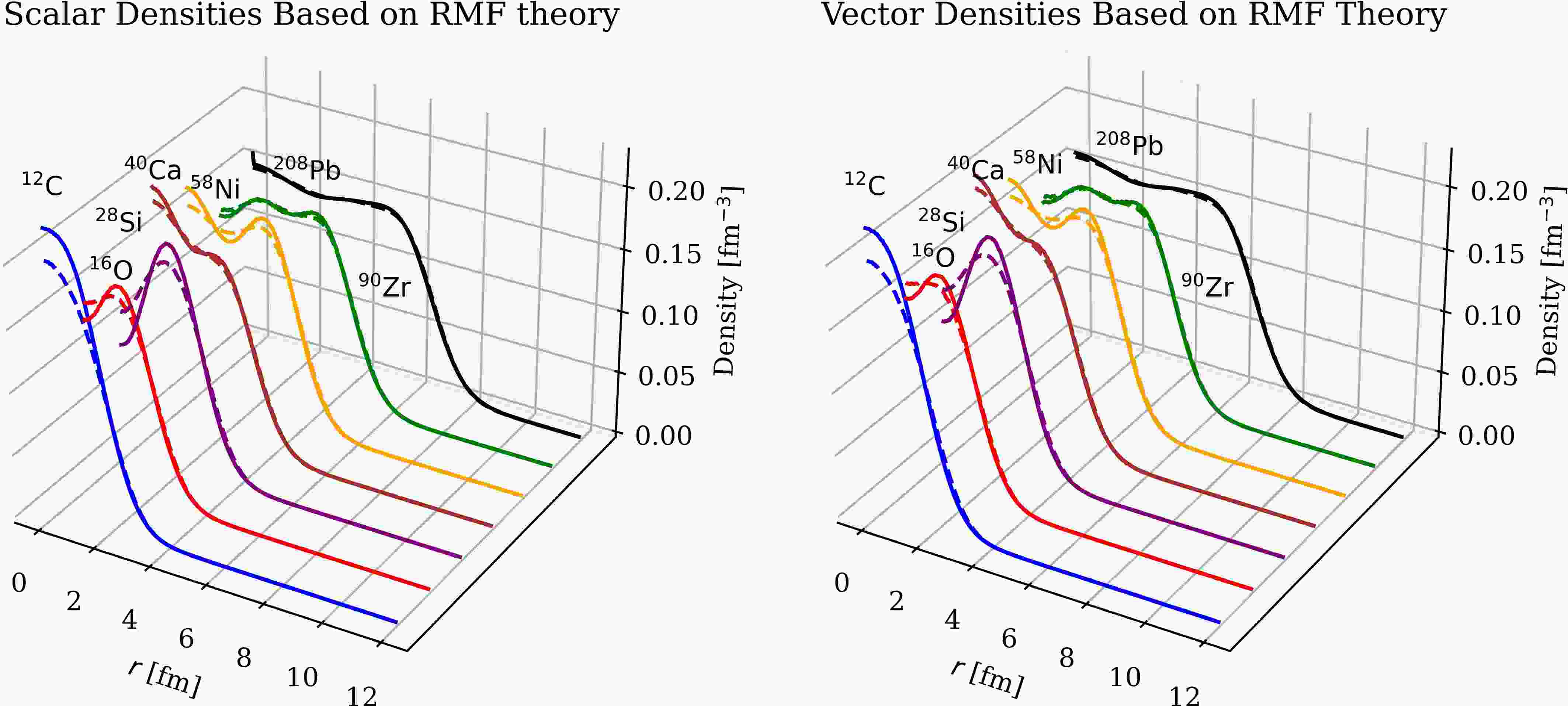
$ {r}_{n} $ ), the rms proton radius ($ {r}_{p} $ ), rms radius ($ {r}_{\rm rms} $ ), rms charge radius ($ r_{c}^{\rm cal} $ ), and$ {r}_{np}={r}_{n}-{r}_{p} $ , as well as the binding energy (Ecal) and energy per nucleon (E/A) were calculated within the RMF theory using a modified DIRHB code for 12C, 16O, 28Si, 40Ca, 58Ni, 90Zr, and 208Pb nuclei along with the corresponding experimental values of$ r_{c}^{\rm exp} $ , and Eexp are listed in Table 1. For each nucleus, values were calculated using the DD-ME2 and DD-PC1 parameterizations. A comparison of the results reveals a small difference between two models.Nucleus Model $ {{r}}_{{n}} $ $ {{r}}_{{p}} $ $ {\Delta {r}}_{{n}{p}} $ $ {{r}}_{\rm rms} $ $ {r}_{{c}}^{\rm {e}{x}{p}} $ $ {r}_{{c}}^{\rm {c}{a}{l}} $ $ {{E}}^{\rm {e}{x}{p}} $ $ {{E}}^{\rm {c}{a}{l}} $ E/A 12C DD-ME2 2.351 2.376 −0.025 2.363 2.470 2.507 −92 −87.31 −7.276 DD-PC1 2.401 2.423 −0.022 2.412 2.552 −87.15 −7.263 16O DD-ME2 2.577 2.606 −0.029 2.591 2.730 2.726 −128 −127.8 −7.988 DD-PC1 2.601 2.627 −0.026 2.614 2.746 −128.4 −8.026 28Si DD-ME2 2.916 2.953 −0.037 2.935 3.138 3.060 −237 −229.7 −8.205 DD-PC1 2.966 3.001 −0.035 2.984 3.105 −228.9 −8.175 40Ca DD-ME2 3.318 3.370 −0.052 3.344 3.478 3.464 −342.05 −342.7 −8.569 DD-PC1 3.316 3.363 −0.047 3.340 3.457 −344.7 −8.619 58Ni DD-ME2 3.670 3.666 0.010 3.668 3.776 3.752 −506.45 −501.6 −8.648 DD-PC1 3.693 3.689 0.004 3.691 3.775 −501.9 −8.653 90Zr DD-ME2 4.267 4.192 0.075 4.234 4.270 4.268 −783.89 −783.1 −8.702 DD-PC1 4.281 4.191 0.090 4.241 4.267 −785.2 −8.725 208Pb DD-ME2 5.560 5.460 0.100 5.576 5.501 5.576 −1636.43 −1640.0 −7.884 DD-PC1 5.649 5.450 0.199 5.571 5.508 −1641.3 −7.890 The obtained scalar and vector (baryon) density distributions of various target nuclei are illustrated in Fig. 1. The vector density distribution for 12C exhibited a pronounced central peak. By contrast, the vector density distributions for 16O and 28Si displayed a bubble-like structure, characterized by a depleted central density. For 40Ca, the vector density distribution was centrally peaked, with a secondary minor peak observed at approximately 3 fm. The vector density distribution of 58Ni was distinguished by a double-peak structure, without the bubble-like feature observed in lighter nuclei. In the case of 90Zr, the vector density distribution showed a reduced central density, with a gradual increase as the radial distance from the nucleus center grew. For 208Pb, the vector density distribution remained nearly constant, with a slight decrease noted at approximately 2.5 fm.
Figure 1. (color online) Density distributions of 12C, 16O, 28Si, 40Ca, 58Ni, 90Zr, and 208Pb nuclei based on DD-ME2 model (the solid lines) and DD-PC1 model (the dashed lines). The left panel displays the scalar density, while the right panel shows the vector (baryon) density.
A comparative analysis of the DD-ME2 and DD-PC1 models showed some notable differences in the calculated density distributions that diminished as the atomic mass of the nucleus increased. The scalar density distributions closely mirrored the qualitative behavior of the vector density distributions across the studied nuclei. The obtained densities were used to obtain the two sets of scalar and vector optical potentials (i.e., the DD-ME2 and DD-PC1 sets).
-
The ground-state densities of the seven nuclei under investigation were computed via RMF calculations using the DD-ME2 and DD-PC1 parameterizations. This was accomplished using a modified version of the DIRHB code that assumed spherical symmetry for all nuclei to enable use of its spherical implementation. We specified the number of oscillator shells and the Lagrangian parameter set (DD-ME2 or DD-PC1). The modified code provided scalar and vector densities for protons and neutrons, which were then used in a folding procedure to construct microscopic optical-model potentials.
The root mean square (rms) neutron radius (
$ {r}_{n} $ ), the rms proton radius ($ {r}_{p} $ ), rms radius ($ {r}_{\rm rms} $ ), rms charge radius ($ r_{c}^{\rm cal} $ ), and$ {r}_{np}={r}_{n}-{r}_{p} $ , as well as the binding energy (Ecal) and energy per nucleon (E/A) were calculated within the RMF theory using a modified DIRHB code for 12C, 16O, 28Si, 40Ca, 58Ni, 90Zr, and 208Pb nuclei along with the corresponding experimental values of$ r_{c}^{\rm exp} $ , and Eexp are listed in Table 1. For each nucleus, values were calculated using the DD-ME2 and DD-PC1 parameterizations. A comparison of the results reveals a small difference between two models.Nucleus Model $ {{r}}_{{n}} $ $ {{r}}_{{p}} $ $ {\Delta {r}}_{{n}{p}} $ $ {{r}}_{\rm rms} $ $ {r}_{{c}}^{\rm {e}{x}{p}} $ $ {r}_{{c}}^{\rm {c}{a}{l}} $ $ {{E}}^{\rm {e}{x}{p}} $ $ {{E}}^{\rm {c}{a}{l}} $ E/A 12C DD-ME2 2.351 2.376 −0.025 2.363 2.470 2.507 −92 −87.31 −7.276 DD-PC1 2.401 2.423 −0.022 2.412 2.552 −87.15 −7.263 16O DD-ME2 2.577 2.606 −0.029 2.591 2.730 2.726 −128 −127.8 −7.988 DD-PC1 2.601 2.627 −0.026 2.614 2.746 −128.4 −8.026 28Si DD-ME2 2.916 2.953 −0.037 2.935 3.138 3.060 −237 −229.7 −8.205 DD-PC1 2.966 3.001 −0.035 2.984 3.105 −228.9 −8.175 40Ca DD-ME2 3.318 3.370 −0.052 3.344 3.478 3.464 −342.05 −342.7 −8.569 DD-PC1 3.316 3.363 −0.047 3.340 3.457 −344.7 −8.619 58Ni DD-ME2 3.670 3.666 0.010 3.668 3.776 3.752 −506.45 −501.6 −8.648 DD-PC1 3.693 3.689 0.004 3.691 3.775 −501.9 −8.653 90Zr DD-ME2 4.267 4.192 0.075 4.234 4.270 4.268 −783.89 −783.1 −8.702 DD-PC1 4.281 4.191 0.090 4.241 4.267 −785.2 −8.725 208Pb DD-ME2 5.560 5.460 0.100 5.576 5.501 5.576 −1636.43 −1640.0 −7.884 DD-PC1 5.649 5.450 0.199 5.571 5.508 −1641.3 −7.890 The obtained scalar and vector (baryon) density distributions of various target nuclei are illustrated in Fig. 1. The vector density distribution for 12C exhibited a pronounced central peak. By contrast, the vector density distributions for 16O and 28Si displayed a bubble-like structure, characterized by a depleted central density. For 40Ca, the vector density distribution was centrally peaked, with a secondary minor peak observed at approximately 3 fm. The vector density distribution of 58Ni was distinguished by a double-peak structure, without the bubble-like feature observed in lighter nuclei. In the case of 90Zr, the vector density distribution showed a reduced central density, with a gradual increase as the radial distance from the nucleus center grew. For 208Pb, the vector density distribution remained nearly constant, with a slight decrease noted at approximately 2.5 fm.
Figure 1. (color online) Density distributions of 12C, 16O, 28Si, 40Ca, 58Ni, 90Zr, and 208Pb nuclei based on DD-ME2 model (the solid lines) and DD-PC1 model (the dashed lines). The left panel displays the scalar density, while the right panel shows the vector (baryon) density.
A comparative analysis of the DD-ME2 and DD-PC1 models showed some notable differences in the calculated density distributions that diminished as the atomic mass of the nucleus increased. The scalar density distributions closely mirrored the qualitative behavior of the vector density distributions across the studied nuclei. The obtained densities were used to obtain the two sets of scalar and vector optical potentials (i.e., the DD-ME2 and DD-PC1 sets).
-
The folded optical potentials were constructed according to the formalism outlined in Eq. (7)−(9) using the previously derived scalar and vector densities. This procedure was implemented using the Relativistic-Love-Franey (RLF) parameters for 150−400 MeV energies and the McNeil-Ray-Wallace (MRW) parameters for 400-1000 MeV [57, 58], which explicitly include pseudovector coupling and Pauli blocking effects in their formulation.
The constructed folded potentials exhibited distinct energy-dependent behaviors. As incident energy increased, the depths of the real parts of both scalar and vector potentials decreased, while their imaginary parts remained largely independent of energy. The real part of the scalar potential was attractive, whereas the real part of the vector potential was repulsive. Conversely, the effective central potential showed increasing depths for both its real and imaginary parts with increasing energy, with the real part exhibiting a repulsive nature for high incident energy. The real part of the effective spin-orbit potential decreased in strength with increasing energy while its imaginary part increased. Figure 2 shows the folded potentials used in DM analysis for p + 40Ca elastic scattering based on DD-ME2 and DD-PC1 models at 201, 362, 500, and 800 MeV.
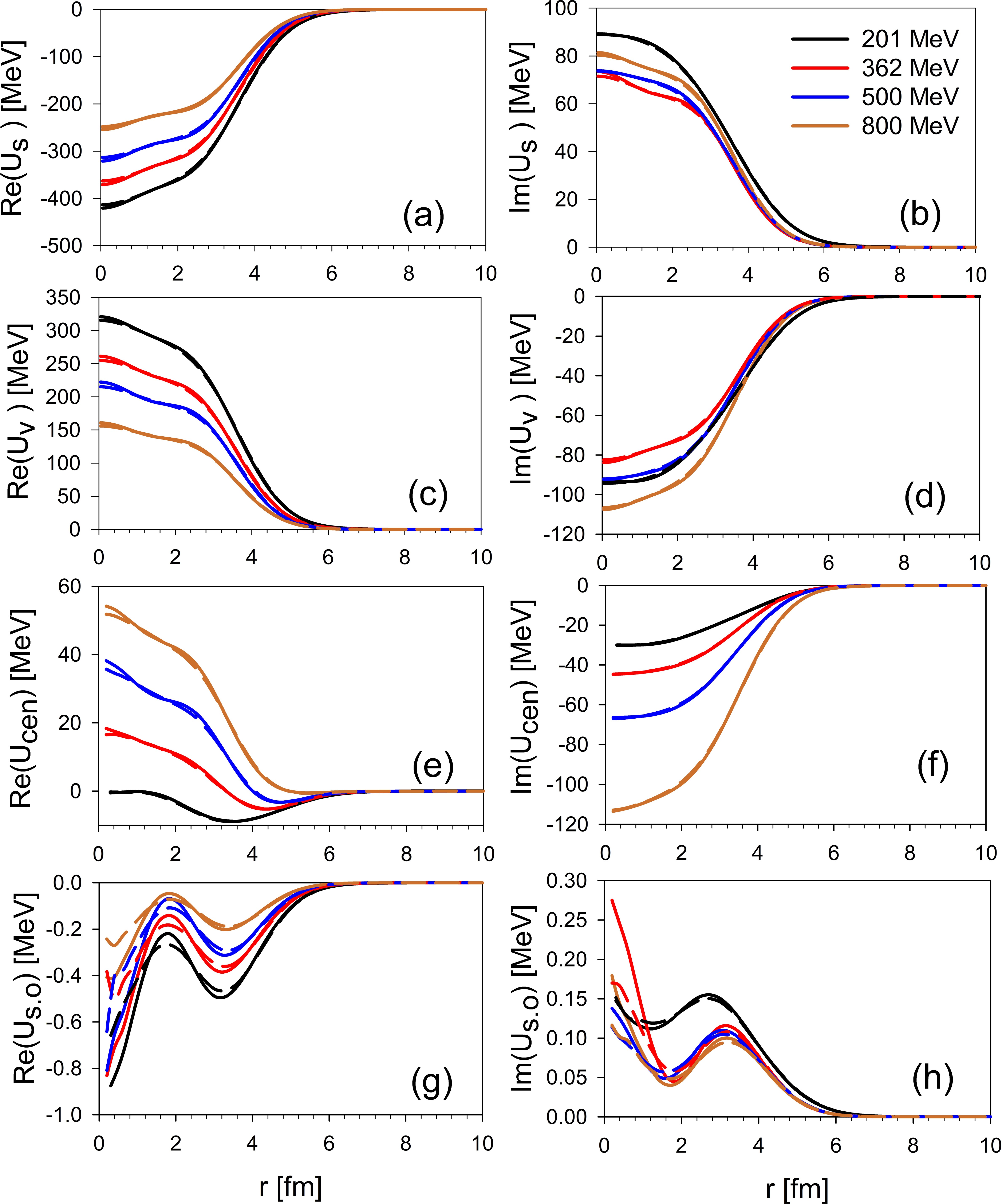
Figure 2. (color online) (a) Real and (b) imaginary parts of folded scalar potential, and (c) real and (d) imaginary parts of folded vector potential. (e) Real and (f) imaginary parts of effective central, and (g) real and (h) imaginary parts effective spin-orbit potentials as a function of radial coordinate based on DD-ME2 (solid lines) and DD-PC1 (dashed lines) for p+40Ca at 201, 362, 500, and 800 MeV.
The effective central and spin-orbit potentials derived by uniquely combining scalar and vector potentials (see Eq. (3) and (4)) enable flexible form factors beyond the conventional Woods-Saxon form. To examine the shapes of these effective potentials, we performed a comparative analysis for 12C, 28Si, and 40Ca nuclei. Figure 3 illustrates the real and imaginary parts of effective central potential and effective spin-orbit potential used in the DM analyses for p+12C at 200, 250, 494, and 800 MeV; p+ 28Si at 200, 250, 400, and 650 MeV; and p+40Ca at 201, 362, 500, and 800 MeV.

Figure 3. (color online) Real and imaginary parts of effective central, and effective spin orbit potentials as a function of radial coordinate based on DD-ME2 (solid lines) and DD-PC1 (dashed lines) for p+12C at 200, 250, 494, and 800 MeV, p+28Si at 200, 250, 400, and 650 MeV, and p+40Ca at 201, 362, 500, and 800 MeV.
The form factors, radial shapes, and depths evolved systematically with increasing proton energy and nuclear mass. Reflecting increased absorption at higher energies and increased nuclear size, higher incident energies generally led to repulsive effective central potentials and increased effective imaginary potentials as expected. However, the radial shapes changed drastically with both energy and nuclear mass. The real effective central potentials resembled a Woods-Saxon form. At low energy, the curves showed broad wells with extended tails beyond ~6 fm, indicating strong refraction into the nuclear interior. By contrast, at high energies, the potentials become sharper and more surface-peaked. For the 28Si nucleus, the surface-peaked character of the real potential was strongly pronounced at 400 and 650 MeV. For the 40Ca nucleus, however, the real potential exhibited a double-peak structure mirroring the neutron-proton density distribution.
The radial shapes of the imaginary potentials generally followed the trends of the real potentials but were less pronounced. Although the potentials generated by the DD-ME2 and DD-PC1 models showed large deviations for low mass numbers, these discrepancies reduced as the mass number increased. Both models displayed remarkably consistent behavior. The depth of the effective spin-orbit potentials was accurately captured in our description. However, their radial shapes demonstrated a significant dependence on mass numbers. This evolution manifested as a transition from a Woods-Saxon form in 12C to a wine-bottle shape in 28Si and finally to a double-peaked structure in 40Ca.
-
The folded optical potentials were constructed according to the formalism outlined in Eq. (7)−(9) using the previously derived scalar and vector densities. This procedure was implemented using the Relativistic-Love-Franey (RLF) parameters for 150−400 MeV energies and the McNeil-Ray-Wallace (MRW) parameters for 400-1000 MeV [57, 58], which explicitly include pseudovector coupling and Pauli blocking effects in their formulation.
The constructed folded potentials exhibited distinct energy-dependent behaviors. As incident energy increased, the depths of the real parts of both scalar and vector potentials decreased, while their imaginary parts remained largely independent of energy. The real part of the scalar potential was attractive, whereas the real part of the vector potential was repulsive. Conversely, the effective central potential showed increasing depths for both its real and imaginary parts with increasing energy, with the real part exhibiting a repulsive nature for high incident energy. The real part of the effective spin-orbit potential decreased in strength with increasing energy while its imaginary part increased. Figure 2 shows the folded potentials used in DM analysis for p + 40Ca elastic scattering based on DD-ME2 and DD-PC1 models at 201, 362, 500, and 800 MeV.
Figure 2. (color online) (a) Real and (b) imaginary parts of folded scalar potential, and (c) real and (d) imaginary parts of folded vector potential. (e) Real and (f) imaginary parts of effective central, and (g) real and (h) imaginary parts effective spin-orbit potentials as a function of radial coordinate based on DD-ME2 (solid lines) and DD-PC1 (dashed lines) for p+40Ca at 201, 362, 500, and 800 MeV.
The effective central and spin-orbit potentials derived by uniquely combining scalar and vector potentials (see Eq. (3) and (4)) enable flexible form factors beyond the conventional Woods-Saxon form. To examine the shapes of these effective potentials, we performed a comparative analysis for 12C, 28Si, and 40Ca nuclei. Figure 3 illustrates the real and imaginary parts of effective central potential and effective spin-orbit potential used in the DM analyses for p+12C at 200, 250, 494, and 800 MeV; p+ 28Si at 200, 250, 400, and 650 MeV; and p+40Ca at 201, 362, 500, and 800 MeV.
Figure 3. (color online) Real and imaginary parts of effective central, and effective spin orbit potentials as a function of radial coordinate based on DD-ME2 (solid lines) and DD-PC1 (dashed lines) for p+12C at 200, 250, 494, and 800 MeV, p+28Si at 200, 250, 400, and 650 MeV, and p+40Ca at 201, 362, 500, and 800 MeV.
The form factors, radial shapes, and depths evolved systematically with increasing proton energy and nuclear mass. Reflecting increased absorption at higher energies and increased nuclear size, higher incident energies generally led to repulsive effective central potentials and increased effective imaginary potentials as expected. However, the radial shapes changed drastically with both energy and nuclear mass. The real effective central potentials resembled a Woods-Saxon form. At low energy, the curves showed broad wells with extended tails beyond ~6 fm, indicating strong refraction into the nuclear interior. By contrast, at high energies, the potentials become sharper and more surface-peaked. For the 28Si nucleus, the surface-peaked character of the real potential was strongly pronounced at 400 and 650 MeV. For the 40Ca nucleus, however, the real potential exhibited a double-peak structure mirroring the neutron-proton density distribution.
The radial shapes of the imaginary potentials generally followed the trends of the real potentials but were less pronounced. Although the potentials generated by the DD-ME2 and DD-PC1 models showed large deviations for low mass numbers, these discrepancies reduced as the mass number increased. Both models displayed remarkably consistent behavior. The depth of the effective spin-orbit potentials was accurately captured in our description. However, their radial shapes demonstrated a significant dependence on mass numbers. This evolution manifested as a transition from a Woods-Saxon form in 12C to a wine-bottle shape in 28Si and finally to a double-peaked structure in 40Ca.
-
Differential cross sections and analyzing powers were obtained using the DM and DP optical models. In the DM approach, the scattering observables were computed by solving the Dirac equation with the ECIS06 method using the microscopically derived folded potentials as direct input. In the DP optical model, the global SV framework was considered to obtain the phenomenological optical potentials using the GLOBAL code, after which the scattering observables were calculated by solving the Dirac equation exactly as in the DM model.
Figure 4 presents the differential cross sections and analyzing powers for p+12C elastic scattering, calculated using DM and DP models, and compared with experimental data at incident energies of 200, 250, 494, and 800 MeV. DM calculations using the DD-ME2 (red lines) and DD-PC1 (blue lines) density models showed close agreement with the data at small scattering angles but exhibited significant deviations at larger angles across all energies. By contrast, DP calculations (brown lines) demonstrated strong agreement with the experimental data across the entire angular range. This superior agreement was attributed to the DP model's use of a multiparameter fitting procedure optimized against an extensive experimental dataset, which is distinct from the parameter-free nature of DM model.
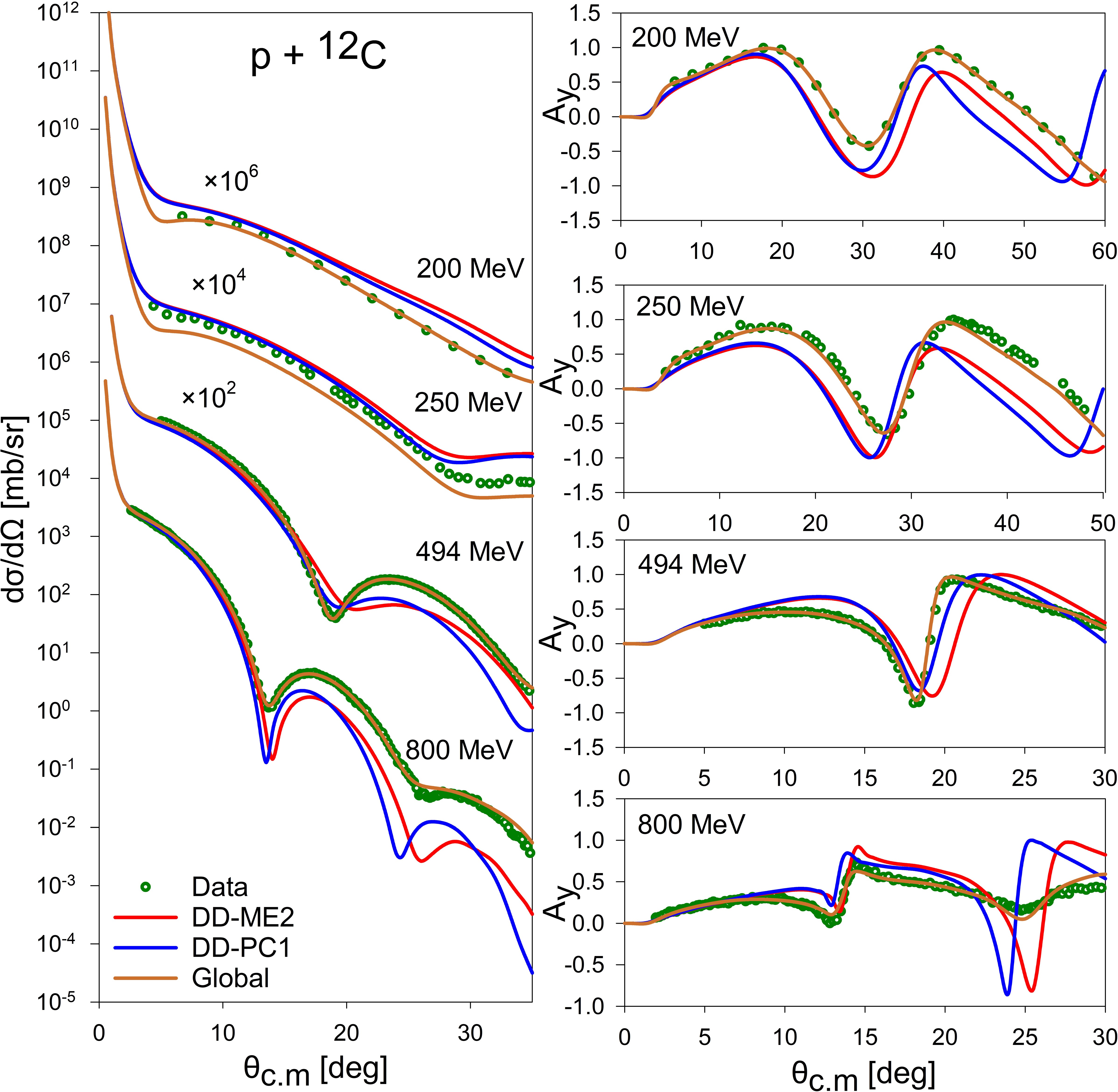
Figure 4. (color online) Differential cross sections and analyzing powers of p+12C elastic scattering in comparison with the experimental data at 200, 250, 494, and 800 MeV.
The calculated differential cross sections and analyzing powers of p+16O using DM and DP models are presented in comparison with the experimental data at 200, 317, 650, and 800 MeV in Fig. 5. For the differential cross sections, DM calculations using the DD-ME2 and DD-PC1 density models showed complete agreement with experimental data at 200 and 317 MeV. At 650 MeV, agreement was maintained at scattering angles below approximately 10°, beyond which minor discrepancies emerged. At 800 MeV, agreement was confined to very small angles, with significant deviations observed from 10° to 25°. Across all energies, the DD-ME2 functional yielded marginally better results than DD-PC1, with the difference becoming more pronounced at higher energies. The analyzing powers calculated with the DM model showed partial agreement with data at 200, 317, and 650 MeV. At 800 MeV, agreement was limited to very small angles (<20°), with disagreement at larger angles.
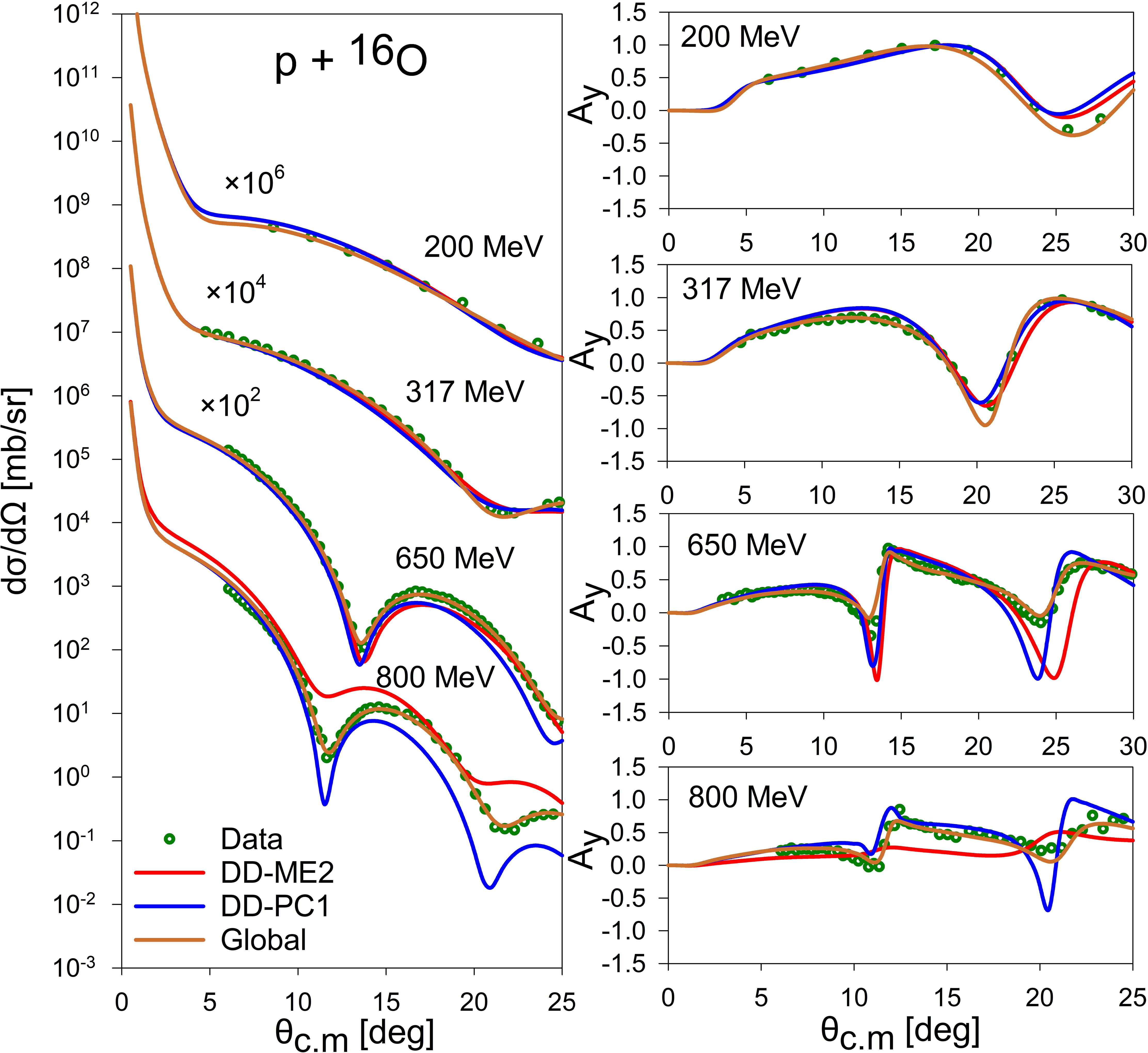
Figure 5. (color online) Differential cross sections and analyzing powers of p+16O elastic scattering in comparison with the experimental data at 200, 317, 650, and 800 MeV.
The calculated differential cross sections and analyzing powers of p + 28Si using the DM and DP models at 200, 250, 400, and 600 MeV are shown in Fig. 6. For p+ 28Si elastic scattering, the calculated differential cross sections from the DD-ME2 and DD-PC1 models presented a strong agreement with the experimental data at four energies. The calculated analyzing powers exhibited good agreement with the experimental data. The DD-ME2 and DD-PC1 models accurately reproduced the scattering observables, with DD-PC1 showing a slight advantage at 650 MeV.
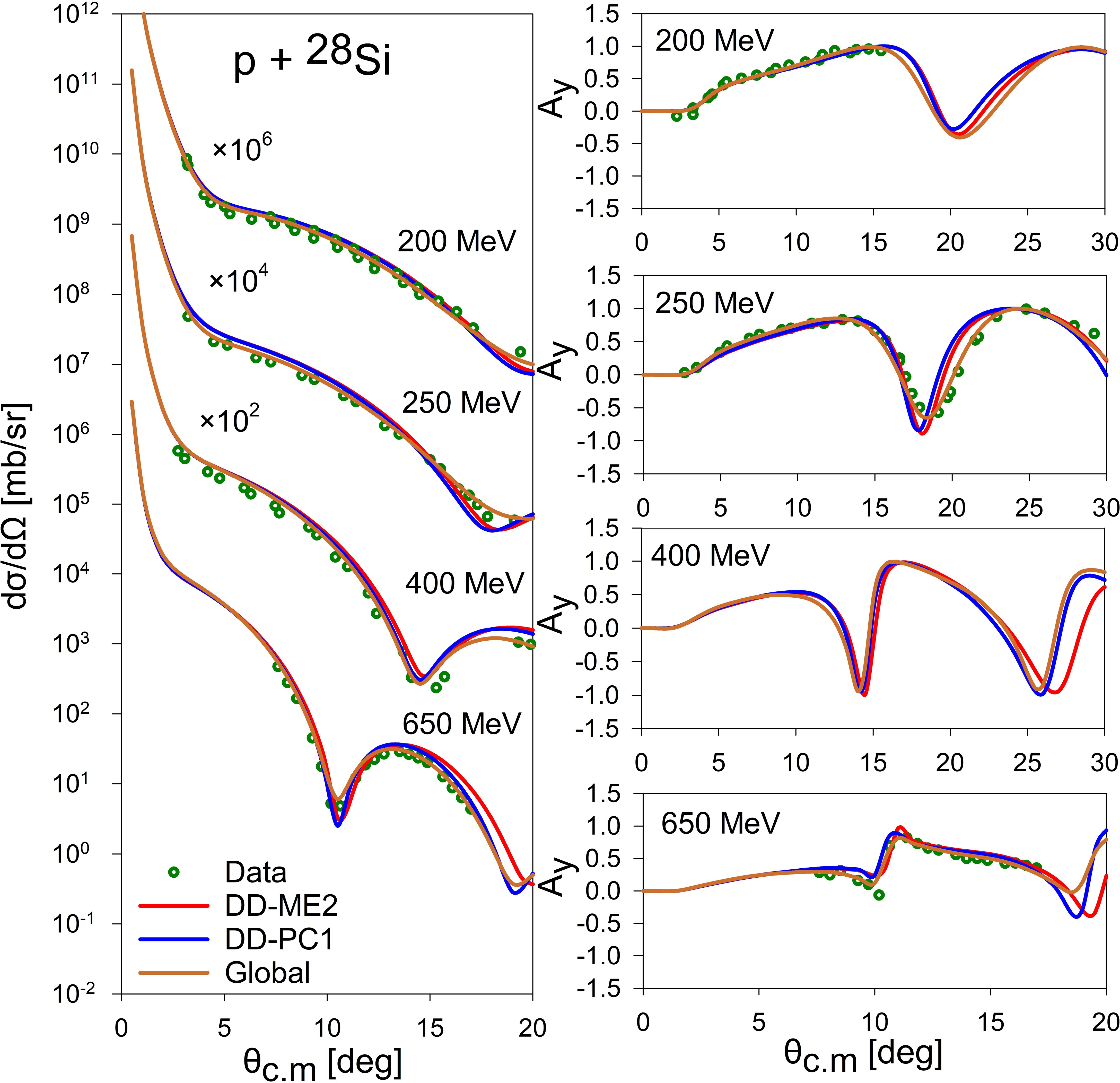
Figure 6. (color online) Differential cross sections and analyzing powers of p+28Si elastic scattering in comparison with the experimental data at 200, 250, 400, and 600 MeV (No Ay data were available at 400 MeV).
Figure 7 presents the differential cross sections and analyzing powers for p + 40Ca elastic scattering, calculated using DM and DP models, in comparison with experimental data at incident energies of 201, 362, 500, and 800 MeV. The differential cross sections computed with the DM model using the DD-ME2 and DD-PC1 density models exhibited excellent agreement with the experimental data across all energies. The analyzing powers also showed good agreement with measurements at 201 and 362 MeV over the entire angular range. At the higher energies of 500 and 800 MeV, the analyzing powers match the experimental data well up to approximately 20°; however, slight discrepancies were observed at larger angles (
$\geqslant $ 25°).
Figure 7. (color online) Differential cross sections and analyzing powers of p+40Ca elastic scattering in comparison with the experimental data at 201, 362, 500, and 800 MeV.
For proton elastic scattering from 58Ni, differential cross sections and analyzing powers were measured at incident beam energies of 250, 295, 400, and 796 MeV (see Fig. 8). Theoretical calculations of DM employing the DD-ME2 and DD-PC1 models and DP calculations were compared with the experimental data. Regarding the differential cross sections, both models demonstrated reasonable agreement with empirical results at 250, 295, and 400 MeV. This agreement was notably enhanced at the highest energy of 796 MeV, where the theoretical predictions exhibited excellent consistency with the measured data. This trend highlights the superior performance of these models in describing high-energy scattering processes while still providing acceptable accuracy at intermediate energies. For the analyzing powers, the calculations from both models achieved excellent agreement with the 295-MeV experimental data across the full angular range. At 250 and 400 MeV, the theoretical values corresponded well with measurements up to a scattering angle of 20°; however, significant deviations emerged at larger angles. At 796 MeV, the models showed approximate agreement with the data over the entire angular distribution.
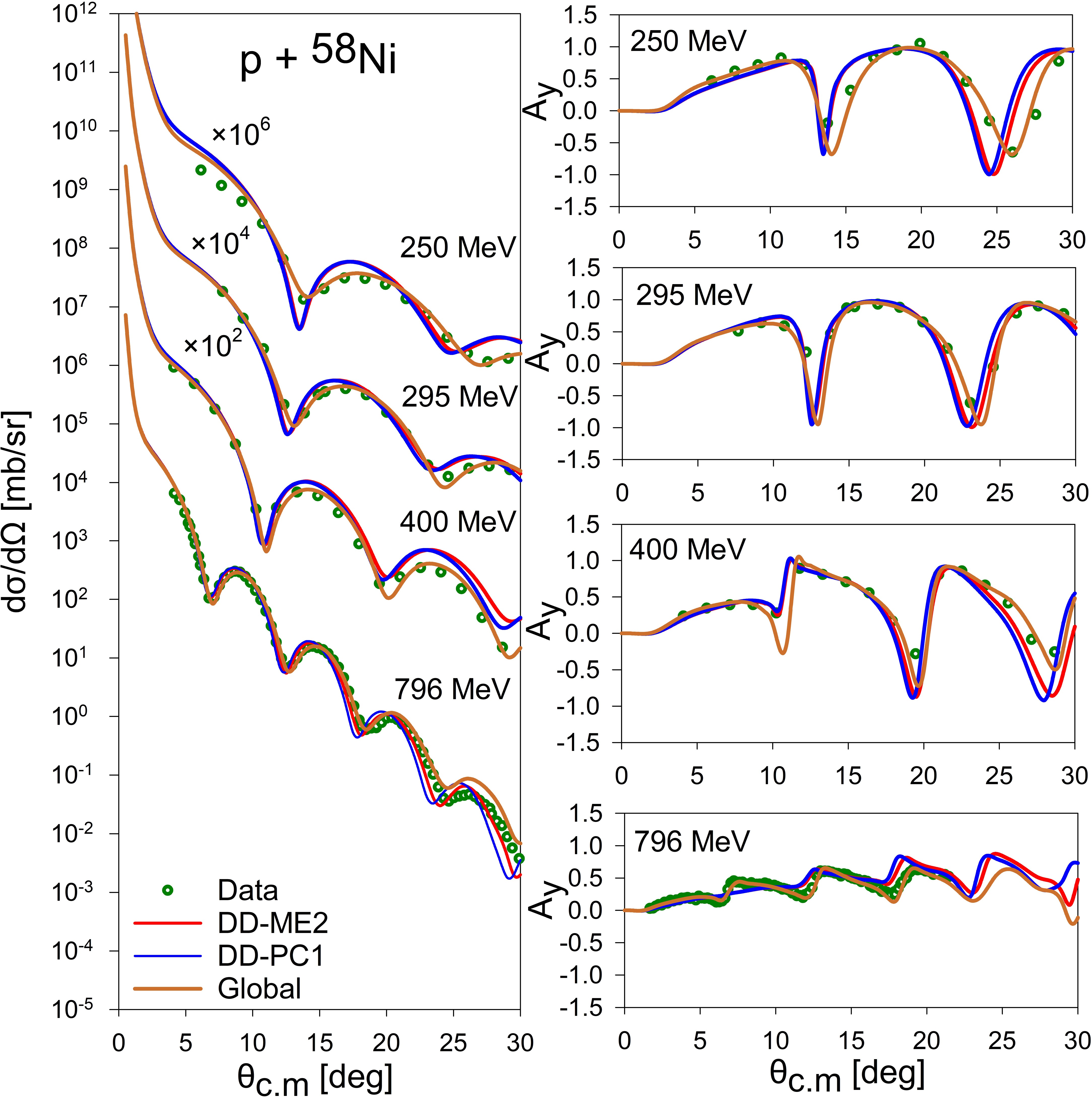
Figure 8. (color online) Differential cross sections and analyzing powers of p+58Ni elastic scattering in comparison with the experimental data at 250, 295, 400, and 796 MeV.
The differential cross sections and analyzing powers of p+90Zr using the DM and DP models in comparison with the experimental data at 400, 500, and 800 MeV are presented in Fig. 9. At 400 MeV, the DM and DP models demonstrate limited accuracy in reproducing the experimental differential cross section data. By contrast, the models demonstrated excellent agreement with the measured differential cross sections at both 500 and 800 MeV while also providing satisfactory results for the analyzing power that matched the experimental data within reasonable uncertainty. The calculated cross sections and analyzing powers for p+208Pb elastic scattering, derived from the DD-ME2 and DD-PC1 models, were compared with experimental data as shown in Fig. 10 at energies of 200, 300, 500, and 800 MeV. At high energy, the scattering equations were solved with a sufficiently high number of partial waves to guarantee the numerical convergence of all calculated observables. The results exhibited strong agreement with data at 200, 300, 500, and 800 MeV.
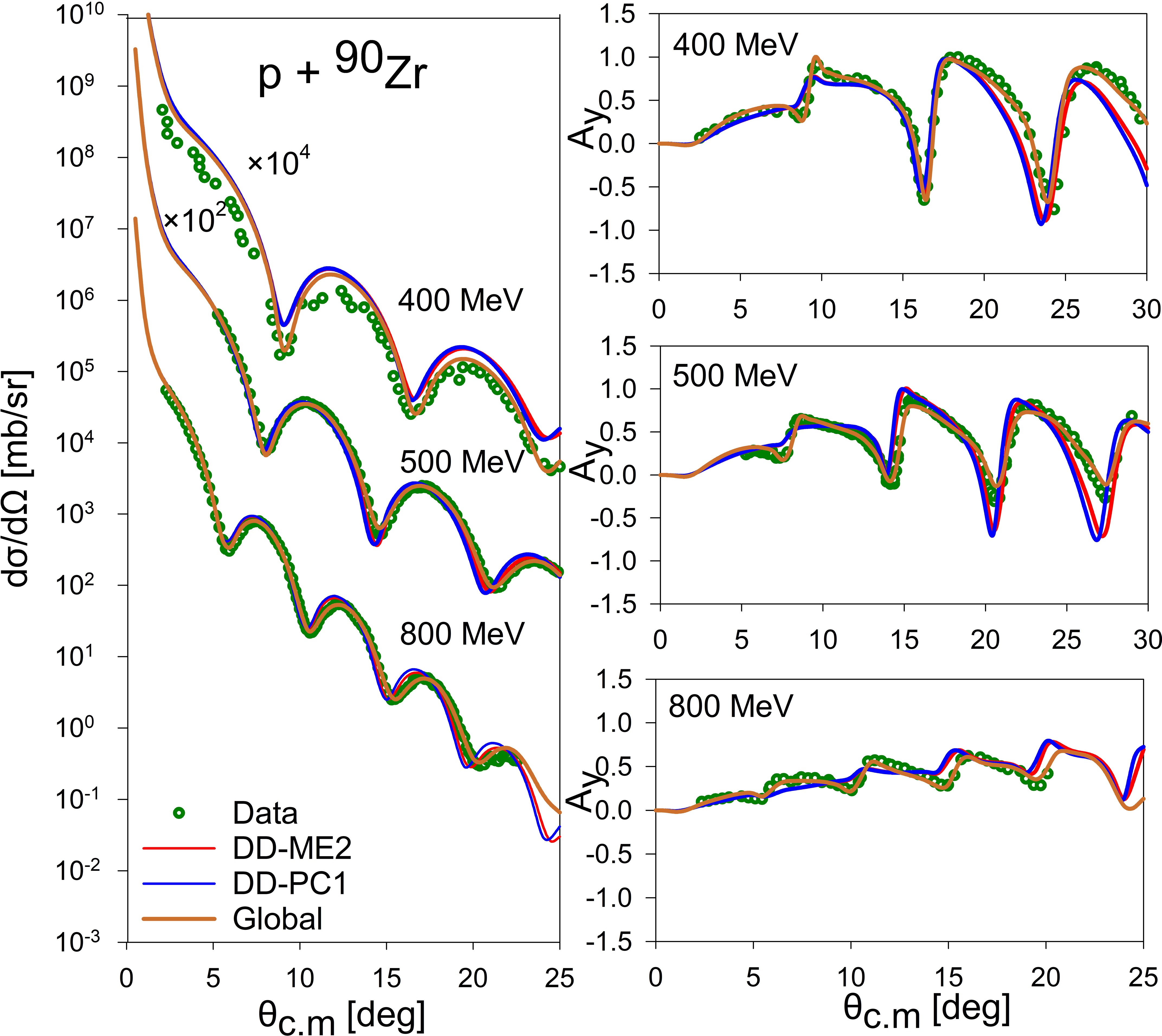
Figure 9. (color online) Differential cross sections and analyzing powers of p+90Zr elastic scattering in comparison with the experimental data at 400, 500, and 800 MeV.
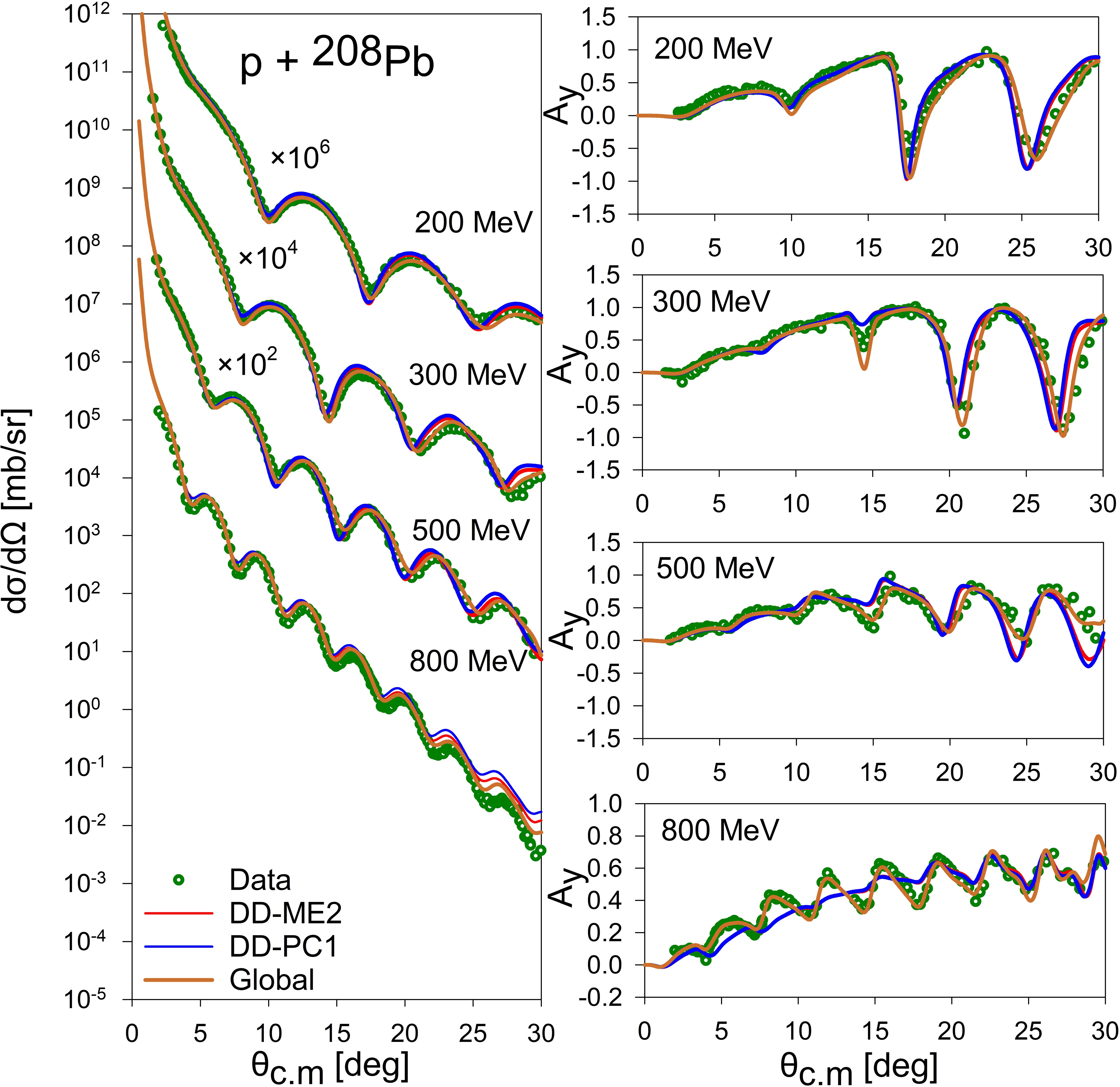
Figure 10. (color online) Differential cross sections and analyzing powers of p+208Pb elastic scattering in comparison with the experimental data at 200, 300, 500, and 800 MeV.
-
Differential cross sections and analyzing powers were obtained using the DM and DP optical models. In the DM approach, the scattering observables were computed by solving the Dirac equation with the ECIS06 method using the microscopically derived folded potentials as direct input. In the DP optical model, the global SV framework was considered to obtain the phenomenological optical potentials using the GLOBAL code, after which the scattering observables were calculated by solving the Dirac equation exactly as in the DM model.
Figure 4 presents the differential cross sections and analyzing powers for p+12C elastic scattering, calculated using DM and DP models, and compared with experimental data at incident energies of 200, 250, 494, and 800 MeV. DM calculations using the DD-ME2 (red lines) and DD-PC1 (blue lines) density models showed close agreement with the data at small scattering angles but exhibited significant deviations at larger angles across all energies. By contrast, DP calculations (brown lines) demonstrated strong agreement with the experimental data across the entire angular range. This superior agreement was attributed to the DP model's use of a multiparameter fitting procedure optimized against an extensive experimental dataset, which is distinct from the parameter-free nature of DM model.
Figure 4. (color online) Differential cross sections and analyzing powers of p+12C elastic scattering in comparison with the experimental data at 200, 250, 494, and 800 MeV.
The calculated differential cross sections and analyzing powers of p+16O using DM and DP models are presented in comparison with the experimental data at 200, 317, 650, and 800 MeV in Fig. 5. For the differential cross sections, DM calculations using the DD-ME2 and DD-PC1 density models showed complete agreement with experimental data at 200 and 317 MeV. At 650 MeV, agreement was maintained at scattering angles below approximately 10°, beyond which minor discrepancies emerged. At 800 MeV, agreement was confined to very small angles, with significant deviations observed from 10° to 25°. Across all energies, the DD-ME2 functional yielded marginally better results than DD-PC1, with the difference becoming more pronounced at higher energies. The analyzing powers calculated with the DM model showed partial agreement with data at 200, 317, and 650 MeV. At 800 MeV, agreement was limited to very small angles (<20°), with disagreement at larger angles.
Figure 5. (color online) Differential cross sections and analyzing powers of p+16O elastic scattering in comparison with the experimental data at 200, 317, 650, and 800 MeV.
The calculated differential cross sections and analyzing powers of p + 28Si using the DM and DP models at 200, 250, 400, and 600 MeV are shown in Fig. 6. For p+ 28Si elastic scattering, the calculated differential cross sections from the DD-ME2 and DD-PC1 models presented a strong agreement with the experimental data at four energies. The calculated analyzing powers exhibited good agreement with the experimental data. The DD-ME2 and DD-PC1 models accurately reproduced the scattering observables, with DD-PC1 showing a slight advantage at 650 MeV.
Figure 6. (color online) Differential cross sections and analyzing powers of p+28Si elastic scattering in comparison with the experimental data at 200, 250, 400, and 600 MeV (No Ay data were available at 400 MeV).
Figure 7 presents the differential cross sections and analyzing powers for p + 40Ca elastic scattering, calculated using DM and DP models, in comparison with experimental data at incident energies of 201, 362, 500, and 800 MeV. The differential cross sections computed with the DM model using the DD-ME2 and DD-PC1 density models exhibited excellent agreement with the experimental data across all energies. The analyzing powers also showed good agreement with measurements at 201 and 362 MeV over the entire angular range. At the higher energies of 500 and 800 MeV, the analyzing powers match the experimental data well up to approximately 20°; however, slight discrepancies were observed at larger angles (
$\geqslant $ 25°).
Figure 7. (color online) Differential cross sections and analyzing powers of p+40Ca elastic scattering in comparison with the experimental data at 201, 362, 500, and 800 MeV.
For proton elastic scattering from 58Ni, differential cross sections and analyzing powers were measured at incident beam energies of 250, 295, 400, and 796 MeV (see Fig. 8). Theoretical calculations of DM employing the DD-ME2 and DD-PC1 models and DP calculations were compared with the experimental data. Regarding the differential cross sections, both models demonstrated reasonable agreement with empirical results at 250, 295, and 400 MeV. This agreement was notably enhanced at the highest energy of 796 MeV, where the theoretical predictions exhibited excellent consistency with the measured data. This trend highlights the superior performance of these models in describing high-energy scattering processes while still providing acceptable accuracy at intermediate energies. For the analyzing powers, the calculations from both models achieved excellent agreement with the 295-MeV experimental data across the full angular range. At 250 and 400 MeV, the theoretical values corresponded well with measurements up to a scattering angle of 20°; however, significant deviations emerged at larger angles. At 796 MeV, the models showed approximate agreement with the data over the entire angular distribution.
Figure 8. (color online) Differential cross sections and analyzing powers of p+58Ni elastic scattering in comparison with the experimental data at 250, 295, 400, and 796 MeV.
The differential cross sections and analyzing powers of p+90Zr using the DM and DP models in comparison with the experimental data at 400, 500, and 800 MeV are presented in Fig. 9. At 400 MeV, the DM and DP models demonstrate limited accuracy in reproducing the experimental differential cross section data. By contrast, the models demonstrated excellent agreement with the measured differential cross sections at both 500 and 800 MeV while also providing satisfactory results for the analyzing power that matched the experimental data within reasonable uncertainty. The calculated cross sections and analyzing powers for p+208Pb elastic scattering, derived from the DD-ME2 and DD-PC1 models, were compared with experimental data as shown in Fig. 10 at energies of 200, 300, 500, and 800 MeV. At high energy, the scattering equations were solved with a sufficiently high number of partial waves to guarantee the numerical convergence of all calculated observables. The results exhibited strong agreement with data at 200, 300, 500, and 800 MeV.
Figure 9. (color online) Differential cross sections and analyzing powers of p+90Zr elastic scattering in comparison with the experimental data at 400, 500, and 800 MeV.
Figure 10. (color online) Differential cross sections and analyzing powers of p+208Pb elastic scattering in comparison with the experimental data at 200, 300, 500, and 800 MeV.
-
This section presents the validation of the RMF theory for characterizing the ground-state properties of isotopes. Subsequently, we address the application of the resulting nuclear densities in the generation of folding potentials for use in elastic scattering analyses. The isotopes 40,42,44,48Ca were selected for this purpose, and their ground-state properties were calculated to produce the corresponding ROPs.
The calculated rms neutron (
$ {r}_{n} $ ), rms proton ($ {r}_{p} $ ), and rms charge ($ r_{c}^{\rm cal} $ ) radii; neutron skin thickness (∆$ {r}_{np} $ ); total binding energy ($ {E}^{\rm cal} $ ); and the binding energy per nucleon (${E}/{A} $ ) for 40,42,44,48Ca are listed in Table 2, alongside the available experimental values for charge radii ($ r_{c}^{\rm cal} $ ) and binding energies ($ {E}^{\rm exp} $ ). The results obtained from the DD-ME2 and DD-PC1 models showed minor discrepancies, which indicates a slight model dependence in the predicted nuclear properties.Nucleus Model $ {{r}}_{{n}} $ $ {{r}}_{{p}} $ $ {\Delta {r}}_{{n}{p}} $ $ {{r}}_{\rm {r}{m}{s}} $ $ {r}_{{c}}^{\rm{exp}} $ $ {r}_{{c}}^{\rm{cal}} $ $ {{E}}^{\rm{exp}} $ $ {{E}}^{\rm{cal}} $ E/A 40Ca DD-ME2 3.318 3.370 -0.052 3.344 3.478 3.464 -342.05 -342.77 -8.569 DD-PC1 3.316 3.363 -0.047 3.340 3.457 -344.79 -8.619 42Ca DD-ME2 3.399 3.373 0.026 3.387 3.508 3.467 -361.89 -362.38 -8.628 DD-PC1 3.400 3.370 0.030 3.385 3.463 -364.62 -8.681 44Ca DD-ME2 3.467 3.378 0.089 3.427 3.518 3.471 -380.96 -380.82 -8.655 DD-PC1 3.473 3.378 0.095 3.430 3.472 -383.30 -8.711 48Ca DD-ME2 3.572 3.387 0.185 3.496 3.479 3.480 -415.99 -414.81 -8.641 DD-PC1 3.594 3.397 0.197 3.513 3.490 -417.55 -8.699 Table 2. The rms neutron radius (
$ {r}_{n} $ ), the rms proton radius ($ {r}_{p} $ ), rms charge radius, and$ \Delta {r}_{np} $ , as well as the binding energy and ($ {E}/{A} $ ) calculated based on RMF theory with (DD-ME2 and DD-PC1 models). The experimental values of$ r_{c}^{\rm exp} $ , and$ {E}^{\rm exp} $ are also listed [53].The neutron rms radius exhibited a systematic increase with neutron number, rising from 3.318 fm (DD-ME2) and 3.316 fm (DD-PC1) for 40Ca to 3.572 fm (DD-ME2) and 3.594 fm (DD-PC1) for 48Ca. This trend was consistent with the expected extension of the nuclear matter distribution upon the addition of neutrons. By contrast, the proton radius remained relatively constant, varying only from 3.370 fm (DD-ME2, 40Ca) to 3.387 fm (DD-ME2, 48Ca). This stability is attributed to the fixed proton number Z=20 across the isotopic chain with minor variations induced by neutron-proton interactions.
Consequently, the neutron-proton radius difference ∆
$ {r}_{np} $ (defined as$ {r}_{n}-{r}_{p} $ ) evolved from negative values of −0.052 fm (DD-ME2) and −0.047 fm (DD-PC1) for the N=Z nucleus 40Ca to positive values of 0.185 fm (DD-ME2) and 0.197 fm (DD-PC1) for the neutron-rich 48Ca. The negative ∆$ {r}_{np} $ for 40Ca indicates a marginally larger proton radius, while the positive values for the neutron-rich isotopes (42Ca, 44Ca, 48Ca) signify the formation of a neutron skin, the thickness of which grew with increasing neutron number.A comparison between the experimental and calculated charge radii of 40Ca, 42Ca, 44Ca, and 48Ca from the DD-ME2 (red line) and DD-PC1 (blue line) models is shown in Fig. 11. This overall expansion is reflected in the calculated rms charge radii, which increased from 3.344 fm (DD-ME2) and 3.340 fm (DD-PC1) for 40Ca to 3.496 fm (DD-ME2) and 3.513 fm (DD-PC1) for 48Ca. A comparison with experimental data revealed a systematic deviation. For 40Ca, the experimental charge radius was 3.478 fm, indicating an underestimation of approximately 4% by both models. For 48Ca, the experimental value was 3.479 fm, resulting in a slight overestimation of 0.5%–1% by the models.
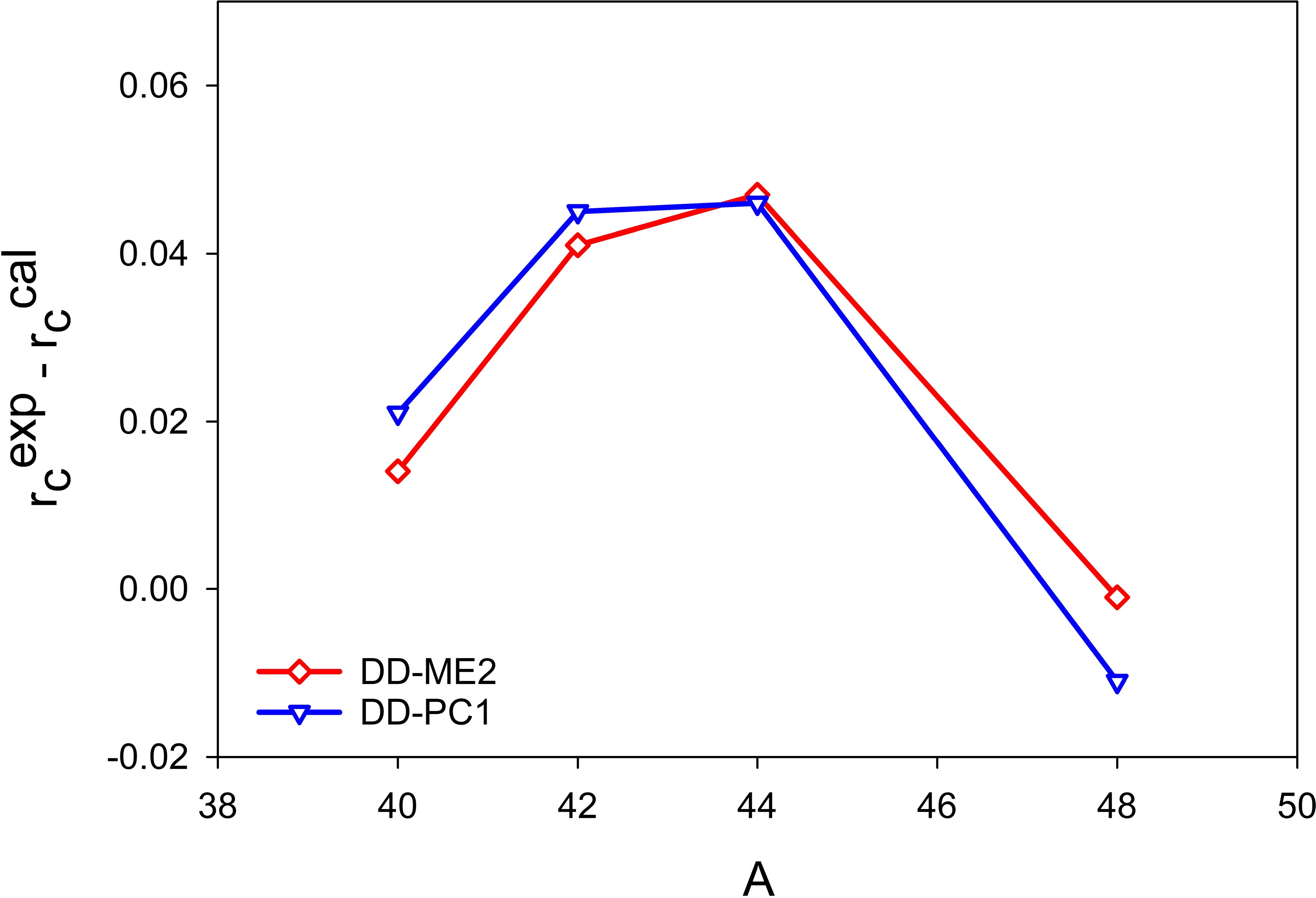
Figure 11. (color online) The difference between the experimental and calculated charge radii for 40Ca, 42Ca, 44Ca, and 48Ca from DD-ME2 (red line) and DD-PC1 (blue line) models.
The binding energy per nucleon became less negative with increasing mass number, varying from –8.569 MeV (DD-ME2) and –8.619 MeV (DD-PC1) for 40Ca to –8.641 MeV (DD-ME2) and –8.699 MeV (DD-PC1) for 48Ca. This result indicates a slight decrease in absolute binding energy per nucleon, which is consistent with the saturation properties of nuclear forces.
Both the RMF models captured the expected isotopic trends with good agreement. The DD-PC1 parameterization consistently predicted slightly larger neutron radii and more negative binding energies than DD-ME2, which suggests marginally stronger neutron interactions. The absolute differences in predicted neutron and proton radii were small (on the order of 0.002–0.022 fm), which indicates that the models performed comparably in describing nuclear sizes. The progression of ∆
$ {r}_{np} $ was robust across both models and aligned with established experimental evidence, particularly for the well-documented neutron skin in the closed-shell nucleus 48Ca (N=28).Figure 12 illustrates the neutron and proton vector densities, and the isotopic difference in neutron and proton vector densities for 40Ca, 42Ca, 44Ca, and 48Ca based on DD-ME2 and DD-PC1 models. The vector neutron and proton density distributions for 40Ca were nearly the same and exhibited a centrally peak structure because the number of protons and neutrons were equal. For 42Ca and 44Ca, the vector neutron density was slightly larger than the vector proton density because the neutron number becomes larger than the proton number. The vector proton density distribution behaved as 40Ca because the proton number remained at 20, whereas the vector neutron and proton density distributions for 48Ca exhibited a double peaks structure. The vector neutron density extended at nuclear surface given that 48Ca has a magic number of neutrons (N=28); however, the vector proton density distribution behaved as 40Ca because the number of protons remained the same at Z=20. A comparison analysis between the DD-ME2 and DD-PC1 models showed relatively small differences in the calculated vector density distributions. The difference in neutron and proton vector densities showed that with increasing mass number the difference increased until reaching the maximum for 48Ca. The results showed that the difference between the two models increased with the atomic mass.
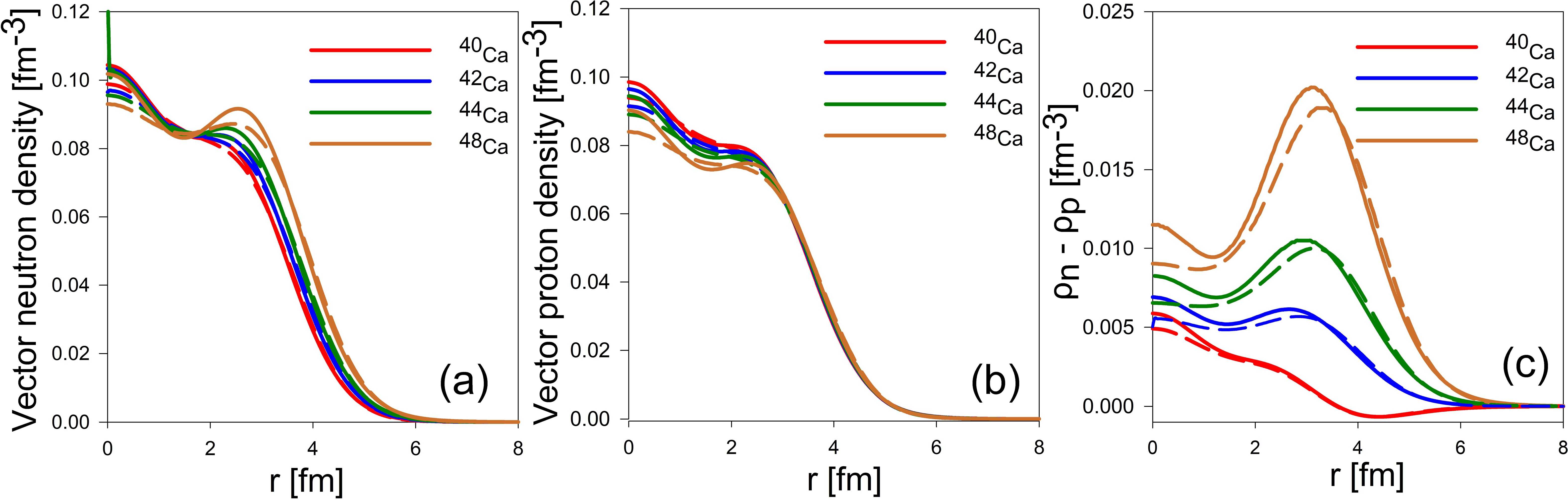
Figure 12. (color online) a) Neutron vector densities based on DD-ME2 (solid lines) and DD-PC1 (dashed lines) models, b) proton vector densities, and c) isotopic difference in neutron, and proton vector densities for 40Ca, 42Ca, 44Ca, and 48Ca.
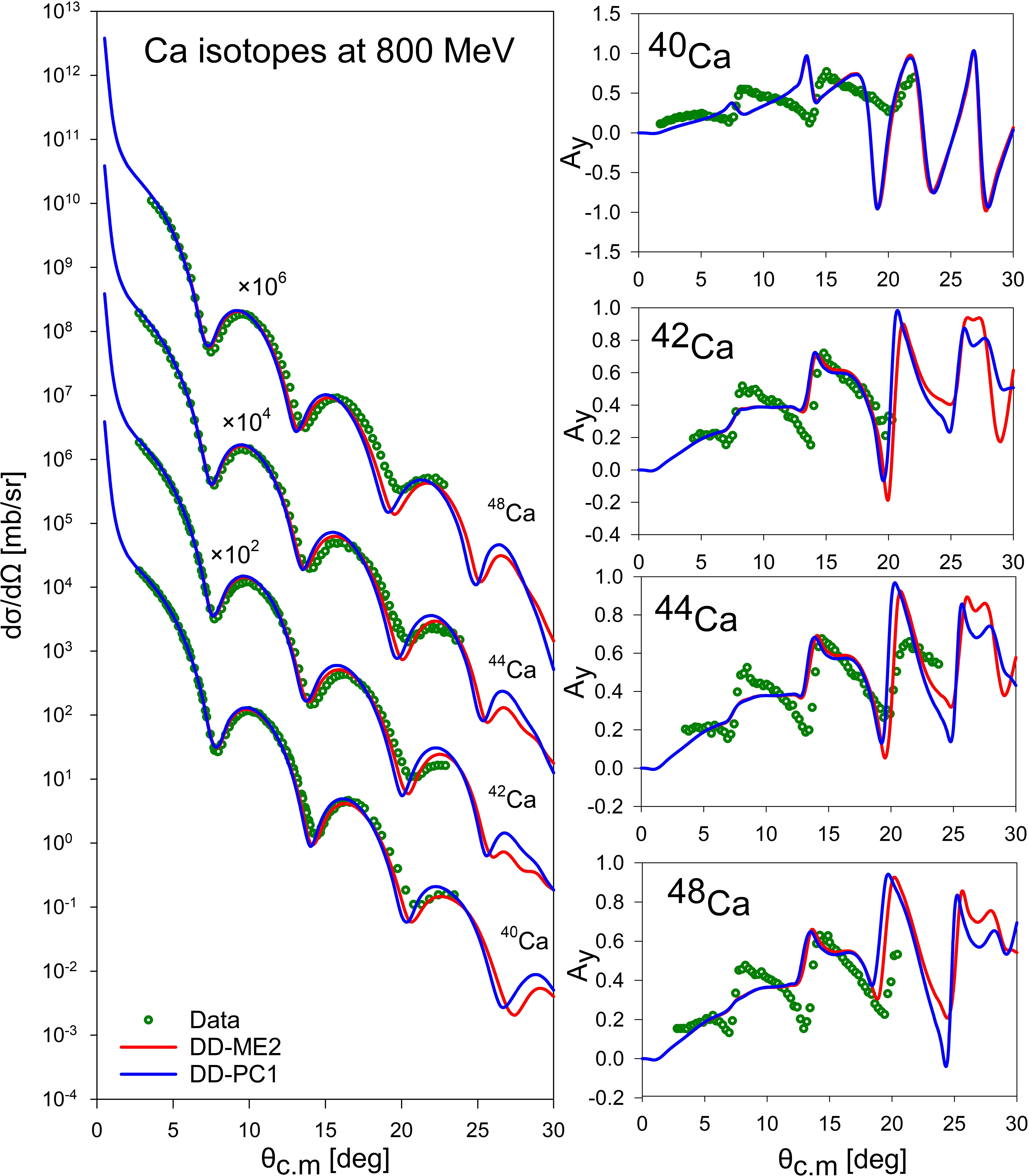
Figure 13. (color online) Differential cross sections and analyzing powers of p+40,42,44,48Ca elastic scattering in comparison with the experimental data at 800 MeV.
The differential cross sections and analyzing powers for p+40Ca, p + 42Ca, p+44Ca, and p+48Ca elastic scattering at 800 MeV are plotted in Fig. 13. DM calculations were used to obtain the scattering observables. The DM optical potentials were constructed by folding the nuclear scalar and vector densities generated from the DD-ME2 and DD-PC1 parameterizations of the RMF theory with an effective NN interaction based on the MRW parameters.
The calculated differential cross sections for proton elastic scattering from 40Ca, 42Ca, 44Ca, and 48Ca, derived from the DD-ME2 and DD-PC1 model densities, showed strong agreement with the experimental data at small angles (up to approximately 15°). At larger angles, the results continued to agree well with the experimental measurements. The analyzing powers calculated by both models for p+40Ca, p+42Ca, and p+44Ca elastic scattering exhibited good agreement with the experimental data across the measured angular range. By contrast, the analyzing power obtained for p+48Ca elastic scattering showed agreement with the experimental data only at very small angles, with deviations becoming apparent at larger angles.
-
This section presents the validation of the RMF theory for characterizing the ground-state properties of isotopes. Subsequently, we address the application of the resulting nuclear densities in the generation of folding potentials for use in elastic scattering analyses. The isotopes 40,42,44,48Ca were selected for this purpose, and their ground-state properties were calculated to produce the corresponding ROPs.
The calculated rms neutron (
$ {r}_{n} $ ), rms proton ($ {r}_{p} $ ), and rms charge ($ r_{c}^{\rm cal} $ ) radii; neutron skin thickness (∆$ {r}_{np} $ ); total binding energy ($ {E}^{\rm cal} $ ); and the binding energy per nucleon (${E}/{A} $ ) for 40,42,44,48Ca are listed in Table 2, alongside the available experimental values for charge radii ($ r_{c}^{\rm cal} $ ) and binding energies ($ {E}^{\rm exp} $ ). The results obtained from the DD-ME2 and DD-PC1 models showed minor discrepancies, which indicates a slight model dependence in the predicted nuclear properties.Nucleus Model $ {{r}}_{{n}} $ $ {{r}}_{{p}} $ $ {\Delta {r}}_{{n}{p}} $ $ {{r}}_{\rm {r}{m}{s}} $ $ {r}_{{c}}^{\rm{exp}} $ $ {r}_{{c}}^{\rm{cal}} $ $ {{E}}^{\rm{exp}} $ $ {{E}}^{\rm{cal}} $ E/A 40Ca DD-ME2 3.318 3.370 -0.052 3.344 3.478 3.464 -342.05 -342.77 -8.569 DD-PC1 3.316 3.363 -0.047 3.340 3.457 -344.79 -8.619 42Ca DD-ME2 3.399 3.373 0.026 3.387 3.508 3.467 -361.89 -362.38 -8.628 DD-PC1 3.400 3.370 0.030 3.385 3.463 -364.62 -8.681 44Ca DD-ME2 3.467 3.378 0.089 3.427 3.518 3.471 -380.96 -380.82 -8.655 DD-PC1 3.473 3.378 0.095 3.430 3.472 -383.30 -8.711 48Ca DD-ME2 3.572 3.387 0.185 3.496 3.479 3.480 -415.99 -414.81 -8.641 DD-PC1 3.594 3.397 0.197 3.513 3.490 -417.55 -8.699 Table 2. The rms neutron radius (
$ {r}_{n} $ ), the rms proton radius ($ {r}_{p} $ ), rms charge radius, and$ \Delta {r}_{np} $ , as well as the binding energy and ($ {E}/{A} $ ) calculated based on RMF theory with (DD-ME2 and DD-PC1 models). The experimental values of$ r_{c}^{\rm exp} $ , and$ {E}^{\rm exp} $ are also listed [53].The neutron rms radius exhibited a systematic increase with neutron number, rising from 3.318 fm (DD-ME2) and 3.316 fm (DD-PC1) for 40Ca to 3.572 fm (DD-ME2) and 3.594 fm (DD-PC1) for 48Ca. This trend was consistent with the expected extension of the nuclear matter distribution upon the addition of neutrons. By contrast, the proton radius remained relatively constant, varying only from 3.370 fm (DD-ME2, 40Ca) to 3.387 fm (DD-ME2, 48Ca). This stability is attributed to the fixed proton number Z=20 across the isotopic chain with minor variations induced by neutron-proton interactions.
Consequently, the neutron-proton radius difference ∆
$ {r}_{np} $ (defined as$ {r}_{n}-{r}_{p} $ ) evolved from negative values of −0.052 fm (DD-ME2) and −0.047 fm (DD-PC1) for the N=Z nucleus 40Ca to positive values of 0.185 fm (DD-ME2) and 0.197 fm (DD-PC1) for the neutron-rich 48Ca. The negative ∆$ {r}_{np} $ for 40Ca indicates a marginally larger proton radius, while the positive values for the neutron-rich isotopes (42Ca, 44Ca, 48Ca) signify the formation of a neutron skin, the thickness of which grew with increasing neutron number.A comparison between the experimental and calculated charge radii of 40Ca, 42Ca, 44Ca, and 48Ca from the DD-ME2 (red line) and DD-PC1 (blue line) models is shown in Fig. 11. This overall expansion is reflected in the calculated rms charge radii, which increased from 3.344 fm (DD-ME2) and 3.340 fm (DD-PC1) for 40Ca to 3.496 fm (DD-ME2) and 3.513 fm (DD-PC1) for 48Ca. A comparison with experimental data revealed a systematic deviation. For 40Ca, the experimental charge radius was 3.478 fm, indicating an underestimation of approximately 4% by both models. For 48Ca, the experimental value was 3.479 fm, resulting in a slight overestimation of 0.5%–1% by the models.
Figure 11. (color online) The difference between the experimental and calculated charge radii for 40Ca, 42Ca, 44Ca, and 48Ca from DD-ME2 (red line) and DD-PC1 (blue line) models.
The binding energy per nucleon became less negative with increasing mass number, varying from –8.569 MeV (DD-ME2) and –8.619 MeV (DD-PC1) for 40Ca to –8.641 MeV (DD-ME2) and –8.699 MeV (DD-PC1) for 48Ca. This result indicates a slight decrease in absolute binding energy per nucleon, which is consistent with the saturation properties of nuclear forces.
Both the RMF models captured the expected isotopic trends with good agreement. The DD-PC1 parameterization consistently predicted slightly larger neutron radii and more negative binding energies than DD-ME2, which suggests marginally stronger neutron interactions. The absolute differences in predicted neutron and proton radii were small (on the order of 0.002–0.022 fm), which indicates that the models performed comparably in describing nuclear sizes. The progression of ∆
$ {r}_{np} $ was robust across both models and aligned with established experimental evidence, particularly for the well-documented neutron skin in the closed-shell nucleus 48Ca (N=28).Figure 12 illustrates the neutron and proton vector densities, and the isotopic difference in neutron and proton vector densities for 40Ca, 42Ca, 44Ca, and 48Ca based on DD-ME2 and DD-PC1 models. The vector neutron and proton density distributions for 40Ca were nearly the same and exhibited a centrally peak structure because the number of protons and neutrons were equal. For 42Ca and 44Ca, the vector neutron density was slightly larger than the vector proton density because the neutron number becomes larger than the proton number. The vector proton density distribution behaved as 40Ca because the proton number remained at 20, whereas the vector neutron and proton density distributions for 48Ca exhibited a double peaks structure. The vector neutron density extended at nuclear surface given that 48Ca has a magic number of neutrons (N=28); however, the vector proton density distribution behaved as 40Ca because the number of protons remained the same at Z=20. A comparison analysis between the DD-ME2 and DD-PC1 models showed relatively small differences in the calculated vector density distributions. The difference in neutron and proton vector densities showed that with increasing mass number the difference increased until reaching the maximum for 48Ca. The results showed that the difference between the two models increased with the atomic mass.
Figure 12. (color online) a) Neutron vector densities based on DD-ME2 (solid lines) and DD-PC1 (dashed lines) models, b) proton vector densities, and c) isotopic difference in neutron, and proton vector densities for 40Ca, 42Ca, 44Ca, and 48Ca.
Figure 13. (color online) Differential cross sections and analyzing powers of p+40,42,44,48Ca elastic scattering in comparison with the experimental data at 800 MeV.
The differential cross sections and analyzing powers for p+40Ca, p + 42Ca, p+44Ca, and p+48Ca elastic scattering at 800 MeV are plotted in Fig. 13. DM calculations were used to obtain the scattering observables. The DM optical potentials were constructed by folding the nuclear scalar and vector densities generated from the DD-ME2 and DD-PC1 parameterizations of the RMF theory with an effective NN interaction based on the MRW parameters.
The calculated differential cross sections for proton elastic scattering from 40Ca, 42Ca, 44Ca, and 48Ca, derived from the DD-ME2 and DD-PC1 model densities, showed strong agreement with the experimental data at small angles (up to approximately 15°). At larger angles, the results continued to agree well with the experimental measurements. The analyzing powers calculated by both models for p+40Ca, p+42Ca, and p+44Ca elastic scattering exhibited good agreement with the experimental data across the measured angular range. By contrast, the analyzing power obtained for p+48Ca elastic scattering showed agreement with the experimental data only at very small angles, with deviations becoming apparent at larger angles.
-
We also extended the application of the ROM potentials to describe elastic scattering in the eikonal approximation. Differential cross sections for proton elastic scattering from 12C, 28Si, and 40Ca were calculated using this approach across a range of incident energies from 200 to 800 MeV. Effective central and spin-orbit terms extracted from DM calculations (see Fig. 3.) were employed in the eikonal calculations to compute the scattering observables. All eikonal calculations were performed using the Hypatia program, which is a computational tool developed using Python. This program was used to evaluate scattering observables by numerically solving the eikonal equation by using the formalism defined by Equations (24) through (27). The Hypatia code was validated by comparing its numerical results tothose generated by the established DWEIKO code [24], confirming the accuracy and reliability of our implementation.
The calculated differential cross sections for p+40Ca elastic scattering at 500 MeV, obtained within the eikonal approximation based on DM potentials, with DDME2 parametrization, are presented in comparison with experimental data (see Fig. 14). Three distinct calculations were performed: one incorporating only the Coulomb potential (brown line); a second including both the Coulomb and effective central potentials (blue line); and a third comprising the Coulomb, effective central, and effective spin-orbit potentials (red line). The results indicated that the calculations that included effective central potential (blue and red lines) showed good agreement with the experimental data. The inclusion of the spin-orbit potential (red line) was found to significantly enhance the description of the differential cross section at larger scattering angles, yielding a strong agreement with the measured data across the entire angular range. A similar impact of incorporating the spin-orbit potential was noted in the preliminary SDGMPS code [59] results for differential cross sections of 0.8 GeV proton elastic scattering on 58Ni. This result demonstrates the critical role of the spin-orbit interaction in accurately modeling intermediate-energy proton-nucleus elastic scattering.
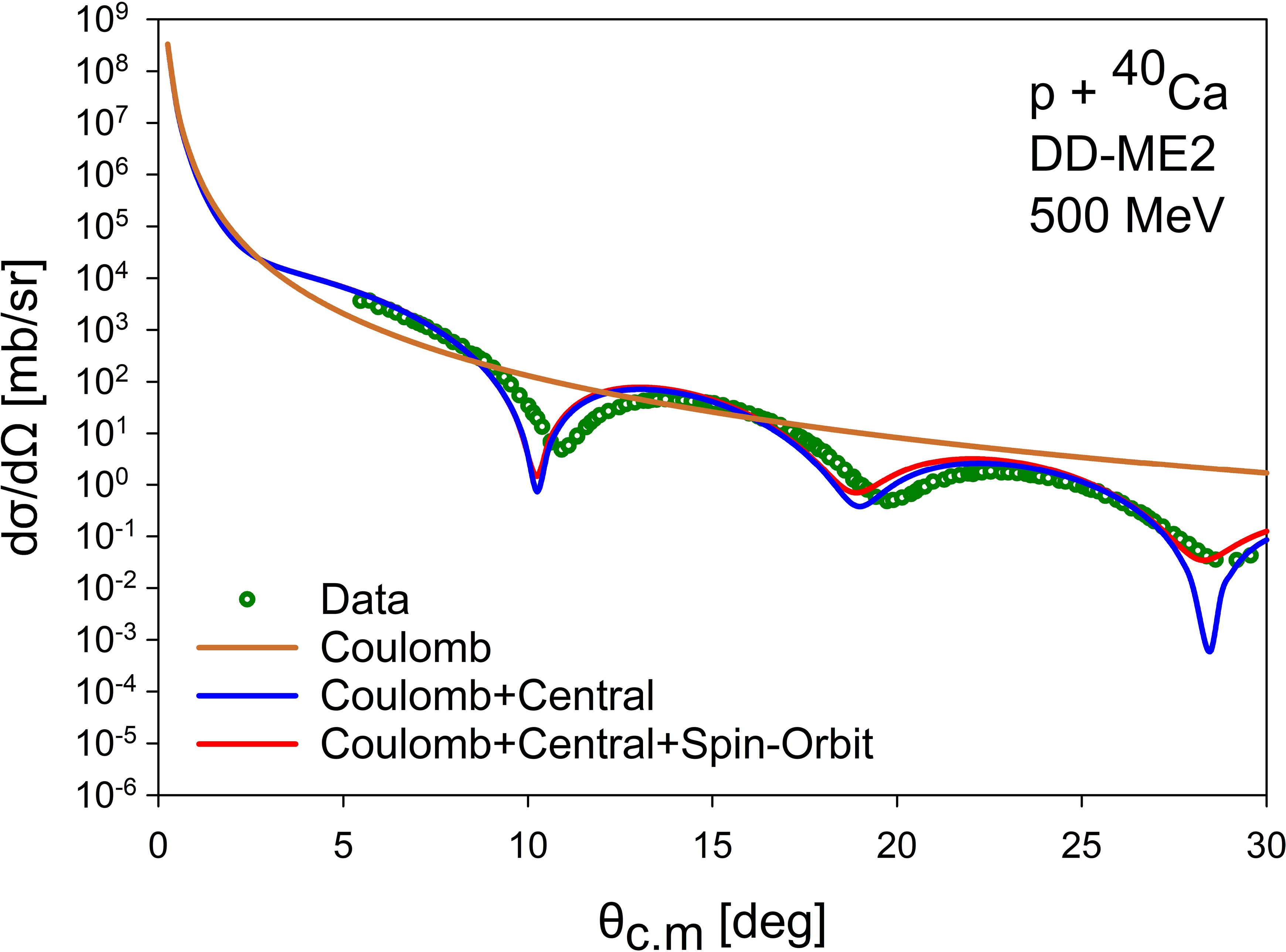
Figure 14. (color online) Differential cross section for proton elastic scattering from 40Ca at 500 MeV using the eikonal approximation. (See text for more details)
The calculated differential cross sections for proton elastic scattering from 12C obtained using the DD-ME2 and DD-PC1 models (see Fig. 15) demonstrated strong agreement with experimental data at 200 MeV. Similarly, both models exhibited good agreement with measurements at incident energies of 250 and 494 MeV. At 800 MeV, the DD-ME2 results agreed well with the data up to approximately 20o, with minor discrepancies observed at larger angles. By contrast, the DD-PC1 calculation at this energy showed agreement only at very forward angles and diverged from experimental data beyond 10o. For scattering from 28Si, the differential cross sections predicted by both DD-ME2 and DD-PC1 were in strong agreement with experimental data across all investigated energies: 200, 250, 400, and 650 MeV. In the case of 40Ca, both models produced differential cross sections that strongly agreed with experimental data at 201 MeV. Good agreement was also maintained at higher energies of 362 and 500 MeV. However, at 800 MeV, the calculations from both models agreed with experimental data only at very small scattering angles and showed significant deviations at angles greater than or equal to 5o.
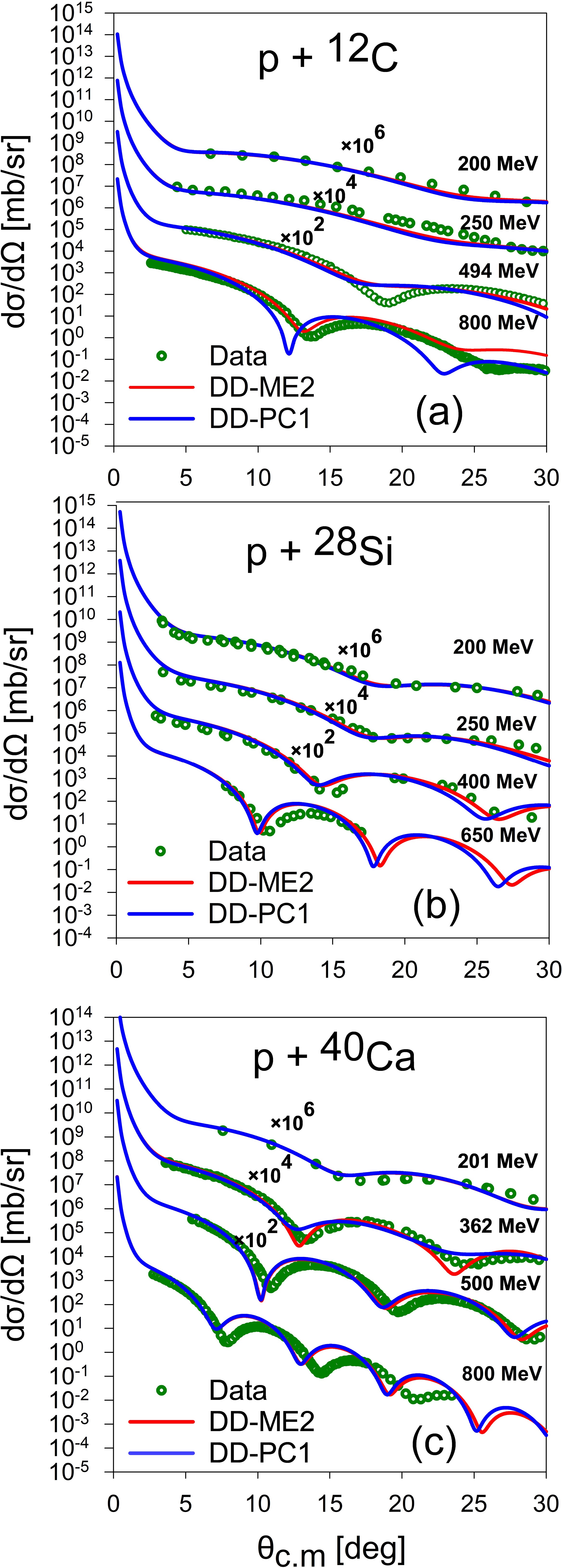
Figure 15. (color online) a) Differential cross sections of p+12C elastic scattering, calculated using the eikonal approximation with effective central and spin-orbit potentials based on DM calculations at 200, 250, 494, and 800 MeV. b) Differential cross sections of p+28Si elastic scattering at 200, 250, 400, and 650 MeV. c) Differential cross sections of p+40Ca elastic scattering at 201, 362, 500, and 800 MeV.
-
We also extended the application of the ROM potentials to describe elastic scattering in the eikonal approximation. Differential cross sections for proton elastic scattering from 12C, 28Si, and 40Ca were calculated using this approach across a range of incident energies from 200 to 800 MeV. Effective central and spin-orbit terms extracted from DM calculations (see Fig. 3.) were employed in the eikonal calculations to compute the scattering observables. All eikonal calculations were performed using the Hypatia program, which is a computational tool developed using Python. This program was used to evaluate scattering observables by numerically solving the eikonal equation by using the formalism defined by Equations (24) through (27). The Hypatia code was validated by comparing its numerical results tothose generated by the established DWEIKO code [24], confirming the accuracy and reliability of our implementation.
The calculated differential cross sections for p+40Ca elastic scattering at 500 MeV, obtained within the eikonal approximation based on DM potentials, with DDME2 parametrization, are presented in comparison with experimental data (see Fig. 14). Three distinct calculations were performed: one incorporating only the Coulomb potential (brown line); a second including both the Coulomb and effective central potentials (blue line); and a third comprising the Coulomb, effective central, and effective spin-orbit potentials (red line). The results indicated that the calculations that included effective central potential (blue and red lines) showed good agreement with the experimental data. The inclusion of the spin-orbit potential (red line) was found to significantly enhance the description of the differential cross section at larger scattering angles, yielding a strong agreement with the measured data across the entire angular range. A similar impact of incorporating the spin-orbit potential was noted in the preliminary SDGMPS code [59] results for differential cross sections of 0.8 GeV proton elastic scattering on 58Ni. This result demonstrates the critical role of the spin-orbit interaction in accurately modeling intermediate-energy proton-nucleus elastic scattering.
Figure 14. (color online) Differential cross section for proton elastic scattering from 40Ca at 500 MeV using the eikonal approximation. (See text for more details)
The calculated differential cross sections for proton elastic scattering from 12C obtained using the DD-ME2 and DD-PC1 models (see Fig. 15) demonstrated strong agreement with experimental data at 200 MeV. Similarly, both models exhibited good agreement with measurements at incident energies of 250 and 494 MeV. At 800 MeV, the DD-ME2 results agreed well with the data up to approximately 20o, with minor discrepancies observed at larger angles. By contrast, the DD-PC1 calculation at this energy showed agreement only at very forward angles and diverged from experimental data beyond 10o. For scattering from 28Si, the differential cross sections predicted by both DD-ME2 and DD-PC1 were in strong agreement with experimental data across all investigated energies: 200, 250, 400, and 650 MeV. In the case of 40Ca, both models produced differential cross sections that strongly agreed with experimental data at 201 MeV. Good agreement was also maintained at higher energies of 362 and 500 MeV. However, at 800 MeV, the calculations from both models agreed with experimental data only at very small scattering angles and showed significant deviations at angles greater than or equal to 5o.
Figure 15. (color online) a) Differential cross sections of p+12C elastic scattering, calculated using the eikonal approximation with effective central and spin-orbit potentials based on DM calculations at 200, 250, 494, and 800 MeV. b) Differential cross sections of p+28Si elastic scattering at 200, 250, 400, and 650 MeV. c) Differential cross sections of p+40Ca elastic scattering at 201, 362, 500, and 800 MeV.
-
In this study, we have systematically investigated proton elastic scattering from a range of spherical nuclei, including 12C, 16O, 28Si, 40Ca, 58Ni, 90Zr, and 208Pb, as well as calcium isotopes, 40,42,44,48Ca, across intermediate energies from 200 to 800 MeV. By employing RMF-derived scalar and vector densities with DD-ME2 and DD-PC1 parameterizations, we generated RMOPs based on the RIA approach to enable DM calculations of scattering observables. We also applied eikonal approximations to assess the validity and efficacy of the effective central and spin-orbit potentials.
The results show that the RMF-derived densities captured ground-state nuclear properties such as rms radii, neutron skin thicknesses, and binding energies accurately with minor differences between the DD-ME2 and DD-PC1 models that diminished for heavier nuclei. The folded potentials exhibited clear energy dependencies, with real parts transitioning from attractive to repulsive behaviors at higher energies, and imaginary parts reflecting enhanced absorption. Differential cross sections from DM calculations generally aligned well with experimental data at forward angles, although deviations emerged at larger angles for lighter nuclei and higher energies, which underscores the limitations of parameter-free microscopic approaches. In future work, we plan to extend this analysis by implementing a four-parameter model. The parameters will control the scaling of the real and imaginary parts of the scalar and vector potentials independently. This will allow us to investigate the contribution of each potential and account for effects of the medium.
For the calcium isotopic chain, the models successfully reproduced isotopic trends in neutron skins and density distributions, with DM predictions showing excellent agreement for differential cross sections at 800 MeV. However, there were some discrepancies in analyzing powers for neutron-rich 48Ca. The eikonal approximation utilizing DM-derived effective potentials further validated this approach by yielding strong agreement with data, particularly when incorporating spin-orbit contributions, which proved essential to describe large-angle scattering.
Overall, these findings affirm the robustness of RMF-based relativistic optical models in describing intermediate-energy proton-nucleus interactions and thus offer new insights into nuclear structure, density dependencies, and the interplay between scalar-vector and central-spin-orbit potentials. The observed mass and energy systematics suggest that such models are particularly effective for medium-to-heavy nuclei, where relativistic effects and density saturation are prominent. However, the partial disagreements at high energies and large angles indicate opportunities for refinement, such as by incorporating medium modifications to the NN interaction or higher-order relativistic corrections.
Future work could extend this framework to exotic nuclei, integrate inelastic scattering channels, or explore polarization observables to further probe spin-dependent dynamics.
-
In this study, we have systematically investigated proton elastic scattering from a range of spherical nuclei, including 12C, 16O, 28Si, 40Ca, 58Ni, 90Zr, and 208Pb, as well as calcium isotopes, 40,42,44,48Ca, across intermediate energies from 200 to 800 MeV. By employing RMF-derived scalar and vector densities with DD-ME2 and DD-PC1 parameterizations, we generated RMOPs based on the RIA approach to enable DM calculations of scattering observables. We also applied eikonal approximations to assess the validity and efficacy of the effective central and spin-orbit potentials.
The results show that the RMF-derived densities captured ground-state nuclear properties such as rms radii, neutron skin thicknesses, and binding energies accurately with minor differences between the DD-ME2 and DD-PC1 models that diminished for heavier nuclei. The folded potentials exhibited clear energy dependencies, with real parts transitioning from attractive to repulsive behaviors at higher energies, and imaginary parts reflecting enhanced absorption. Differential cross sections from DM calculations generally aligned well with experimental data at forward angles, although deviations emerged at larger angles for lighter nuclei and higher energies, which underscores the limitations of parameter-free microscopic approaches. In future work, we plan to extend this analysis by implementing a four-parameter model. The parameters will control the scaling of the real and imaginary parts of the scalar and vector potentials independently. This will allow us to investigate the contribution of each potential and account for effects of the medium.
For the calcium isotopic chain, the models successfully reproduced isotopic trends in neutron skins and density distributions, with DM predictions showing excellent agreement for differential cross sections at 800 MeV. However, there were some discrepancies in analyzing powers for neutron-rich 48Ca. The eikonal approximation utilizing DM-derived effective potentials further validated this approach by yielding strong agreement with data, particularly when incorporating spin-orbit contributions, which proved essential to describe large-angle scattering.
Overall, these findings affirm the robustness of RMF-based relativistic optical models in describing intermediate-energy proton-nucleus interactions and thus offer new insights into nuclear structure, density dependencies, and the interplay between scalar-vector and central-spin-orbit potentials. The observed mass and energy systematics suggest that such models are particularly effective for medium-to-heavy nuclei, where relativistic effects and density saturation are prominent. However, the partial disagreements at high energies and large angles indicate opportunities for refinement, such as by incorporating medium modifications to the NN interaction or higher-order relativistic corrections.
Future work could extend this framework to exotic nuclei, integrate inelastic scattering channels, or explore polarization observables to further probe spin-dependent dynamics.
Relativistic microscopic optical potentials based on covariant density functional theory
- Received Date: 2025-09-19
- Available Online: 2026-04-15
Abstract: Relativistic microscopic optical potentials (RMOPs) were constructed for nucleon-nucleus scattering within the framework of relativistic impulse approximation (RIA). Nuclear matter densities were calculated using relativistic mean-field (RMF) theory, employing both the density-dependent meson-exchange (DD-ME2) and point-coupling (DD-PC1) parameterizations. The resulting RMOP comprised real and imaginary scalar and vector components. Its efficacy was evaluated through a systematic analysis of elastic proton scattering from seven nuclei (12C, 16O, 28Si, 40Ca, 58Ni, 90Zr, and 208Pb) and calcium isotopes (42,44,48Ca) at incident energies of 200–800 MeV using the Dirac optical model. The RMF-derived densities showed good agreement with experimental root-mean-square radii, neutron skin thicknesses, and binding energies. Differences between the two parameterizations were minimal and diminished for heavier nuclei. The folded potentials displayed characteristic energy-dependent behavior: the real part transitioned from attractive to repulsive, whereas the imaginary absorption strengthened with increasing energy. The differential cross sections calculated using RMOPs showed strong agreement with experimental data. For calcium isotopes, the calculated isotopic trends in neutron skins and densities yielded excellent agreement with cross-section data at 800 MeV. However, the analyzing powers for the neutron-rich 48Ca exhibited some discrepancies. Furthermore, eikonal approximation was employed to compute differential cross sections. This approach incorporated effective central and spin-orbit terms derived from the RMF-based RMOP, providing strong validation of the potential and highlighting the significance of the spin-orbit contribution. It also successfully extended the application of the RMOP to eikonal formalism.



 DownLoad: