


 Abstract
 HTML
HTML Reference
 Related
 PDF
PDF


-
Nuclear structure studies in the vicinity of
$ Z \sim 40 $ and$ N \sim 50 $ have attracted considerable attention in recent years. These investigations focus on a variety of intriguing phenomena, such as seniority conservation, cross-shell excitations, and exotic rotations [1–5]. In this nuclear region, many nuclei have near-spherical ground states, and their low-lying excitations are predominantly of single-particle character, well described by the shell model [2–4, 6]. As the neutron number increases from the$ N=50 $ closed shell, the shapes of nuclei in this region gradually evolve from spherical to deformed.For example, in the Mo isotopic chain in this nuclear region, the level structures of 92−94Mo predominantly exhibit single-particle excitations [7–9], whereas rotational-like structures have been observed in 97,99−101Mo [10–12]. For instance, the systematic observation of rotational-like sequences in 97,99,101Mo has been interpreted as
$ \nu h_{11/2} $ decoupled bands, and theoretical calculations indicate a gradual increase in deformation for these nuclei [12]. Similar collective rotational structures have emerged systematically in other odd-A nuclei (adjacent to the Mo isotopes) [12–16]. In particular, with increasing proton number, the negative-parity sequences in nuclei such as 101,102Ru and 99,101Pd have been proposed as antimagnetic rotational bands [5, 17–19], demonstrating the diversity of collective modes in this region. For the Mo isotopic chain, in the$ N=50 $ closed-shell nucleus 92Mo, the two valence protons in the$ g_{9/2} $ orbital give rise to a seniority scheme, and an$ 8^+ $ isomer has been observed [1, 20]. With the addition of only one neutron, 93Mo exhibits a particularly interesting structure, including a high-spin$ 21/2^+ $ isomer [8, 21]. In 94Mo, an$ 8^+ $ isomer is still present [22]; however, the level spacing from$ 0^+ $ to$ 8^+ $ does not decrease as rapidly with increasing spin as it does in 92Mo.The aforementioned description indicates that 95Mo likely lies in the transitional region from spherical to deformed nuclei. Consequently, 95Mo was selected as the subject of this study to explore the possible coexistence of single-particle excitations and collective motion. Investigations of the level structure of 95Mo date back to early works. Initial investigations of its low-spin structure were performed via the 94Zr(α,3n) reaction by Lederer et al. [22, 23] and via the 92Zr(α,n) reaction by Meško et al. [24]. Subsequently, the low-spin structure of 95Mo was also investigated via Coulomb excitation [25] and β decay [26], with the obtained results further enriching the low-spin level scheme [27]. In addition, several specific low-lying states in 95Mo were established (these specific low-lying states were not observed in subsequent high-spin studies, nor in the present work). In 1998, Kharraja et al. investigated its high-spin states using the 65Cu(36S,α
$ pn $ ) reaction for the first time [28]. Subsequent investigations, including those by Chatterjee et al. in 2004 [29] using the 82Se(18O,3n) heavy-ion fusion-evaporation reaction and by Zhang et al. in 2009 [9] using the 16O(82Se,3n) reaction, further enriched the high-spin level scheme of 95Mo.The present study further extends the level structure of 95Mo via the 87Rb(12C,1p3n) fusion-evaporation reaction. This paper is organized as follows: The experimental details are described in Sec. II. The analysis of the experimental data and the corresponding results are presented in Sec. III. Shell-model and three-dimensional tilted axis cranking covariant density functionaltheory (3DTAC-CDFT) calculations are discussed in Secs. IV.A and IV.B, respectively. Finally, a summary of the present study is provided in Sec. V.
-
Nuclear structure studies in the vicinity of
$ Z \sim 40 $ and$ N \sim 50 $ have attracted considerable attention in recent years. These investigations focus on a variety of intriguing phenomena such as seniority conservation, cross-shell excitations, and exotic rotations [1–5]. In this nuclear region, many nuclei have near-spherical ground states, and their low-lying excitations are predominantly of single-particle character, well described by the shell model [2–4, 6]. As the neutron number increases away from the$ N=50 $ closed shell, nuclei in this region undergo a gradual evolution from spherical to deformed shapes.Taking the Mo isotopic chain in this nuclear region as an example, the level structures of 92−94Mo predominantly exhibit single-particle excitations [7–9], while rotational-like structures have been observed in 97,99−101Mo [10–12]. For instance, the systematic observation of rotational-like sequences in 97,99,101Mo has been interpreted as
$ \nu h_{11/2} $ decoupled bands, and theoretical calculations indicate a gradual increase in deformation for these nuclei [12]. In fact, similar collective rotational structures have emerged systematically in other odd-A nuclei adjacent to the Mo isotopes [12–16]. In particular, with increasing proton number, the negative-parity sequences in nuclei such as 101,102Ru and 99,101Pd have been proposed as antimagnetic rotational bands [5, 17–19], demonstrating the diversity of collective modes in this region. For the Mo isotopic chain, it is also worth noting that in the$ N=50 $ closed-shell nucleus 92Mo, the two valence protons in the$ g_{9/2} $ orbital give rise to a seniority scheme, and an$ 8^+ $ isomer has been observed [1, 20]. With the addition of only one neutron, 93Mo exhibits a particularly interesting structure, including a high-spin$ 21/2^+ $ isomer [8, 21]. Moving further to 94Mo, an$ 8^+ $ isomer is still present [22]; however, the level spacing from$ 0^+ $ to$ 8^+ $ does not decrease as rapidly with increasing spin as it does in 92Mo.Based on the above description, it can be inferred that 95Mo likely lies in the transitional region from spherical to deformed nuclei. Consequently, 95Mo was selected as the subject of this study to explore the possible coexistence of single-particle excitations and collective motion. Investigations of the level structure of 95Mo date back to early works. Initial studies of its low-spin structure were performed via the 94Zr(α,3n) reaction by Lederer and co-workers [22, 23] and via the 92Zr(α,n) reaction by Meško et al. [24]. Subsequently, the low-spin structure of 95Mo was also investigated via Coulomb excitation [25] and β decay [26], further enriching the low-spin level scheme[27]. In addition, several specific low-lying states in 95Mo were established (these specific low-lying states were not observed in subsequent high-spin studies, nor in the present work). In 1998, Kharraja et al. reported the first study of its high-spin states using the 65Cu(36S,α
$ pn $ ) reaction [28]. Subsequent research, including works by Chatterjee et al. in 2004 [29] using the 82Se(18O,3n) heavy-ion fusion-evaporation reaction and by Zhang et al. in 2009 [9] using the 16O(82Se,3n) reaction, further enriched the high-spin level scheme of 95Mo.The present work further extends the level structure of 95Mo via the 87Rb(12C,1p3n) fusion-evaporation reaction. This paper is organized as follows: The experimental details are described in Sec. II. The analysis of the experimental data and the results are presented in Sec. III. Shell-model and 3DTAC-CDFT calculations are discussed in Secs. IV A and IV B, respectively. Finally, a brief summary of the present work is given in Sec. V.
-
Nuclear structure studies in the vicinity of
$ Z \sim 40 $ and$ N \sim 50 $ have attracted considerable attention in recent years. These investigations focus on a variety of intriguing phenomena, such as seniority conservation, cross-shell excitations, and exotic rotations [1–5]. In this nuclear region, many nuclei have near-spherical ground states, and their low-lying excitations are predominantly of single-particle character, well described by the shell model [2–4, 6]. As the neutron number increases from the$ N=50 $ closed shell, the shapes of nuclei in this region gradually evolve from spherical to deformed.For example, in the Mo isotopic chain in this nuclear region, the level structures of 92−94Mo predominantly exhibit single-particle excitations [7–9], whereas rotational-like structures have been observed in 97,99−101Mo [10–12]. For instance, the systematic observation of rotational-like sequences in 97,99,101Mo has been interpreted as
$ \nu h_{11/2} $ decoupled bands, and theoretical calculations indicate a gradual increase in deformation for these nuclei [12]. Similar collective rotational structures have emerged systematically in other odd-A nuclei (adjacent to the Mo isotopes) [12–16]. In particular, with increasing proton number, the negative-parity sequences in nuclei such as 101,102Ru and 99,101Pd have been proposed as antimagnetic rotational bands [5, 17–19], demonstrating the diversity of collective modes in this region. For the Mo isotopic chain, in the$ N=50 $ closed-shell nucleus 92Mo, the two valence protons in the$ g_{9/2} $ orbital give rise to a seniority scheme, and an$ 8^+ $ isomer has been observed [1, 20]. With the addition of only one neutron, 93Mo exhibits a particularly interesting structure, including a high-spin$ 21/2^+ $ isomer [8, 21]. In 94Mo, an$ 8^+ $ isomer is still present [22]; however, the level spacing from$ 0^+ $ to$ 8^+ $ does not decrease as rapidly with increasing spin as it does in 92Mo.The aforementioned description indicates that 95Mo likely lies in the transitional region from spherical to deformed nuclei. Consequently, 95Mo was selected as the subject of this study to explore the possible coexistence of single-particle excitations and collective motion. Investigations of the level structure of 95Mo date back to early works. Initial investigations of its low-spin structure were performed via the 94Zr(α,3n) reaction by Lederer et al. [22, 23] and via the 92Zr(α,n) reaction by Meško et al. [24]. Subsequently, the low-spin structure of 95Mo was also investigated via Coulomb excitation [25] and β decay [26], with the obtained results further enriching the low-spin level scheme [27]. In addition, several specific low-lying states in 95Mo were established (these specific low-lying states were not observed in subsequent high-spin studies, nor in the present work). In 1998, Kharraja et al. investigated its high-spin states using the 65Cu(36S,α
$ pn $ ) reaction for the first time [28]. Subsequent investigations, including those by Chatterjee et al. in 2004 [29] using the 82Se(18O,3n) heavy-ion fusion-evaporation reaction and by Zhang et al. in 2009 [9] using the 16O(82Se,3n) reaction, further enriched the high-spin level scheme of 95Mo.The present study further extends the level structure of 95Mo via the 87Rb(12C,1p3n) fusion-evaporation reaction. This paper is organized as follows: The experimental details are described in Sec. II. The analysis of the experimental data and the corresponding results are presented in Sec. III. Shell-model and three-dimensional tilted axis cranking covariant density functionaltheory (3DTAC-CDFT) calculations are discussed in Secs. IV.A and IV.B, respectively. Finally, a summary of the present study is provided in Sec. V.
-
The excited states of 95Mo were populated via the 87Rb(12C,1p3n)95Mo nuclear reaction. The
$ ^{12}{\rm{C}} $ beam with an energy of 62 MeV was delivered by the Sector Focusing Cyclotron at the Heavy Ion Research Facility in Lanzhou (HIRFL). In this experiment, the target a 87RbCl foil, with a thickness of 4.2 mg/cm2, was used as the target. Given its hygroscopic nature, it was capped on the front side with a 18 μg/cm2 carbon foil and backed by an 8.7 mg/cm2 foil of natural Pb, which served as the backing material. The emitted γ rays were detected using a multi-detector array, containing five clover detectors of the EXOGAM type [30] grouped into a ring at 90° and fourteen high-purity germanium (HPGe) detectors (with a relative efficiency of 70%) grouped into four rings at ±52° and ±26° relative to the beam axis. All the detectors were equipped with BGO anti-Compton shields. Energy and efficiency calibrations were performed using 60Co, 133Ba, and 152Eu standard radioactive sources. The typical energy resolution was approximately 2.0−2.5 keV at the full width at half-maximum (FWHM) of the 1332.5-keV γ ray of 60Co. A total of$ 1 \times 10^9 $ γ-γ-γ coincidence events were recorded. These events were sorted into fully symmetrized matrices and cubes, which were subsequently analyzed off-line using the RADWARE [31] software package.To extract multipolarity information of the γ rays, two asymmetric coincidence matrices were constructed. In these matrices, the y-axis utilized the γ rays detected at all angles, while the x-axis included γ rays detected under two conditions, ±26° and 90°. From these two matrices, the angular distribution asymmetry ratios, defined as
$ R_{{\rm{ADO}}} = I_{\gamma}(\pm 26^\circ) / I_{\gamma}(90^\circ) $ , were extracted from the γ-ray intensities$ I_{\gamma}(26^\circ \ \text{and}\ -26^\circ) $ and$ I_{\gamma}(90^\circ) $ in the coincidence spectra gated by the γ transitions (on the y-axis) of any multipolarity. For the present detector geometry and through comparison with γ rays of known polarity from this experiment, the$ R_{{\rm{ADO}}} $ value for stretched quadrupole (or$ \Delta J=0 $ dipole) transitions was$ \sim $ 1.4, whereas that for stretched pure dipole transitions was$ \sim $ 0.8. -
The excited states of 95Mo were populated via the 87Rb(12C,1p3n)95Mo nuclear reaction. The
$ ^{12}{\rm{C}} $ beam with an energy of 62 MeV was delivered by the Sector Focusing Cyclotron at the Heavy Ion Research Facility in Lanzhou (HIRFL). In this experiment, the target was a 87RbCl foil with a thickness of 4.2 mg/cm2. Given its hygroscopic nature, it was capped on the front side with a 18 μ g/cm2 carbon foil and backed by a 8.7 mg/cm2 foil of natural Pb, which served as the backing material. The emitted γ rays were detected using a multi-detector array, which contains five Clover detectors of the EXOGAM type [30] grouped into a ring at 90° and fourteen high-purity germanium (HPGe) detectors with the relative efficiency of 70% grouped into four rings at ±52° and ±26° relative to the beam axis. All detectors were equipped with BGO anti-Compton shields. the energy and efficiency calibrations were made using 60Co, 133Ba, and 152Eu standard sources and the typical energy resolution was about 2.0 - 2.5 keV at full width at half-maximum (FWHM) for the 1332.5-keV γ ray of 60Co. A total of$ 1 \times 10^9 $ γ-γ-γ coincidence events were recorded. These events were sorted into fully symmetrized matrices and cubes, which were subsequently analyzed off-line using the RADWARE[31] software package.To extract multipolarity information of the γ rays, two asymmetric coincidence matrices were constructed. In these matrices, the y-axis utilized the γ rays detected at all angles, while the x-axis included the γ rays detected under two conditions: ±26°, and 90°. From these two matrices, the angular distribution asymmetry ratios, defined as
$ R_{{\rm{ADO}}} = I_{\gamma}(\pm 26^\circ) / I_{\gamma}(90^\circ) $ were extracted from the γ-ray intensities$ I_{\gamma}(26^\circ \text{and}\ -26^\circ) $ and$ I_{\gamma}(90^\circ) $ in the coincidence spectra gated by the γ transitions (on the y-axis) of any multipolarity. For the present detector geometry and through comparison with γ rays of known polarity from this experiment, the$ R_{{\rm{ADO}}} $ value for stretched quadrupole (or$ \Delta J=0 $ dipole) transitions was determined to be$ \sim $ 1.4, while that for stretched pure dipole transitions was$ \sim $ 0.8. -
The excited states of 95Mo were populated via the 87Rb(12C,1p3n)95Mo nuclear reaction. The
$ ^{12}{\rm{C}} $ beam with an energy of 62 MeV was delivered by the Sector Focusing Cyclotron at the Heavy Ion Research Facility in Lanzhou (HIRFL). In this experiment, the target a 87RbCl foil, with a thickness of 4.2 mg/cm2, was used as the target. Given its hygroscopic nature, it was capped on the front side with a 18 μg/cm2 carbon foil and backed by an 8.7 mg/cm2 foil of natural Pb, which served as the backing material. The emitted γ rays were detected using a multi-detector array, containing five clover detectors of the EXOGAM type [30] grouped into a ring at 90° and fourteen high-purity germanium (HPGe) detectors (with a relative efficiency of 70%) grouped into four rings at ±52° and ±26° relative to the beam axis. All the detectors were equipped with BGO anti-Compton shields. Energy and efficiency calibrations were performed using 60Co, 133Ba, and 152Eu standard radioactive sources. The typical energy resolution was approximately 2.0−2.5 keV at the full width at half-maximum (FWHM) of the 1332.5-keV γ ray of 60Co. A total of$ 1 \times 10^9 $ γ-γ-γ coincidence events were recorded. These events were sorted into fully symmetrized matrices and cubes, which were subsequently analyzed off-line using the RADWARE [31] software package.To extract multipolarity information of the γ rays, two asymmetric coincidence matrices were constructed. In these matrices, the y-axis utilized the γ rays detected at all angles, while the x-axis included γ rays detected under two conditions, ±26° and 90°. From these two matrices, the angular distribution asymmetry ratios, defined as
$ R_{{\rm{ADO}}} = I_{\gamma}(\pm 26^\circ) / I_{\gamma}(90^\circ) $ , were extracted from the γ-ray intensities$ I_{\gamma}(26^\circ \ \text{and}\ -26^\circ) $ and$ I_{\gamma}(90^\circ) $ in the coincidence spectra gated by the γ transitions (on the y-axis) of any multipolarity. For the present detector geometry and through comparison with γ rays of known polarity from this experiment, the$ R_{{\rm{ADO}}} $ value for stretched quadrupole (or$ \Delta J=0 $ dipole) transitions was$ \sim $ 1.4, whereas that for stretched pure dipole transitions was$ \sim $ 0.8. -
The level scheme of 95Mo, constructed in the present study, is shown in Fig. 1. This work extends and revises the level scheme of 95Mo, adding 13 γ-ray transitions and 11 new levels, and reassigning the placements of 6 transitions. Notably, the 201.8-, 977.1-, 990.8-, 1078.2-, and 1310.8-keV transitions, which were observed in Ref. [29], have been confirmed in the present study. Their placements within the scheme have been reassigned based on the coincidence relationships observed in this study. The γ-ray energies, initial and final levels, intensities, and ADO ratios for 95Mo, extracted from the current experiment, are listed in Table 1. An evaluation of the
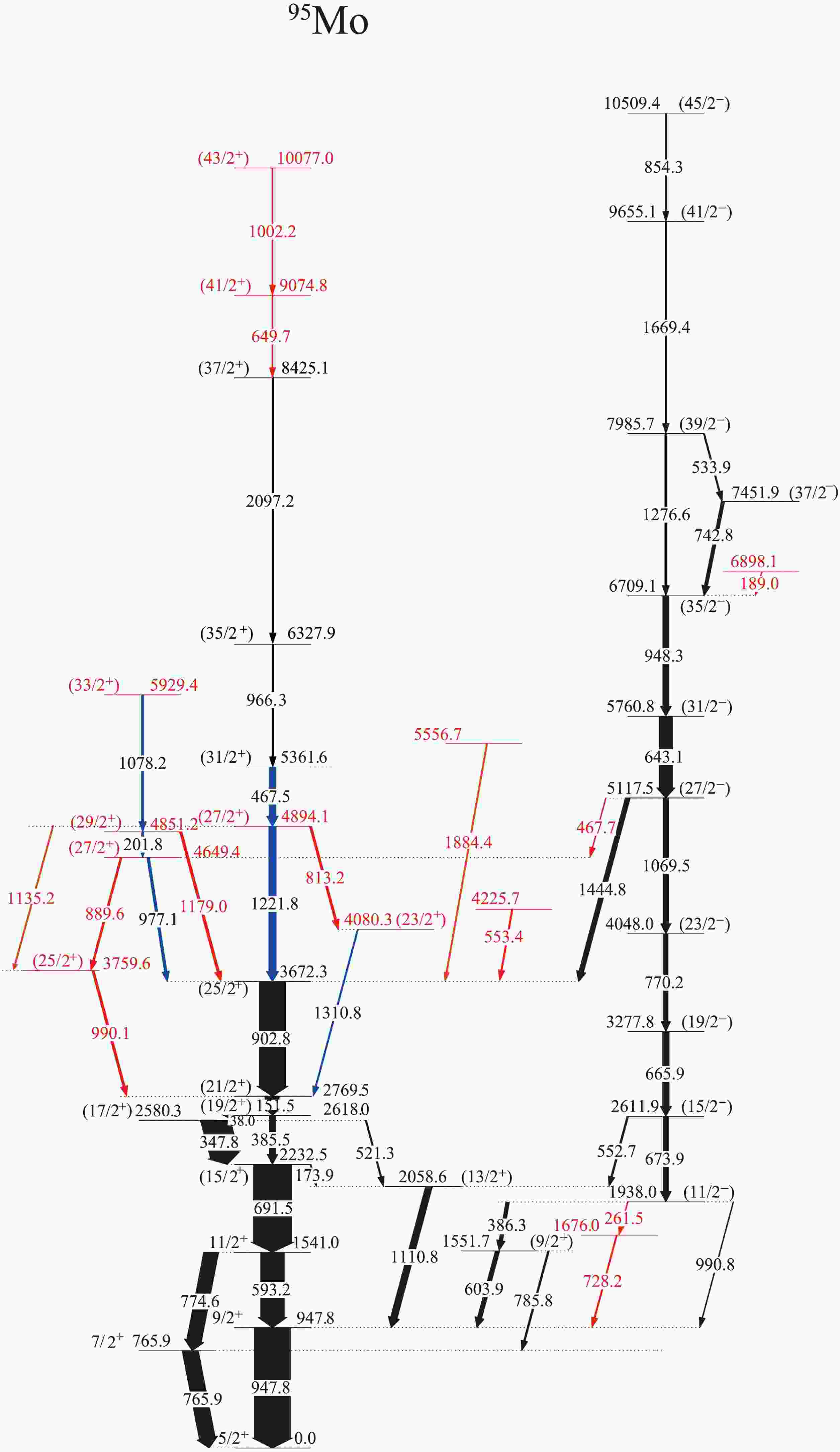
$ R_{{\rm{ADO}}} $ values for the γ rays with known multipolarity in 95Mo produced in the current experiment, as shown in Figs. 2, reveals$ R_{{\rm{ADO}}} $ $ \sim $ 1.4 and$ \sim $ 0.8 for the stretched quadrupole and stretched dipole transitions, respectively. The spin-parity assignments for 95Mo, based on the ADO ratios from the present data, previously reported data, and shell-model calculations, are also presented in Table 1. Gated coincidence spectra from the$ E_{\gamma} $ -$ E_{\gamma} $ matrix, constructed based on the present experimental results, are displayed in Figs. 3(a)(b). In addition, double-gated coincidence spectra from the$ E_{\gamma} $ -$ E_{\gamma} $ -$ E_{\gamma} $ cube are displayed in Figs. 4(a)-(d) and 5(a)(b). The double-coincidence gated spectra in Figs. 3(a)(b) and triple-coincidence gated spectra in Figs. 4(a) and 5(b) show all the new transitions as well as the previously reported ones. Key details are discussed as follows.
Figure 1. (color online) Level scheme of 95Mo established in the present study. The thicknesses of the arrows are approximately proportional to the γ-ray intensity listed in Table 1. The new and rearranged γ rays are marked in red and blue, respectively.
$ E_{\gamma} $ /keV$ I_{\gamma} $ $ R_{\rm ADO} $ $ E_{i} $ /keV$ E_{f} $ /keV$ J_{i}^{\pi} $ $ J_f^{\pi} $ multipolarity 38.0 - - 2618.0 2580.3 $ (19/2^{+}) $ $ (17/2^{+}) $ $ (M1/E2) $ 151.5(1) 36.0(7) 1.06(9) 2769.5 2618.0 $ (21/2^{+}) $ $ (19/2^{+}) $ $ (M1/E2) $ 173.9(11) 4.3(4) 0.92(10) 2232.5 2058.6 $ (15/2^{+}) $ $ (13/2^{+}) $ $ (M1/E2) $ 189.0(10)* 1.7(8) - 6898.1 6709.1 - $ (35/2^{-}) $ - 201.8(5) 5.6(7) 1.04(3) 4851.2 4649.4 $ (29/2^{+}) $ $ (27/2^{+}) $ $ (M1/E2) $ 261.5(3)* 1.8(8) - 1938.0 1676.0 $ (11/2^-) $ - - 347.8(1) 75.6(6) 1.07(2) 2580.3 2232.5 $ (17/2^{+}) $ $ (15/2^{+}) $ $ (M1/E2) $ 385.5(3) 14.8(13) 1.54(2) 2618.0 2232.5 $ (19/2^{+}) $ $ (15/2+) $ $ (E2) $ 386.3(3) 9.4(5) 1.10(4) 1938.0 1551.7 $ (11/2^{-}) $ $ (9/2^{+}) $ $ (E1) $ 467.5(1) 17.7(10) 1.66(2) 5361.6 4894.1 $ (31/2^{+}) $ $ (27/1^{+}) $ $ (E2) $ 467.7(2)* 1.9(2) - 4894.1 4649.4 $ (27/2^{-}) $ $ (27/2^{+}) $ $ (E1) $ 521.3(5) 3.6(5) 1.58(3) 2618.0 2058.6 $ (17/2^{+}) $ $ (13/2^{+}) $ $ (E2) $ 553.9(4) 3.5(2) 0.87(2) 7985.7 7451.9 $ (39/2^{-}) $ $ (37/2^{-}) $ $ (M1/E2) $ 552.7(2) 4.2(4) 0.99(3) 2611.9 2058.6 $ (15/2^{-}) $ $ (13/2^{+}) $ $ (E1) $ 553.4(6)* 2.0(7) - 4225.7 3672.3 - $ (25/2^{+}) $ - 593.2(1) 61.7(2) 0.92(1) 1541.0 947.8 $ 11/2^{+} $ $ 9/2^{+} $ $ M1/E2 $ 603.9(2) 11.3(2) 1.68(3) 1551.7 947.8 $ (9/2^{+}) $ $ 9/2^{+} $ $ (M1/E2) $ 643.1(2) 34.8(13) 1.41(1) 5760.8 5117.5 $ (31/2^{-}) $ $ (27/2^{-}) $ $ (E2) $ 649.7(2)* 2.3(3) 1.30(12) 9074.8 8425.1 $ (41/2^{+}) $ $ (37/2^+) $ $ (E2) $ 665.9(1) 16.9(4) 1.36(2) 3277.8 2611.9 $ (19/2^-) $ $ 15/2^- $ $ (E2) $ 673.9(1) 14.6(3) 1.71(2) 2611.9 1938.0 $ (15/2^-) $ $ (11/2^-) $ $ (E2) $ 691.5(1) 100(1) 1.39(1) 2232.5 1541.0 $ (15/2^+) $ $ 11/2^+ $ $ (E2) $ 728.2(10)* 1.9(1) - 1676.0 947.8 - $ 9/2^+ $ - 742.8(7) 8.5(4) 0.90(3) 7451.9 6709.1 $ (37/2^-) $ $ (35/2^-) $ $ (M1/E2) $ 765.9(1) 41.8(2) 1.09(1) 765.9 0 $ 7/2^+ $ $ 5/2^+ $ $ M1/E2 $ 770.2(1) 11.2(7) 1.43(2) 4048.0 3277.8 $ (23/2^-) $ $ (19/2^-) $ $ (E2) $ 774.6(1) 38.6(7) 1.36(2) 1541.0 765.9 $ 11/2^+ $ $ 7/2^+ $ $ E2 $ 785.8(6) 4.2(10) 0.80(3) 1551.7 947.8 $ (9/2^+) $ $ 7/2^+ $ $ (M1/E2) $ 813.2(6)* 3.2(2) 1.42(6) 4894.1 4080.3 $ (27/2^+) $ $ (23/2^+) $ $ (E2) $ 854.3(9) 2.5(3) 1.23(6) 10509.4 9655.1 $ (45/2^-) $ $ (41/2^-) $ $ (E2) $ 889.6(2)* 4.9(5) 0.76(3) 4649.4 3759.6 $ (25/2^+) $ $ (21/2^+) $ $ (E2) $ 902.8(2) 69.0(2) 1.35(1) 3672.3 2769.5 $ (25/2^+) $ $ (21/2^+) $ $ (E2) $ 947.8(1) 93.9(2) 1.29(1) 947.8 0 $ 9/2^+ $ $ 5/2^+ $ $ E2 $ 948.3(2) 15.5(6) 1.54(2) 6709.1 5760.8 $ (35/2^-) $ $ (31/2^-) $ $ (E2) $ 966.3(4) 3.9(4) 1.59(5) 6327.9 5361.6 $ (35/2^+) $ $ (31/2^+) $ $ (E2) $ 977.1(2) 9.8(3) 0.98(2) 4649.4 3672.3 $ (27/2^+) $ $ (25/2^+) $ $ (M1/E2) $ 990.1(3)* 5.9(5) 1.30(3) 3759.6 2769.5 $ (25/2^+) $ $ (21/2^+) $ $ (E2) $ 990.8(7) 1.8(3) - 1938.0 947.8 $ (11/2^-) $ $ 9/2^+ $ $ (E1) $ 1002.2(3)* 2.3(3) 0.97(5) 10077.0 9074.8 $ (43/2^+) $ $ (41/2^+) $ $ (M1/E2) $ 1069.5(4)* 13.7(1) 1.87(5) 5117.5 4048.0 $ (27/2^-) $ $ (23/2^-) $ $ (E2) $ 1078.2(2) 6.1(5) 1.33(10) 5929.4 4851.2 $ (33/2^+) $ $ (29/2^+) $ $ (E2) $ 1110.8(3) 17.4(1) 1.33(2) 2058.6 947.8 $ (13/2^+) $ $ 9/2^+ $ $ (E2) $ 1135.2(4)* 3.5(6) 0.93(10) 4894.1 3759.6 $ (27/2^+) $ $ (25/2^+) $ $ (M1/E2) $ 1179.0(3)* 6.3(6) 1.41(6) 4851.2 3672.3 $ (29/2^+) $ $ (25/2^+) $ $ (E2) $ 1221.8(2)* 19.3(1) 1.05(2) 4894.1 3672.3 $ (27/2^+) $ $ (25/2^+) $ $ (M1/E2) $ 1276.6(2)* 5.2(5) 1.53(5) 7985.7 6709.1 $ (39/2^-) $ $ (35/2^-) $ $ (E2) $ 1310.8(3) 3.3(4) 0.87(2) 4080.3 2769.5 $ (23/2^+) $ $ (21/2^+) $ $ (M1/E2) $ 1444.8(2) 12.5(1) 1.09(2) 5117.5 3672.3 $ (27/2^-) $ $ (25/2^+) $ $ (E1) $ 1669.4(4) 4.0(5) 0.81(3) 9655.1 7985.7 $ (41/2^-) $ $ (39/2^-) $ $ (M1/E2) $ 1884.4(6)* 1.5(6) - 5556.7 3672.3 - $ (25/2^+) $ - 2097.2(6) 4.0(6) 0.68(2) 8425.1 6327.9 $ (37/2^+) $ $ (35/2^+) $ $ (M1/E2) $ aThe asterisks denote newly identified γ -ray transitions.
bIntensities of transitions are normalized to the 691.5 keV γ ray.Table 1. γ-ray transition energies, relative intensities, ADO ratios, and their assignments in 95Mo.
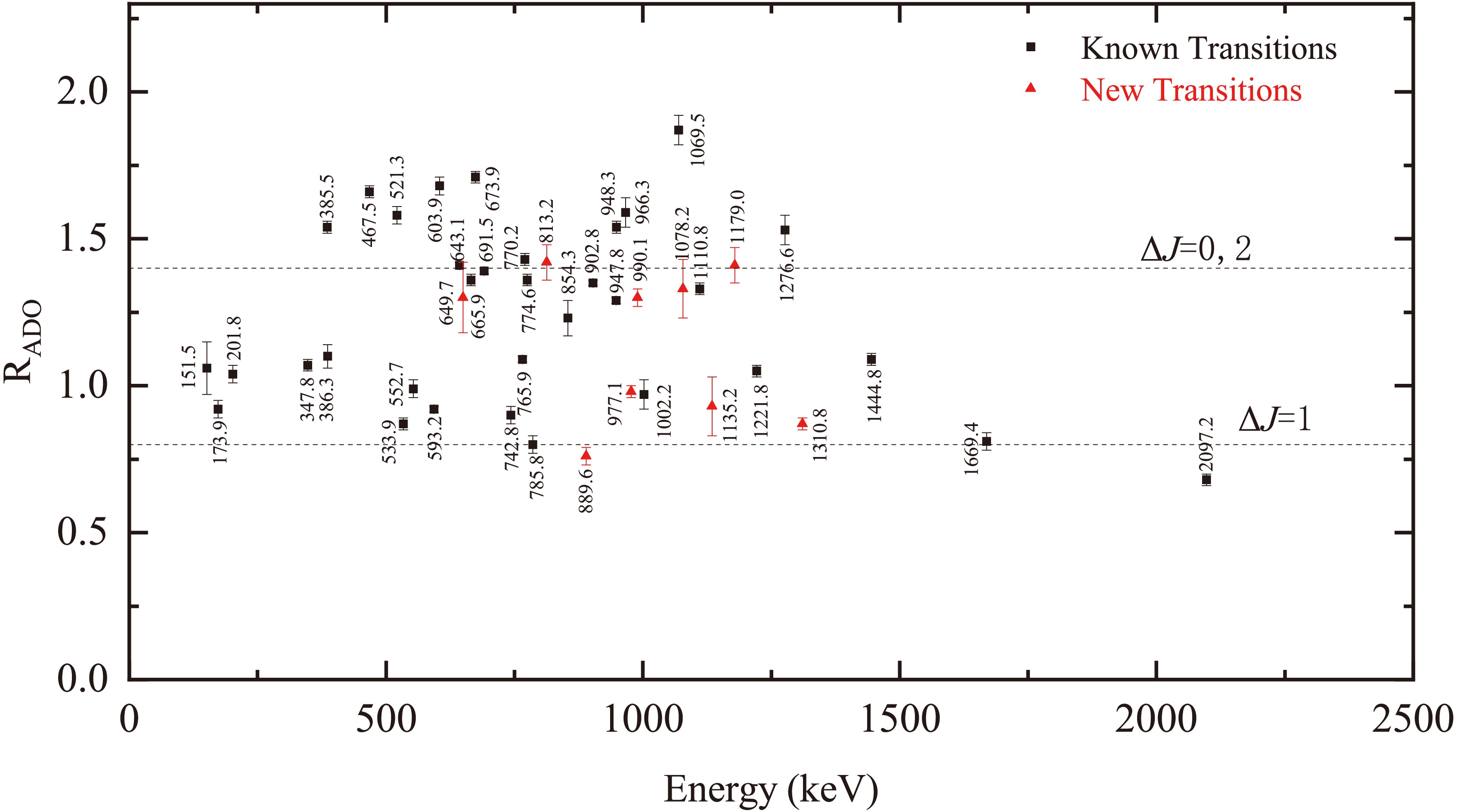
Figure 2. (color online)
$ R_{\rm ADO} $ plotted for the γ-ray transitions of 95Mo. The lines correspond to the value of$ R_{\rm ADO} $ for the known quadrupoles and dipoles. The quoted error includes the error due to background subtraction, fitting, and efficiency correction.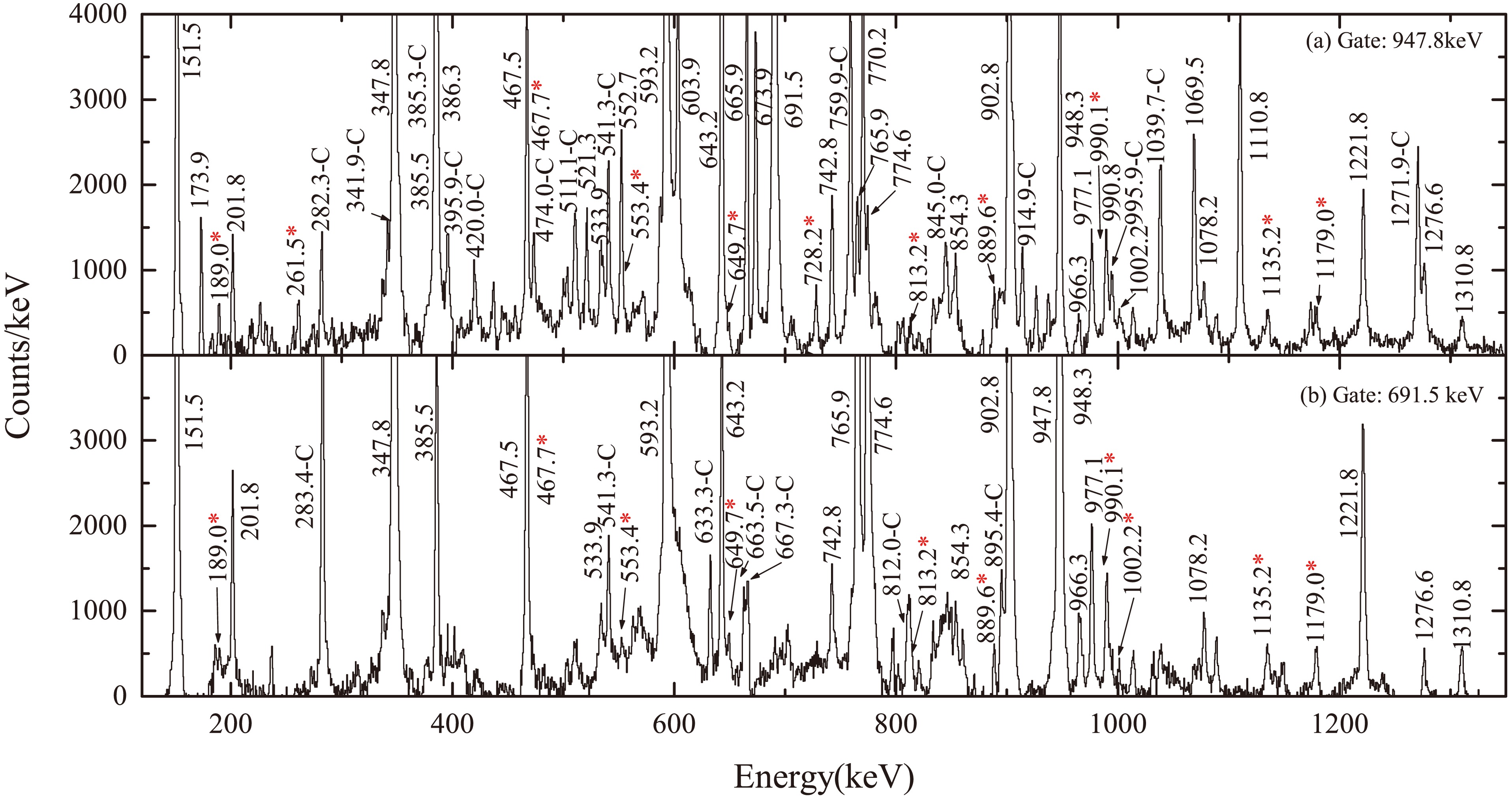
Figure 3. (color online) Typical gated γ-ray coincidence spectrum at 947.8 keV (a) and gated γ-ray coincidence spectrum at 691.5 keV (b). The contaminant peaks are labeled as C, indicating that they originate from other nuclei.
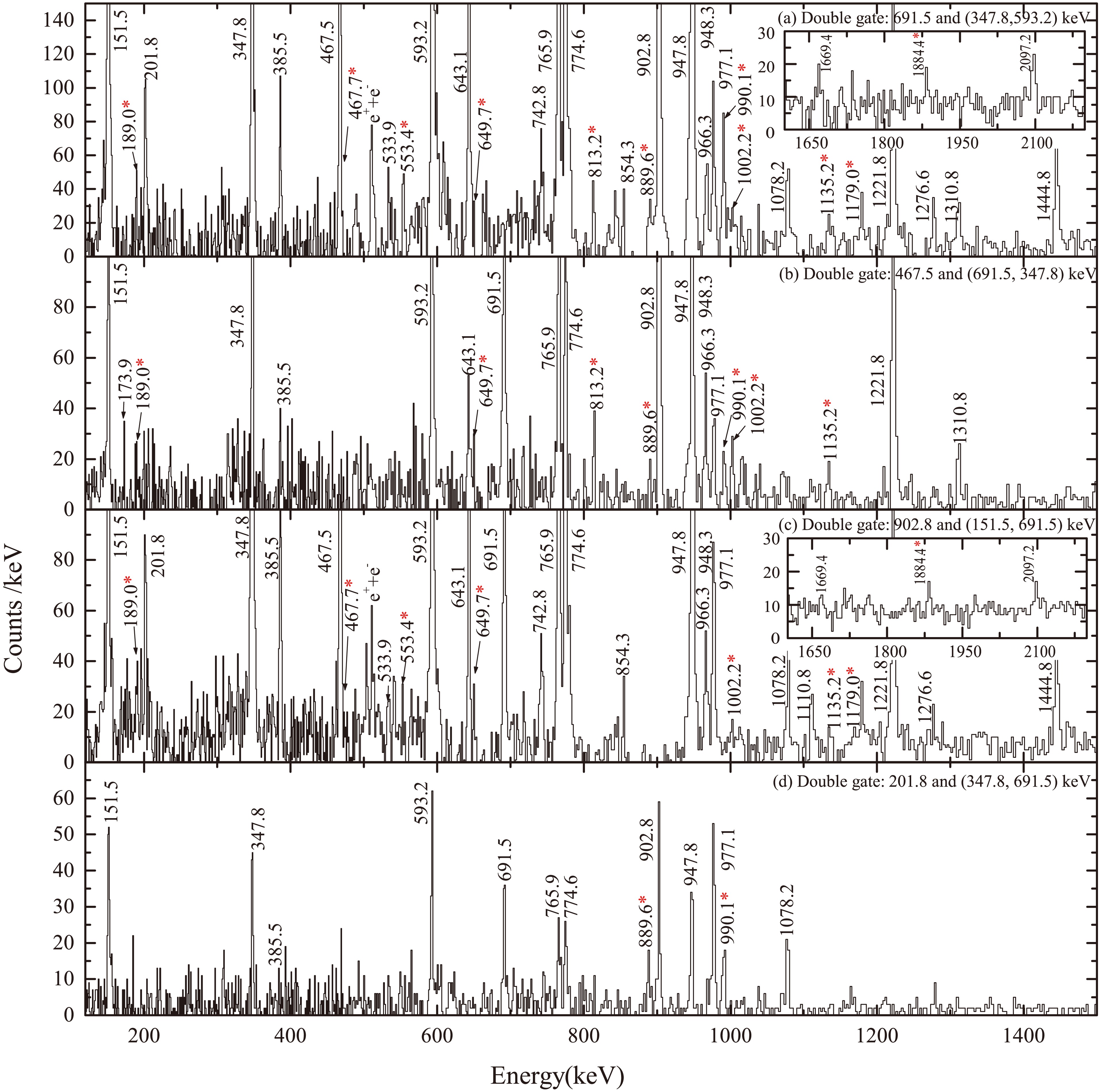
Figure 4. (color online) Typical double-gated γ-ray coincidence spectra for 95Mo. The spectra are generated by adding spectra selected from the double-gated coincidence spectra with gates on various transition combinations, as labeled.
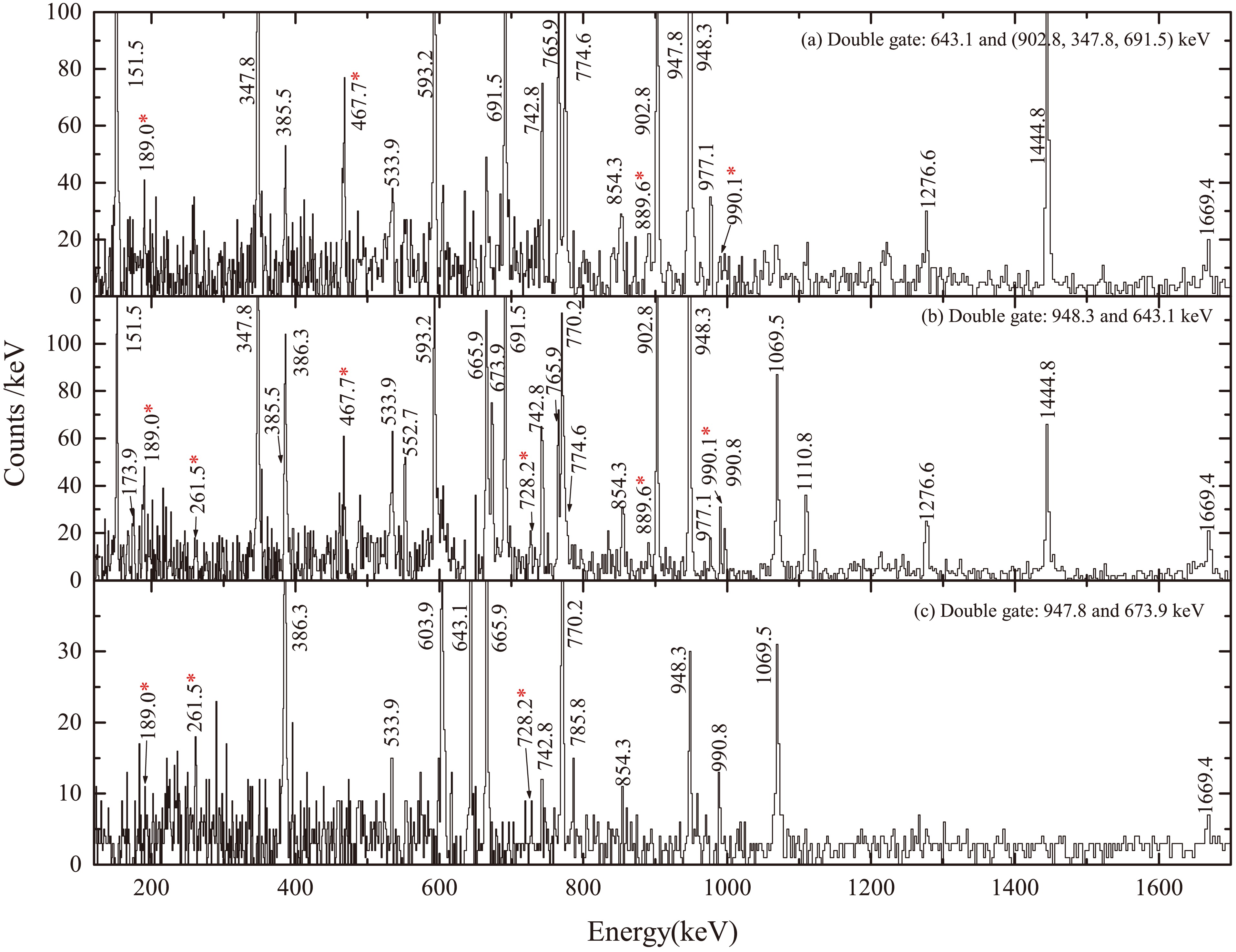
Figure 5. (color online) Typical double-gated γ-ray coincidence spectra for 95Mo. Figure (a) is generated by summing double-gated coincidence spectra from different transition combinations, as labeled. Figure (b) is the double-gated spectrum on transitions 948.3-keV and 643.1-keV. Figure (c) is the double-gated spectrum on transitions 947.8-keV and 673.9-keV.
As shown in Fig. 4(b), new transitions at 649.7 and 1002.2 keV are observed in the double-gated coincidence spectra of the 467.5-, 691.5-keV and the 467.5-, 347.8-keV γ-ray transitions. Further gating analysis confirms that the 649.7- and 1002.2-keV transitions are in mutual coincidence and also coincide with the connecting transitions, including and below the 966.3- and 2097.2-keV transitions. Thus, these two transitions are tentatively positioned above the 2097.2-keV transition. Based on the ADO ratio information, the level at 9074.8 keV, which is deexcited by the 649.7-keV transition, is tentatively assigned a spin-parity of
$ 41/2^+ $ . Similarly, the level at 10077.0 keV, deexcited by the 1002.2-keV transition, is tentatively assigned a spin-parity of$ 43/2^+ $ .As shown in Fig. 1, in the present study, the 467.5- and 1221.8-keV transitions are repositioned, and the new 813.2- and 1310.8-keV transitions are positioned parallel to the 1221.8- and 902.8-keV transitions. The rationale for these adjustments is illustrated in Figs. 4(b) and (c). In Fig. 4(b), the 813.2 keV and 1310.8 keV transitions are distinctly visible in the summed spectrum of the double gates on the 467.5-, 691.5-keV transitions and 467.5-, 347.8-keV transitions; the 902.8 keV and 1221.8 keV transitions are also observed. Conversely, the double-gated spectrum of the 902.8- and 347.8-keV γ rays, shown in Fig. 4(c), reveals the 1221.8-keV transition; however, no evidence of the 813.2- and 1310.8-keV γ transitions is obtained. Further coincidence analysis confirms that the 813.2- and 1310.8-keV transitions are in mutual coincidence. This result indicates that the 813.2- and 1310.8-keV transitions do not coincide with the 902.8- and 1221.8-keV transitions. Furthermore, the sum of the energies of the 813.2- and 1310.8-keV transitions is approximately equal to that of the energies of the 902.8- and 1221.8-keV transitions. All these transitions share coincidence relationships with the 467.5-keV transition. Based on this evidence, the placements of the 467.5- and 1221.8-keV transitions are interchanged. The level at 4894.1 keV, associated with the 1221.8-keV transition, is tentatively assigned a spin-parity of
$ 27/2^+ $ based on the ADO ratio of transition. Based on the ADO ratios listed in Table 1 for the 813.2- and 1310.8-keV transitions, their multipolarities are assigned as quadrupole and dipole, respectively. Consequently, the spin-parity of the level at 4080.3 keV is assigned as$( 23/2^+ )$ . Notably, as shown in Figs. 4(a) and (c), the 553.4- and 1884.4-keV transitions are tentatively placed above the level at 3672.3 keV, based on the available coincidence relationships.Based on the observed coincidence relationships, the presence of the 201.8-keV transition, along with its coincident partners at 977.1 and 1078.2 keV, is confirmed. In conjunction with the newly identified transitions at 889.6, 990.1, and 1179.0 keV and guided by their mutual coincidence relationships, their placements within the level scheme are revised as depicted in Fig. 1. As shown in Fig. 4(d), the new transitions at 889.6, 990.1, 977.1, and 1078.2 keV appear in the summed spectrum of the double gates on the 201.8-keV transition with the 347.8-keV and 691.5-keV transitions. Further coincidence analysis confirms that the 977.1- and 1078.2-keV transitions are mutually coincident. Moreover, these transitions, including the 201.8-keV transition, exhibit coincidence relationships with the 902.8-keV transition and the deexciting levels below it (Figs. 4(a) and (c)). Consequently, these three transitions are placed above the 902.8-keV transition. As shown in Fig. 4(c), the new 1179.0-keV transition is in coincidence with the 1078.2-keV transition as well as with the 902.8-keV transition and those below it. However, it shows no coincidence with the 201.8-keV transition, as confirmed by its absence in Fig. 4(d). Furthermore, the 1179.0-keV transition is not coincident with the 977.1-keV transition. Given that the sum of the energies of the 201.8- and 977.1-keV transitions well aligns with the energy of the 1179.0-keV transition, the 1179.0-keV transition is placed parallel to the 201.8- and 977.1-keV transitions, thereby deexciting the level at 3672.3 keV. Additionally, the 889.6- and 990.1-keV transitions are mutually coincident. Fig. 4(d) also indicates that they are not coincident with the 902.8-keV transition. The sum of their energies well aligns with that of the energies of the 977.1- and 902.8-keV transitions. Therefore, the 889.6- and 990.1-keV transitions are placed above the level at 2769.5 keV and connected via the 201.8-keV transition. Based on the ADO ratio information, the level at 4649.4 keV, which is deexcited by both the 977.1- and 889.6-keV transitions, is tentatively assigned a spin-parity of
$ 27/2^+ $ . The level at 3759.6 keV, deexcited by the 990.1-keV transition, is tentatively assigned a spin-parity of$ 25/2^+ $ . The spin-parities of the levels at 4851.2 keV and 5929.4 keV are tentatively assigned as$ 29/2^+ $ and$ 33/2^+ $ , respectively. Notably, as shown in Fig. 4(b), the 1135.2-keV transition is in coincidence with the 467.5-keV transition. Further coincidence analysis reveals that the 1135.2-keV transition also coincides with the 990.1-keV transition as well as with the connecting transitions below it. Moreover, the sum of the energies of the 1135.2- and 990.1-keV transitions is approximately equal to that of the 1221.8- and 902.8-keV transitions. Therefore, the 1135.2-keV transition is tentatively placed above the 990.1-keV transition, and the level at 4894.1 keV de-excites via the 1135.2-keV transition to that at 3759.6 keV.As shown in Fig. 5(a) and (b), the 643.1-keV transition is in coincidence with the 467.7-, 889.6-, and 990.1-keV transitions as well as with the 151.5-keV transition and other connecting transitions below it. Furthermore, Fig. 4(b) demonstrates that the 467.7-keV transition is coincident with the 889.6- and 990.1-keV transitions. Consequently, a new 467.7-keV transition, deexciting the level at 5117.5 keV to that at 4649.4 keV, is introduced. Additionally, a new 189.0-keV transition is observed in Fig. 5(a) and (b). Further coincidence analysis indicates that the 189.0-keV transition tentatively deexcites the level at 6709.1 keV.
As shown in Fig. 5(c), the new transitions at 261.5 and 728.2 keV appear in the double-gated coincidence spectrum of the 947.7- and 673.9-keV transitions. An alternative de-excitation path from the 1938.0-keV level to the 9/2+ state, consisting of a cascade of the 261.5- and 728.2-keV transitions, is established. Furthermore, the 1938.0-keV level de-excite via the 261.5-keV transition to the 1676.0-keV level.
-
The level scheme of 95Mo, constructed in the present study, is shown in Fig. 1. This work extends and revises the level scheme of 95Mo, adding 13 γ-ray transitions and 11 new levels, and reassigning the placements of 6 transitions. Notably, the 201.8-, 977.1-, 990.8-, 1078.2-, and 1310.8-keV transitions, which were observed in Ref. [29], have been confirmed in the present study. Their placements within the scheme have been reassigned based on the coincidence relationships observed in this study. The γ-ray energies, initial and final levels, intensities, and ADO ratios for 95Mo, extracted from the current experiment, are listed in Table 1. An evaluation of the
$ R_{{\rm{ADO}}} $ values for the γ rays with known multipolarity in 95Mo produced in the current experiment, as shown in Figs. 2, reveals$ R_{{\rm{ADO}}} $ $ \sim $ 1.4 and$ \sim $ 0.8 for the stretched quadrupole and stretched dipole transitions, respectively. The spin-parity assignments for 95Mo, based on the ADO ratios from the present data, previously reported data, and shell-model calculations, are also presented in Table 1. Gated coincidence spectra from the$ E_{\gamma} $ -$ E_{\gamma} $ matrix, constructed based on the present experimental results, are displayed in Figs. 3(a)(b). In addition, double-gated coincidence spectra from the$ E_{\gamma} $ -$ E_{\gamma} $ -$ E_{\gamma} $ cube are displayed in Figs. 4(a)-(d) and 5(a)(b). The double-coincidence gated spectra in Figs. 3(a)(b) and triple-coincidence gated spectra in Figs. 4(a) and 5(b) show all the new transitions as well as the previously reported ones. Key details are discussed as follows.
Figure 1. (color online) Level scheme of 95Mo established in the present study. The thicknesses of the arrows are approximately proportional to the γ-ray intensity listed in Table 1. The new and rearranged γ rays are marked in red and blue, respectively.
$ E_{\gamma} $ /keV$ I_{\gamma} $ $ R_{\rm ADO} $ $ E_{i} $ /keV$ E_{f} $ /keV$ J_{i}^{\pi} $ $ J_f^{\pi} $ multipolarity 38.0 - - 2618.0 2580.3 $ (19/2^{+}) $ $ (17/2^{+}) $ $ (M1/E2) $ 151.5(1) 36.0(7) 1.06(9) 2769.5 2618.0 $ (21/2^{+}) $ $ (19/2^{+}) $ $ (M1/E2) $ 173.9(11) 4.3(4) 0.92(10) 2232.5 2058.6 $ (15/2^{+}) $ $ (13/2^{+}) $ $ (M1/E2) $ 189.0(10)* 1.7(8) - 6898.1 6709.1 - $ (35/2^{-}) $ - 201.8(5) 5.6(7) 1.04(3) 4851.2 4649.4 $ (29/2^{+}) $ $ (27/2^{+}) $ $ (M1/E2) $ 261.5(3)* 1.8(8) - 1938.0 1676.0 $ (11/2^-) $ - - 347.8(1) 75.6(6) 1.07(2) 2580.3 2232.5 $ (17/2^{+}) $ $ (15/2^{+}) $ $ (M1/E2) $ 385.5(3) 14.8(13) 1.54(2) 2618.0 2232.5 $ (19/2^{+}) $ $ (15/2+) $ $ (E2) $ 386.3(3) 9.4(5) 1.10(4) 1938.0 1551.7 $ (11/2^{-}) $ $ (9/2^{+}) $ $ (E1) $ 467.5(1) 17.7(10) 1.66(2) 5361.6 4894.1 $ (31/2^{+}) $ $ (27/1^{+}) $ $ (E2) $ 467.7(2)* 1.9(2) - 4894.1 4649.4 $ (27/2^{-}) $ $ (27/2^{+}) $ $ (E1) $ 521.3(5) 3.6(5) 1.58(3) 2618.0 2058.6 $ (17/2^{+}) $ $ (13/2^{+}) $ $ (E2) $ 553.9(4) 3.5(2) 0.87(2) 7985.7 7451.9 $ (39/2^{-}) $ $ (37/2^{-}) $ $ (M1/E2) $ 552.7(2) 4.2(4) 0.99(3) 2611.9 2058.6 $ (15/2^{-}) $ $ (13/2^{+}) $ $ (E1) $ 553.4(6)* 2.0(7) - 4225.7 3672.3 - $ (25/2^{+}) $ - 593.2(1) 61.7(2) 0.92(1) 1541.0 947.8 $ 11/2^{+} $ $ 9/2^{+} $ $ M1/E2 $ 603.9(2) 11.3(2) 1.68(3) 1551.7 947.8 $ (9/2^{+}) $ $ 9/2^{+} $ $ (M1/E2) $ 643.1(2) 34.8(13) 1.41(1) 5760.8 5117.5 $ (31/2^{-}) $ $ (27/2^{-}) $ $ (E2) $ 649.7(2)* 2.3(3) 1.30(12) 9074.8 8425.1 $ (41/2^{+}) $ $ (37/2^+) $ $ (E2) $ 665.9(1) 16.9(4) 1.36(2) 3277.8 2611.9 $ (19/2^-) $ $ 15/2^- $ $ (E2) $ 673.9(1) 14.6(3) 1.71(2) 2611.9 1938.0 $ (15/2^-) $ $ (11/2^-) $ $ (E2) $ 691.5(1) 100(1) 1.39(1) 2232.5 1541.0 $ (15/2^+) $ $ 11/2^+ $ $ (E2) $ 728.2(10)* 1.9(1) - 1676.0 947.8 - $ 9/2^+ $ - 742.8(7) 8.5(4) 0.90(3) 7451.9 6709.1 $ (37/2^-) $ $ (35/2^-) $ $ (M1/E2) $ 765.9(1) 41.8(2) 1.09(1) 765.9 0 $ 7/2^+ $ $ 5/2^+ $ $ M1/E2 $ 770.2(1) 11.2(7) 1.43(2) 4048.0 3277.8 $ (23/2^-) $ $ (19/2^-) $ $ (E2) $ 774.6(1) 38.6(7) 1.36(2) 1541.0 765.9 $ 11/2^+ $ $ 7/2^+ $ $ E2 $ 785.8(6) 4.2(10) 0.80(3) 1551.7 947.8 $ (9/2^+) $ $ 7/2^+ $ $ (M1/E2) $ 813.2(6)* 3.2(2) 1.42(6) 4894.1 4080.3 $ (27/2^+) $ $ (23/2^+) $ $ (E2) $ 854.3(9) 2.5(3) 1.23(6) 10509.4 9655.1 $ (45/2^-) $ $ (41/2^-) $ $ (E2) $ 889.6(2)* 4.9(5) 0.76(3) 4649.4 3759.6 $ (25/2^+) $ $ (21/2^+) $ $ (E2) $ 902.8(2) 69.0(2) 1.35(1) 3672.3 2769.5 $ (25/2^+) $ $ (21/2^+) $ $ (E2) $ 947.8(1) 93.9(2) 1.29(1) 947.8 0 $ 9/2^+ $ $ 5/2^+ $ $ E2 $ 948.3(2) 15.5(6) 1.54(2) 6709.1 5760.8 $ (35/2^-) $ $ (31/2^-) $ $ (E2) $ 966.3(4) 3.9(4) 1.59(5) 6327.9 5361.6 $ (35/2^+) $ $ (31/2^+) $ $ (E2) $ 977.1(2) 9.8(3) 0.98(2) 4649.4 3672.3 $ (27/2^+) $ $ (25/2^+) $ $ (M1/E2) $ 990.1(3)* 5.9(5) 1.30(3) 3759.6 2769.5 $ (25/2^+) $ $ (21/2^+) $ $ (E2) $ 990.8(7) 1.8(3) - 1938.0 947.8 $ (11/2^-) $ $ 9/2^+ $ $ (E1) $ 1002.2(3)* 2.3(3) 0.97(5) 10077.0 9074.8 $ (43/2^+) $ $ (41/2^+) $ $ (M1/E2) $ 1069.5(4)* 13.7(1) 1.87(5) 5117.5 4048.0 $ (27/2^-) $ $ (23/2^-) $ $ (E2) $ 1078.2(2) 6.1(5) 1.33(10) 5929.4 4851.2 $ (33/2^+) $ $ (29/2^+) $ $ (E2) $ 1110.8(3) 17.4(1) 1.33(2) 2058.6 947.8 $ (13/2^+) $ $ 9/2^+ $ $ (E2) $ 1135.2(4)* 3.5(6) 0.93(10) 4894.1 3759.6 $ (27/2^+) $ $ (25/2^+) $ $ (M1/E2) $ 1179.0(3)* 6.3(6) 1.41(6) 4851.2 3672.3 $ (29/2^+) $ $ (25/2^+) $ $ (E2) $ 1221.8(2)* 19.3(1) 1.05(2) 4894.1 3672.3 $ (27/2^+) $ $ (25/2^+) $ $ (M1/E2) $ 1276.6(2)* 5.2(5) 1.53(5) 7985.7 6709.1 $ (39/2^-) $ $ (35/2^-) $ $ (E2) $ 1310.8(3) 3.3(4) 0.87(2) 4080.3 2769.5 $ (23/2^+) $ $ (21/2^+) $ $ (M1/E2) $ 1444.8(2) 12.5(1) 1.09(2) 5117.5 3672.3 $ (27/2^-) $ $ (25/2^+) $ $ (E1) $ 1669.4(4) 4.0(5) 0.81(3) 9655.1 7985.7 $ (41/2^-) $ $ (39/2^-) $ $ (M1/E2) $ 1884.4(6)* 1.5(6) - 5556.7 3672.3 - $ (25/2^+) $ - 2097.2(6) 4.0(6) 0.68(2) 8425.1 6327.9 $ (37/2^+) $ $ (35/2^+) $ $ (M1/E2) $ aThe asterisks denote newly identified γ -ray transitions.
bIntensities of transitions are normalized to the 691.5 keV γ ray.Table 1. γ-ray transition energies, relative intensities, ADO ratios, and their assignments in 95Mo.
Figure 2. (color online)
$ R_{\rm ADO} $ plotted for the γ-ray transitions of 95Mo. The lines correspond to the value of$ R_{\rm ADO} $ for the known quadrupoles and dipoles. The quoted error includes the error due to background subtraction, fitting, and efficiency correction.
Figure 3. (color online) Typical gated γ-ray coincidence spectrum at 947.8 keV (a) and gated γ-ray coincidence spectrum at 691.5 keV (b). The contaminant peaks are labeled as C, indicating that they originate from other nuclei.
Figure 4. (color online) Typical double-gated γ-ray coincidence spectra for 95Mo. The spectra are generated by adding spectra selected from the double-gated coincidence spectra with gates on various transition combinations, as labeled.
Figure 5. (color online) Typical double-gated γ-ray coincidence spectra for 95Mo. Figure (a) is generated by summing double-gated coincidence spectra from different transition combinations, as labeled. Figure (b) is the double-gated spectrum on transitions 948.3-keV and 643.1-keV. Figure (c) is the double-gated spectrum on transitions 947.8-keV and 673.9-keV.
As shown in Fig. 4(b), new transitions at 649.7 and 1002.2 keV are observed in the double-gated coincidence spectra of the 467.5-, 691.5-keV and the 467.5-, 347.8-keV γ-ray transitions. Further gating analysis confirms that the 649.7- and 1002.2-keV transitions are in mutual coincidence and also coincide with the connecting transitions, including and below the 966.3- and 2097.2-keV transitions. Thus, these two transitions are tentatively positioned above the 2097.2-keV transition. Based on the ADO ratio information, the level at 9074.8 keV, which is deexcited by the 649.7-keV transition, is tentatively assigned a spin-parity of
$ 41/2^+ $ . Similarly, the level at 10077.0 keV, deexcited by the 1002.2-keV transition, is tentatively assigned a spin-parity of$ 43/2^+ $ .As shown in Fig. 1, in the present study, the 467.5- and 1221.8-keV transitions are repositioned, and the new 813.2- and 1310.8-keV transitions are positioned parallel to the 1221.8- and 902.8-keV transitions. The rationale for these adjustments is illustrated in Figs. 4(b) and (c). In Fig. 4(b), the 813.2 keV and 1310.8 keV transitions are distinctly visible in the summed spectrum of the double gates on the 467.5-, 691.5-keV transitions and 467.5-, 347.8-keV transitions; the 902.8 keV and 1221.8 keV transitions are also observed. Conversely, the double-gated spectrum of the 902.8- and 347.8-keV γ rays, shown in Fig. 4(c), reveals the 1221.8-keV transition; however, no evidence of the 813.2- and 1310.8-keV γ transitions is obtained. Further coincidence analysis confirms that the 813.2- and 1310.8-keV transitions are in mutual coincidence. This result indicates that the 813.2- and 1310.8-keV transitions do not coincide with the 902.8- and 1221.8-keV transitions. Furthermore, the sum of the energies of the 813.2- and 1310.8-keV transitions is approximately equal to that of the energies of the 902.8- and 1221.8-keV transitions. All these transitions share coincidence relationships with the 467.5-keV transition. Based on this evidence, the placements of the 467.5- and 1221.8-keV transitions are interchanged. The level at 4894.1 keV, associated with the 1221.8-keV transition, is tentatively assigned a spin-parity of
$ 27/2^+ $ based on the ADO ratio of transition. Based on the ADO ratios listed in Table 1 for the 813.2- and 1310.8-keV transitions, their multipolarities are assigned as quadrupole and dipole, respectively. Consequently, the spin-parity of the level at 4080.3 keV is assigned as$( 23/2^+ )$ . Notably, as shown in Figs. 4(a) and (c), the 553.4- and 1884.4-keV transitions are tentatively placed above the level at 3672.3 keV, based on the available coincidence relationships.Based on the observed coincidence relationships, the presence of the 201.8-keV transition, along with its coincident partners at 977.1 and 1078.2 keV, is confirmed. In conjunction with the newly identified transitions at 889.6, 990.1, and 1179.0 keV and guided by their mutual coincidence relationships, their placements within the level scheme are revised as depicted in Fig. 1. As shown in Fig. 4(d), the new transitions at 889.6, 990.1, 977.1, and 1078.2 keV appear in the summed spectrum of the double gates on the 201.8-keV transition with the 347.8-keV and 691.5-keV transitions. Further coincidence analysis confirms that the 977.1- and 1078.2-keV transitions are mutually coincident. Moreover, these transitions, including the 201.8-keV transition, exhibit coincidence relationships with the 902.8-keV transition and the deexciting levels below it (Figs. 4(a) and (c)). Consequently, these three transitions are placed above the 902.8-keV transition. As shown in Fig. 4(c), the new 1179.0-keV transition is in coincidence with the 1078.2-keV transition as well as with the 902.8-keV transition and those below it. However, it shows no coincidence with the 201.8-keV transition, as confirmed by its absence in Fig. 4(d). Furthermore, the 1179.0-keV transition is not coincident with the 977.1-keV transition. Given that the sum of the energies of the 201.8- and 977.1-keV transitions well aligns with the energy of the 1179.0-keV transition, the 1179.0-keV transition is placed parallel to the 201.8- and 977.1-keV transitions, thereby deexciting the level at 3672.3 keV. Additionally, the 889.6- and 990.1-keV transitions are mutually coincident. Fig. 4(d) also indicates that they are not coincident with the 902.8-keV transition. The sum of their energies well aligns with that of the energies of the 977.1- and 902.8-keV transitions. Therefore, the 889.6- and 990.1-keV transitions are placed above the level at 2769.5 keV and connected via the 201.8-keV transition. Based on the ADO ratio information, the level at 4649.4 keV, which is deexcited by both the 977.1- and 889.6-keV transitions, is tentatively assigned a spin-parity of
$ 27/2^+ $ . The level at 3759.6 keV, deexcited by the 990.1-keV transition, is tentatively assigned a spin-parity of$ 25/2^+ $ . The spin-parities of the levels at 4851.2 keV and 5929.4 keV are tentatively assigned as$ 29/2^+ $ and$ 33/2^+ $ , respectively. Notably, as shown in Fig. 4(b), the 1135.2-keV transition is in coincidence with the 467.5-keV transition. Further coincidence analysis reveals that the 1135.2-keV transition also coincides with the 990.1-keV transition as well as with the connecting transitions below it. Moreover, the sum of the energies of the 1135.2- and 990.1-keV transitions is approximately equal to that of the 1221.8- and 902.8-keV transitions. Therefore, the 1135.2-keV transition is tentatively placed above the 990.1-keV transition, and the level at 4894.1 keV de-excites via the 1135.2-keV transition to that at 3759.6 keV.As shown in Fig. 5(a) and (b), the 643.1-keV transition is in coincidence with the 467.7-, 889.6-, and 990.1-keV transitions as well as with the 151.5-keV transition and other connecting transitions below it. Furthermore, Fig. 4(b) demonstrates that the 467.7-keV transition is coincident with the 889.6- and 990.1-keV transitions. Consequently, a new 467.7-keV transition, deexciting the level at 5117.5 keV to that at 4649.4 keV, is introduced. Additionally, a new 189.0-keV transition is observed in Fig. 5(a) and (b). Further coincidence analysis indicates that the 189.0-keV transition tentatively deexcites the level at 6709.1 keV.
As shown in Fig. 5(c), the new transitions at 261.5 and 728.2 keV appear in the double-gated coincidence spectrum of the 947.7- and 673.9-keV transitions. An alternative de-excitation path from the 1938.0-keV level to the 9/2+ state, consisting of a cascade of the 261.5- and 728.2-keV transitions, is established. Furthermore, the 1938.0-keV level de-excite via the 261.5-keV transition to the 1676.0-keV level.
-
The level scheme of 95Mo constructed in the present work is shown in Fig. 1. This work extends and revises the level scheme of 95Mo, adding 13 γ-ray transitions and 11 new levels, and reassigning the placements of 6 transitions. It is noteworthy that the 201.8-, 977.1-, 990.8-, 1078.2-, and 1310.8-keV transitions, which were observed in Ref. [29], have been confirmed in this work. Their placements within the scheme have been reassigned based on the coincidence relationships observed herein. The γ-ray energies, initial and final levels, intensities, and ADO ratios for 95Mo extracted from the current experiment are listed in Table 1. By evaluating the
$ R_{{\rm{ADO}}} $ values for the γ rays with known multipolarity in 95Mo produced in the current experiment as shown in Figs. 2, it is observed that the$ R_{{\rm{ADO}}} $ $ \sim $ 1.4 and$ \sim $ 0.8 for the stretched quadrupole and the stretched dipole transitions in the current experimental setup, respectively. The spin-parity assignments for 95Mo, based on the ADO ratios from the present data, previously reported data, and shell-model calculations, are also presented in Table 1. Gated coincidence spectra from the$ E_{\gamma} $ -$ E_{\gamma} $ matrix built from the present experiment are displayed in Figs. 3(a)(b). Double-gated coincidence spectra from the$ E_{\gamma} $ -$ E_{\gamma} $ -$ E_{\gamma} $ cube built from the present experiment are displayed in Figs. 4(a)-(d) and 5(a)(b). As demonstrated by the double-coincidence gated spectra in Figs. 3(a)(b) and triple-coincidence gated spectra in Figs. 4(a) and 5(b), all new transitions as well as previously reported ones are observed. Key details will be discussed as follows.
Figure 1. (color online) The level scheme of 95Mo established from the present work is shown. The thicknesses of the arrows are roughly proportional to the γ-ray intensity listed in Table 1. The new and rearranged γ rays are marked in red and blue, respectively.
$ E_{\gamma} $
keV$ I_{\gamma} $ $ R_{ADO} $ $ E_{i} $
keV$ E_{f} $
keV$ J_{i}^{\pi} $ $ J_f^{\pi} $ multipolarity 38.0 - - 2618.0 2580.3 $ (19/2^{+}) $ $ (17/2^{+}) $ $ (M1/E2) $ 151.5(1) 36.0(7) 1.06(9) 2769.5 2618.0 $ (21/2^{+}) $ $ (19/2^{+}) $ $ (M1/E2) $ 173.9(11) 4.3(4) 0.92(10) 2232.5 2058.6 $ (15/2^{+}) $ $ (13/2^{+}) $ $ (M1/E2) $ 189.0(10)* 1.7(8) - 6898.1 6709.1 - $ (35/2^{-}) $ - 201.8(5) 5.6(7) 1.04(3) 4851.2 4649.4 $ (29/2^{+}) $ $ (27/2^{+}) $ $ (M1/E2) $ 261.5(3)* 1.8(8) - 1938.0 1676.0 $ (11/2^-) $ - - 347.8(1) 75.6(6) 1.07(2) 2580.3 2232.5 $ (17/2^{+}) $ $ (15/2^{+}) $ $ (M1/E2) $ 385.5(3) 14.8(13) 1.54(2) 2618.0 2232.5 $ (19/2^{+}) $ $ (15/2+) $ $ (E2) $ 386.3(3) 9.4(5) 1.10(4) 1938.0 1551.7 $ (11/2^{-}) $ $ (9/2^{+}) $ $ (E1) $ 467.5(1) 17.7(10) 1.66(2) 5361.6 4894.1 $ (31/2^{+}) $ $ (27/1^{+}) $ $ (E2) $ 467.7(2)* 1.9(2) - 4894.1 4649.4 $ (27/2^{-}) $ $ (27/2^{+}) $ $ (E1) $ 521.3(5) 3.6(5) 1.58(3) 2618.0 2058.6 $ (17/2^{+}) $ $ (13/2^{+}) $ $ (E2) $ 553.9(4) 3.5(2) 0.87(2) 7985.7 7451.9 $ (39/2^{-}) $ $ (37/2^{-}) $ $ (M1/E2) $ 552.7(2) 4.2(4) 0.99(3) 2611.9 2058.6 $ (15/2^{-}) $ $ (13/2^{+}) $ $ (E1) $ 553.4(6)* 2.0(7) - 4225.7 3672.3 - $ (25/2^{+}) $ - 593.2(1) 61.7(2) 0.92(1) 1541.0 947.8 $ 11/2^{+} $ $ 9/2^{+} $ $ M1/E2 $ 603.9(2) 11.3(2) 1.68(3) 1551.7 947.8 $ (9/2^{+}) $ $ 9/2^{+} $ $ (M1/E2) $ 643.1(2) 34.8(13) 1.41(1) 5760.8 5117.5 $ (31/2^{-}) $ $ (27/2^{-}) $ $ (E2) $ 649.7(2)* 2.3(3) 1.30(12) 9074.8 8425.1 $ (41/2^{+}) $ $ (37/2^+) $ $ (E2) $ 665.9(1) 16.9(4) 1.36(2) 3277.8 2611.9 $ (19/2^-) $ $ 15/2^- $ $ (E2) $ 673.9(1) 14.6(3) 1.71(2) 2611.9 1938.0 $ (15/2^-) $ $ (11/2^-) $ $ (E2) $ 691.5(1) 100(1) 1.39(1) 2232.5 1541.0 $ (15/2^+) $ $ 11/2^+ $ $ (E2) $ 728.2(10)* 1.9(1) - 1676.0 947.8 - $ 9/2^+ $ - 742.8(7) 8.5(4) 0.90(3) 7451.9 6709.1 $ (37/2^-) $ $ (35/2^-) $ $ (M1/E2) $ 765.9(1) 41.8(2) 1.09(1) 765.9 0 $ 7/2^+ $ $ 5/2^+ $ $ M1/E2 $ 770.2(1) 11.2(7) 1.43(2) 4048.0 3277.8 $ (23/2^-) $ $ (19/2^-) $ $ (E2) $ 774.6(1) 38.6(7) 1.36(2) 1541.0 765.9 $ 11/2^+ $ $ 7/2^+ $ $ E2 $ 785.8(6) 4.2(10) 0.80(3) 1551.7 947.8 $ (9/2^+) $ $ 7/2^+ $ $ (M1/E2) $ 813.2(6)* 3.2(2) 1.42(6) 4894.1 4080.3 $ (27/2^+) $ $ (23/2^+) $ $ (E2) $ 854.3(9) 2.5(3) 1.23(6) 10509.4 9655.1 $ (45/2^-) $ $ (41/2^-) $ $ (E2) $ 889.6(2)* 4.9(5) 0.76(3) 4649.4 3759.6 $ (25/2^+) $ $ (21/2^+) $ $ (E2) $ 902.8(2) 69.0(2) 1.35(1) 3672.3 2769.5 $ (25/2^+) $ $ (21/2^+) $ $ (E2) $ 947.8(1) 93.9(2) 1.29(1) 947.8 0 $ 9/2^+ $ $ 5/2^+ $ $ E2 $ 948.3(2) 15.5(6) 1.54(2) 6709.1 5760.8 $ (35/2^-) $ $ (31/2^-) $ $ (E2) $ 966.3(4) 3.9(4) 1.59(5) 6327.9 5361.6 $ (35/2^+) $ $ (31/2^+) $ $ (E2) $ 977.1(2) 9.8(3) 0.98(2) 4649.4 3672.3 $ (27/2^+) $ $ (25/2^+) $ $ (M1/E2) $ 990.1(3)* 5.9(5) 1.30(3) 3759.6 2769.5 $ (25/2^+) $ $ (21/2^+) $ $ (E2) $ 990.8(7) 1.8(3) - 1938.0 947.8 $ (11/2^-) $ $ 9/2^+ $ $ (E1) $ 1002.2(3)* 2.3(3) 0.97(5) 10077.0 9074.8 $ (43/2^+) $ $ (41/2^+) $ $ (M1/E2) $ 1069.5(4)* 13.7(1) 1.87(5) 5117.5 4048.0 $ (27/2^-) $ $ (23/2^-) $ $ (E2) $ 1078.2(2) 6.1(5) 1.33(10) 5929.4 4851.2 $ (33/2^+) $ $ (29/2^+) $ $ (E2) $ 1110.8(3) 17.4(1) 1.33(2) 2058.6 947.8 $ (13/2^+) $ $ 9/2^+ $ $ (E2) $ 1135.2(4)* 3.5(6) 0.93(10) 4894.1 3759.6 $ (27/2^+) $ $ (25/2^+) $ $ (M1/E2) $ 1179.0(3)* 6.3(6) 1.41(6) 4851.2 3672.3 $ (29/2^+) $ $ (25/2^+) $ $ (E2) $ 1221.8(2)* 19.3(1) 1.05(2) 4894.1 3672.3 $ (27/2^+) $ $ (25/2^+) $ $ (M1/E2) $ 1276.6(2)* 5.2(5) 1.53(5) 7985.7 6709.1 $ (39/2^-) $ $ (35/2^-) $ $ (E2) $ 1310.8(3) 3.3(4) 0.87(2) 4080.3 2769.5 $ (23/2^+) $ $ (21/2^+) $ $ (M1/E2) $ 1444.8(2) 12.5(1) 1.09(2) 5117.5 3672.3 $ (27/2^-) $ $ (25/2^+) $ $ (E1) $ 1669.4(4) 4.0(5) 0.81(3) 9655.1 7985.7 $ (41/2^-) $ $ (39/2^-) $ $ (M1/E2) $ 1884.4(6)* 1.5(6) - 5556.7 3672.3 - $ (25/2^+) $ - 2097.2(6) 4.0(6) 0.68(2) 8425.1 6327.9 $ (37/2^+) $ $ (35/2^+) $ $ (M1/E2) $ aThe asterisks denote newly identified γ -ray transitions.
bIntensities of transitions are normalized to the 691.5 keV γ ray.Table 1. γ−ray transition energies, relative intensities, ADO ratios, and their assignments in 95Mo
Figure 2. (color online)
$ R_{ADO} $ plotted for γ-ray transitions of 95Mo. The lines correspond to the value of$ R_{ADO} $ for the known quadrupoles and dipoles. The quoted error includes the error due to background subtraction, fitting, and efficiency correction.
Figure 3. (color online) Typical gated γ-ray coincidence spectrum at 947.8 keV(a) and gated γ-ray coincidence spectrum at 691.5 keV(b). The contaminant peaks are labeled as C, indicating that they originate from other nuclei.
Figure 4. (color online) Typical double-gated γ-ray coincidence spectra for 95Mo. The spectra are generated by adding spectra selected from the double-gated coincidence spectra with gates on various transition combinations, as labeled.
Figure 5. (color online) Typical double-gated γ-ray coincidence spectra for 95Mo. Figure (a) is generated by summing double-gated coincidence spectra from different transition combinations, as labeled. Figure (b) is the double-gated spectrum on transitions 948.3-keV and 643.1-keV. Figure (c) is the double-gated spectrum on transitions 947.8-keV and 673.9-keV.
As shown in Fig. 4(b), the new transitions at 649.7, and 1002.2 keV are observed in the double-gated coincidence spectra on the 467.5-, 691.5-keV and the 467.5-, 347.8-keV γ-ray transitions. Further gating analysis confirms that the 649.7- and 1002.2-keV transitions are in mutual coincidence and also coincide with the connecting transitions including and below the 966.3- and 2097.2-keV transitions. These two transitions were thus tentatively placed above the 2097.2-keV transition. Based on the ADO ratio information, the level at 9074.8 keV, which is deexcited by the 649.7-keV transition, was tentatively assigned a spin-parity of
$ 41/2^+ $ . Similarly, the level at 10077.0 keV, deexcited by the 1002.2-keV transition, was tentatively assigned a spin-parity of$ 43/2^+ $ .As shown in Fig. 1, the present work has repositioned the 467.5- and 1221.8-keV transitions and placed the new 813.2- and 1310.8-keV transitions parallel to the 1221.8- and 902.8-keV transitions. The rationale for these adjustments is illustrated in Figs. 4(b) and (c). In Fig. 4(b), the 813.2 keV and 1310.8 keV transitions are clearly visible in the summed spectrum of the double gates on the 467.5-, 691.5-keV transitions and the 467.5-, 347.8-keV transitions, where the 902.8 keV and 1221.8 keV transitions are also observed. Conversely, the double-gated spectrum on the 902.8- and 347.8-keV γ rays, shown in Fig. 4(c), clearly reveals the 1221.8-keV transition but shows no evidence of the 813.2- and 1310.8-keV γ transitions. Further coincidence analysis confirms that the 813.2- and 1310.8-keV transitions are in mutual coincidence. This indicates that the 813.2- and 1310.8-keV transitions do not coincide with the 902.8- and 1221.8-keV transitions. Furthermore, the sum of the energies of the 813.2- and 1310.8-keV transitions is approximately equal to the sum of the energies of the 902.8- and 1221.8-keV transitions, while all these transitions share coincidence relationships with the 467.5-keV transition, among others. Based on this evidence, the placements of the 467.5- and 1221.8-keV transitions have been interchanged. The level at 4894.1 keV, associated with the 1221.8-keV transition, was tentatively assigned a spin-parity of
$ 27/2^+ $ based on the ADO ratio of transition. From the ADO ratios listed in Table 1 for the 813.2- and 1310.8-keV transitions, their multipolarities were assigned as quadrupole and dipole, respectively. Consequently, the spin-parity of the level at 4080.3 keV was assigned as$( 23/2^+ )$ . Incidentally, as shown in Figs. 4(a) and (c), the 553.4- and 1884.4-keV transitions were tentatively placed above the level at 3672.3 keV based on the available coincidence relationships.Based on coincidence relationships, the present work has confirmed the presence of the 201.8-keV transition, along with its coincident partners at 977.1 and 1078.2 keV. In conjunction with the newly identified transitions at 889.6,990.1, and 1179.0 keV, and guided by their mutual coincidence relationships, their placements within the level scheme have been revised as depicted in Fig. 1. As shown in Fig. 4(d), the new transitions at 889.6,990.1,977.1, and 1078.2 keV are observed in the summed spectrum of the double gates on the 201.8-keV transition with the 347.8-keV and 691.5-keV transitions, respectively. Further coincidence analysis confirms that the 977.1- and 1078.2-keV transitions are mutually coincident. Moreover, these transitions, including the 201.8-keV transition, all exhibit coincidence relationships with the 902.8-keV transition and those deexciting levels below it, as evidenced in Figs. 4(a) and (c). Consequently, these three transitions were placed above the 902.8-keV transition. From Fig. 4(c), the new 1179.0-keV transition is found to be in coincidence with the 1078.2-keV transition and with the 902.8-keV transition and those below it. However, it shows no coincidence with the 201.8-keV transition, as confirmed by its absence in Fig. 4(d). Furthermore, the 1179.0-keV transition is not coincident with the 977.1-keV transition. Given that the sum of the energies of the 201.8- and 977.1-keV transitions is very close to the energy of the 1179.0-keV transition, the 1179.0-keV transition was placed parallel to the 201.8- and 977.1-keV transitions, deexciting the level at 3672.3 keV. Additionally, the 889.6- and 990.1-keV transitions are mutually coincident. Fig. 4(d) also indicates they are not coincident with the 902.8-keV transition. The sum of their energies is very close to the sum of the energies of the 977.1- and 902.8-keV transitions. Therefore, the 889.6- and 990.1-keV transitions were placed above the level at 2769.5 keV and connected via the 201.8-keV transition. Based on the ADO ratio information, the level at 4649.4 keV, which is deexcited by both the 977.1- and 889.6-keV transitions, was tentatively assigned a spin-parity of
$ 27/2^+ $ . The level at 3759.6 keV, deexcited by the 990.1-keV transition, was tentatively assigned a spin-parity of$ 25/2^+ $ . The spin-parities of the levels at 4851.2 keV and 5929.4 keV were tentatively assigned as$ 29/2^+ $ and$ 33/2^+ $ , respectively. It is noteworthy that, as shown in Fig. 4(b), the 1135.2-keV transition is in coincidence with the 467.5-keV transition. Further coincidence analysis reveals that the 1135.2-keV transition also coincides with the 990.1-keV transition and with the connecting transitions below it. Moreover, the sum of the energies of the 1135.2- and 990.1-keV transitions is approximately equal to that of the 1221.8- and 902.8-keV transitions. Therefore, the 1135.2-keV transition was tentatively placed above the 990.1-keV transition, and the level at 4894.1 keV de-excites via the 1135.2-keV transition to the level at 3759.6 keV.As shown in Fig. 5(a) and (b), it reveals that the 643.1-keV transition is in coincidence with the 467.7-, 889.6-, and 990.1-keV transitions, as well as with the 151.5-keV transition and other connecting transitions below it. Furthermore, from Fig. 4(b), it is evident that the 467.7-keV transition is coincident with the 889.6- and 990.1-keV transitions. Consequently, a new 467.7-keV transition deexciting the level at 5117.5 keV to the level at 4649.4 keV has been introduced. Additionally, a new 189.0-keV transition is observed in Fig. 5(a) and (b). Based on further coincidence analysis, the 189.0-keV transition was tentatively placed as deexciting the level at 6709.1 keV.
As shown in Fig. 5(c), the new transitions of 261.5 and 728.2 keV are observed in the double-gated coincidence spectrum on the 947.7- and 673.9-keV transitions. An alternative de-excitation path from the 1938.0-keV level to the 9/2+ state, consisting of a cascade of the 261.5- and 728.2-keV transitions, has been established. Furthermore, the 1938.0-keV level is found to de-excite via the 261.5-keV transition to the 1676.0-keV level.
-
To account for the partial level structure observed experimentally in 95Mo, shell-model calculations are performed using the NuShellX code [32]. For a more comprehensive analysis of the level structure of this nucleus, two effective interactions, GWBXG [33] and SNET [34], are employed in the calculations. For the GWBXG interaction, the model space comprises the four proton orbitals
$ 1f_{5/2} $ ,$ 2p_{3/2} $ ,$ 2p_{1/2} $ , and$ 1g_{9/2} $ and the six neutron orbitals$ 2p_{1/2} $ ,$ 1g_{9/2} $ ,$ 1g_{7/2} $ ,$ 2d_{5/2} $ ,$ 2d_{3/2} $ , and$ 3s_{1/2} $ . The model space for the SNET interaction is larger than that for GWBXG: the proton sector additionally includes the$ 1g_{7/2} $ ,$ 2d_{5/2} $ ,$ 2d_{3/2} $ , and$ 3s_{1/2} $ orbitals above the$ Z=50 $ closed shell, whereas the neutron sector includes the$ 1f_{5/2} $ ,$ 2p_{1/2} $ orbitals above the$ N=28 $ closed shell and the$ 1h_{11/2} $ orbital above the$ N=50 $ closed shell. To obtain reasonable caculation results within accpetable time periods, space truncation is applied in the present calculations. Specifically, for the GWBXG model space, proton excitations are confined within the$ 1f_{5/2} $ ,$ 2p_{3/2} $ ,$ 2p_{1/2} $ , and$ 1g_{9/2} $ orbitals, allowing a maximum of two proton excitations from the$ 1f_{5/2} $ orbital; neutron excitations are restricted to the$ 1g_{7/2} $ ,$ 2d_{5/2} $ ,$ 2d_{3/2} $ , and$ 3s_{1/2} $ orbitals above the$ N=50 $ core. To facilitate a comparison focusing on the influence of the$ 1h_{11/2} $ orbital within the SNET interaction, we ensure that the allowed single-particle excitations remain identical to those for the GWBXG interaction, except that one neutron is permitted to occupy the$ 1h_{11/2} $ orbital. The levels calculatedbased on the two interactions are compared with the experimental data, and the results are shown in Figs. 6 and 7. The calculated energies, their corresponding experimental values, and the resulting configuration information are listed in Tables 2 and 3. As evident from Figs. 6 and 7 and Tables 2 and 3, the results obtained with the GWBXG interaction satisfactorily reproduce most of the lower-lying positive-parity states. In contrast, the SNET interaction generally overestimates the energies of the positive-parity levels; it provides a reasonable description for the low-lying negative-parity states, whereas it underestimates the energies of the higher-lying negative-parity levels. The results of the shell-model calculations are briefly discussed in the following.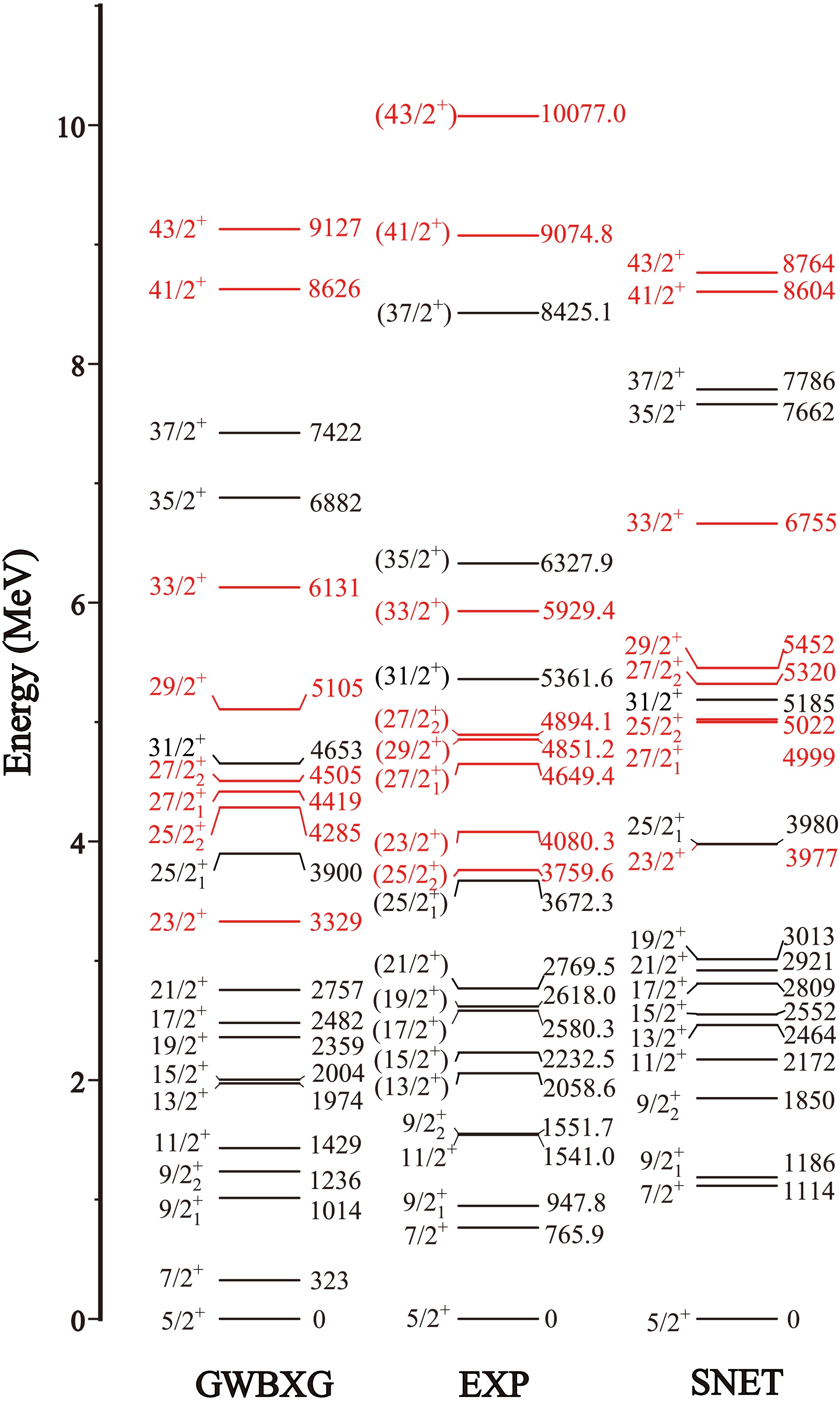
Figure 6. (color online) Comparison of experimental excitation energies in 95Mo (π=+) with shell-model predictions with GWBXG and SNET interactions.
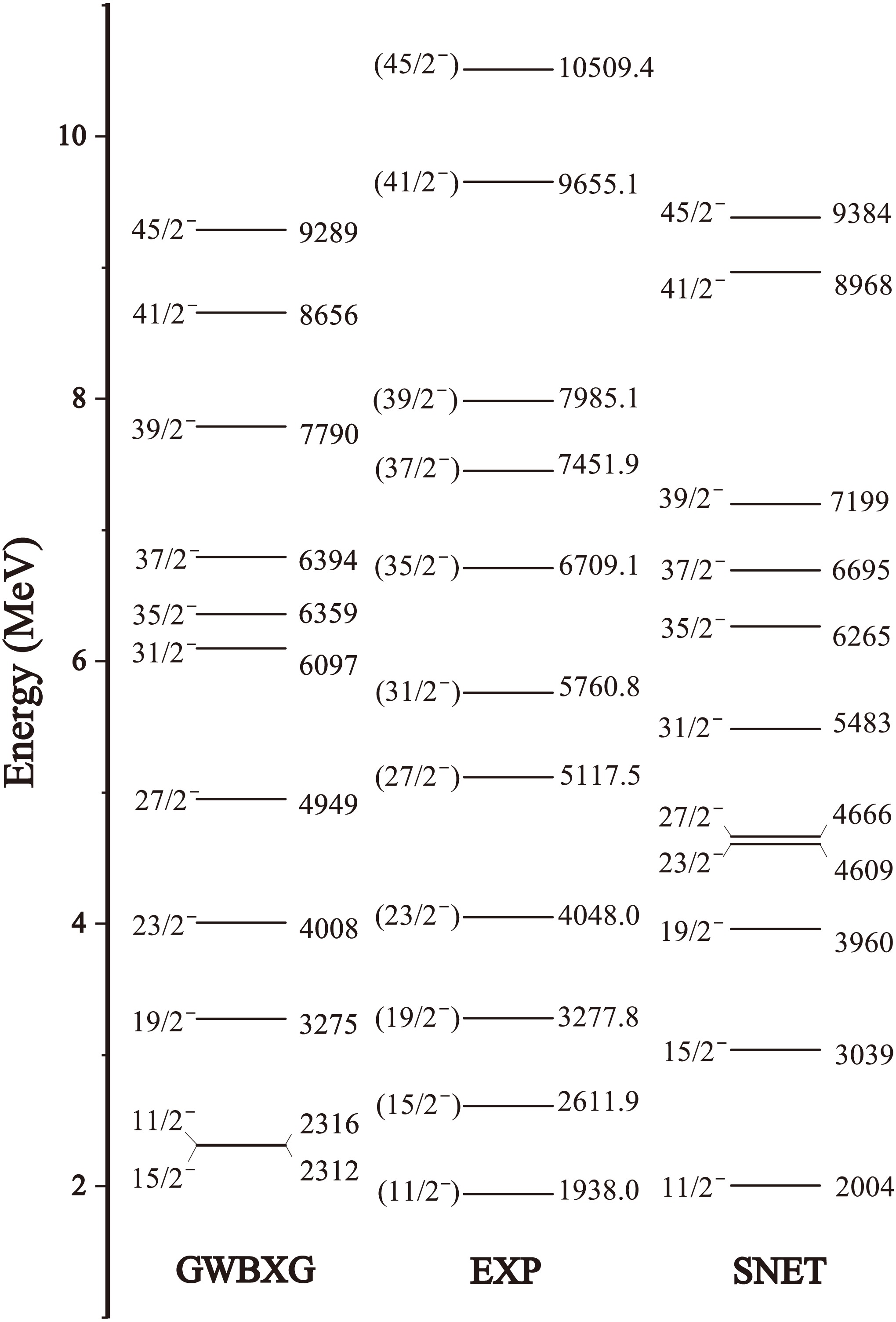
Figure 7. (color online) Comparison of experimental excitation energies in 95Mo (π=−) with shell-model predictions with GWBXG and SNET interactions.
$ I^{\pi} $ /$ \hbar $ $ E_{\mathrm{exp}} $ /keV$ E_{(\mathrm{GWBXG})} $ /keV$ E_{(\mathrm{SNET})} $ /keVWave function $ \pi \otimes \nu $ (GWBXG)Partitions
(GWBXG)Wave function $ \pi \otimes \nu $ (SNET)Partitions
(SNET)5/2+ 0 0 0 6422 $ \otimes $ 030055.8% 6422 $ \otimes $ 0300039.8% 6404 $ \otimes $ 03008.4% 6404 $ \otimes $ 0300012.0% 7/2+ 765.9 323 1114 6422 $ \otimes $ 120028.5% 6422 $ \otimes $ 1200025.1% 6404 $ \otimes $ 120018.4% 6404 $ \otimes $ 1200016.5% $ 9/2^+_1 $ 947.8 1014 1186 6422 $ \otimes $ 030051.8% 6422 $ \otimes $ 0300048.8% 6404 $ \otimes $ 03005.0% 6404 $ \otimes $ 0300013.0% $9/2^+_2 $ 1551.7 1236 1850 6422 $ \otimes $ 120022.8% 6422 $ \otimes $ 0300045.9% 6404 $ \otimes $ 120016.0% 6404 $ \otimes $ 030005.7% 11/2+ 1541.0 1429 2172 6422 $ \otimes $ 120022.1% 6422 $ \otimes $ 1200024.2% 6404 $ \otimes $ 120017.5% 6404 $ \otimes $ 1200014.0% 13/2+ 2058.6 1973 2464 6422 $ \otimes $ 030067.1% 6422 $ \otimes $ 0300041.9% 6422 $ \otimes $ 12003.23% 6422 $ \otimes $ 030009.8% 15/2+ 2232.5 2004 2552 6422 $ \otimes $ 120029.0% 6422 $ \otimes $ 1200038.5% 6404 $ \otimes $ 120015.2% 6404 $ \otimes $ 1200021.7% 17/2+ 2580.3 2482 2809 6422 $ \otimes $ 030069.9% 6422 $ \otimes $ 0300051.2% 6224 $ \otimes $ 03004.2% 6404 $ \otimes $ 030007.8% 19/2+ 2618.0 2359 3013 6422 $ \otimes $ 030076.9% 6422 $ \otimes $ 0300054.6% 6224 $ \otimes $ 03004.5% 6404 $ \otimes $ 030007.4% 21/2+ 2769.5 2757 2921 6422 $ \otimes $ 030070.2% 6422 $ \otimes $ 0300050.7% 6224 $ \otimes $ 03004.7% 6404 $ \otimes $ 030008.4% 23/2+ 4080.3 3329 3977 6422 $ \otimes $ 120050.0% 6422 $ \otimes $ 0201039.8% 6224 $ \otimes $ 120012.8% 6422 $ \otimes $ 0300019.9% $ 25/2^+_1 $ 3672.3 3900 3980 6422 $ \otimes $ 030070.1% 6422 $ \otimes $ 0300064.8% 6422 $ \otimes $ 03004.9% 6404 $ \otimes $ 030008.7% $ 25/2^+_2 $ 3759.6 4285 5022 6422 $ \otimes $ 120051.2% 6422 $ \otimes $ 1200045.6% 6404 $ \otimes $ 12008.0% 6404 $ \otimes $ 1200017.1% $ 27/2^+_1 $ 4649.4 4419 4999 6422 $ \otimes $ 120025.8% 6422 $ \otimes $ 1200045.1% 6404 $ \otimes $ 120020.0% 6404 $ \otimes $ 1200012.9% $ 27/2^+_2 $ 4894.1 4505 5320 6422 $ \otimes $ 120038.2% 6422 $ \otimes $ 1200045.5% 6404 $ \otimes $ 120015.5% 6404 $ \otimes $ 1200023.9% 29/2+ 4851.2 5105 5452 6422 $ \otimes $ 120034.7% 6422 $ \otimes $ 1200056.2% 6404 $ \otimes $ 120017.2% 6404 $ \otimes $ 1200017.1% 31/2+ 5361.6 4653 5185 6422 $ \otimes $ 120073.6% 6422 $ \otimes $ 1200066.2% 6404 $ \otimes $ 12008.1% 6404 $ \otimes $ 1200017.4% 33/2+ 5929.4 6131 6664 6422 $ \otimes $ 210031.1% 6404 $ \otimes $ 2100037.4% 6404 $ \otimes $ 210028.0% 6422 $ \otimes $ 2100036.6% 35/2+ 6327.9 6882 7662 6404 $ \otimes $ 120022.0% 6404 $ \otimes $ 1200054.0% 5414 $ \otimes $ 120020.7% 4424 $ \otimes $ 120009.7% 37/2+ 8425.1 7422 7786 5414 $ \otimes $ 120054.9 6413 $ \otimes $ 0200174.6% 5324 $ \otimes $ 12009.4% 6323 $ \otimes $ 020015.8% 41/2+ 9074.8 8626 8604 6404 $ \otimes $ 210034.2% 6413 $ \otimes $ 0200157.2% 6314 $ \otimes $ 210013.2% 6413 $ \otimes $ 1100110.4% 43/2+ 10077.0 9127 8764 5414 $ \otimes $ 120059.6% 6422 $ \otimes $ 1101086.0% 5324 $ \otimes $ 120023.1% 6323 $ \otimes $ 110013.9% Table 2. Main components of the wave fuctions and their partitions for positive parity states in 95Mo. For
$ \pi\otimes\nu $ , GWBXG represents$ \pi(f_{5/2}p_{3/2}p_{1/2}g_{9/2})\otimes \nu(g_{7/2}d_{5/2}d_{3/2}s_{1/2}) $ . For$ \pi\otimes\nu $ ,SNET represents$ \pi(f_{5/2}p_{3/2}p_{1/2}g_{9/2})\otimes \nu(g_{7 /2}d_{5/2}d_{3/2}s_{1/2}h_{11/2}) $. $ I^{\pi} $ /$ \hbar $ $ E_{\mathrm{exp}} $ /keV$ E_{(\mathrm{GWBXG})} $ /keV$ E_{(\mathrm{SNET})} $ /keVWave function $ \pi \otimes \nu $ (GWBXG)Partitions
(GWBXG)Wave function $ \pi \otimes \nu $ (SNET)Partitions
(SNET)11/2- 1938.0 2316 2004 6413 $ \otimes $ 030049.1% 6422 $ \otimes $ 0200132.3% 5423 $ \otimes $ 030011.6% 6404 $ \otimes $ 0200114.4% 15/2- 2611.9 2312 3039 6413 $ \otimes $ 120054.8% 6422 $ \otimes $ 0200146.2% 5423 $ \otimes $ 120012.3% 6404 $ \otimes $ 0200117.4% 19/2- 3277.8 3275 3960 6413 $ \otimes $ 120031.2% 6422 $ \otimes $ 0200127.9% 5423 $ \otimes $ 120026.5% 6404 $ \otimes $ 0200112.1% 23/2- 4048.0 4008 4609 6413 $ \otimes $ 120048.9% 6422 $ \otimes $ 0200130.3% 5423 $ \otimes $ 120019.0% 6404 $ \otimes $ 020018.3% 27/2- 5117.5 4949 4666 6413 $ \otimes $ 120039.4% 6422 $ \otimes $ 0200144.7% 6323 $ \otimes $ 120022.2% 6404 $ \otimes $ 0200111.4% 31/2- 5760.8 6097 5483 6413 $ \otimes $ 120058.2% 6422 $ \otimes $ 0200166.4% 6323 $ \otimes $ 12008.7% 6404 $ \otimes $ 0200112.5% 35/2- 6709.1 6359 6265 6413 $ \otimes $ 120058.6% 6422 $ \otimes $ 0200159.4% 6323 $ \otimes $ 120025.4% 6404 $ \otimes $ 0200110.7% 37/2- 7451.9 6794 6695 6413 $ \otimes $ 120084.1% 6422 $ \otimes $ 1100156.9% 6323 $ \otimes $ 12003.5% 6404 $ \otimes $ 1100125.1% 39/2- 7985.1 7790 7199 6413 $ \otimes $ 210086.6% 6422 $ \otimes $ 1100153.8% 6215 $ \otimes $ 21003.4% 6404 $ \otimes $ 1100124.2% 41/2- 9655.1 8656 8968 5423 $ \otimes $ 120064.2% 6404 $ \otimes $ 1100165.6% 5405 $ \otimes $ 120015.1% 6314 $ \otimes $ 110016.3% 43/2- 10509.4 9289 9384 5405 $ \otimes $ 210048.0% 6404 $ \otimes $ 1100146.4% 5423 $ \otimes $ 210015.5% 6314 $ \otimes $ 110017.0% Table 3. Similar to Table 2, but for the negative parity states.
For the positive-parity states (Table 2), the two dominant configurations for the ground
$ 5/2^+ $ state, calculated with the GWBXG and SNET interactions, are$ \pi(g_{9/2}^2)\otimes \nu (d_{5/2}^3) $ and$ \pi(g_{9/2}^4)\otimes \nu (d_{5/2}^3) $ , respectively. As shown in Fig. 6 or Table 2, the calculated energies for the$ 7/2^+ $ state, from both the GWBXG and SNET interactions, deviate from the experimental value by approximately 400 keV. However, the GWBXG interaction successfully reproduces the level order relative to the$ 9/2_1^+ $ state; that is, the position of this state is below the$ 9/2_1^+ $ state. When proton excitations from the$ 1f_{5/2} $ orbital are fully restricted, the result obtained based on the GWBXG interaction well reproduces the$ 7/2^+ $ state, with a difference of only 120 keV from the experimental value. As listed in Table 2, the configuration components for the$ 7/2^+ $ state are consistent between the two interactions, with the two dominant configurations being$ \pi(g_{9/2}^2)\otimes \nu (g_{7/2}^1 d_{5/2}^2) $ and$ \pi(g_{9/2}^4)\otimes \nu (g_{7/2}^1 d_{5/2}^2) $ . An analysis of the shell-model output reveals that this state originates primarily from the excitation of a neutron from the$ 2d_{5/2} $ orbital to the$ 1g_{7/2} $ orbital. In other words, the main angular momentum contribution for this state is$ \nu (g_{7/2}^1 d_{5/2}^2)_{7/2^+} $ . For the yrast states from$ 9/2^+ $ to$ 21/2^+ $ , the GWBXG interaction well reproduces their experimental energies, with differences of approximately 200 keV, whereas the SNET interaction overestimates the energies of these states. The dominant configuration components for these states are identical for the two interactions. For the$ 9/2_1^+ $ state, the main configuration is$ \pi(g_{9/2}^2)\otimes \nu (d_{5/2}^3) $ . This state primarily involves a mixture of the angular momentum contributions$ \pi(g_{9/2}^2)_{2^+}\otimes \nu (d_{5/2}^3)_{5/2^+} $ and$ \nu(d_{5/2}^3)_{9/2^+} $ . The$ 11/2^+ $ and$ 15/2^+ $ states exhibit significant configuration mixing, with the highest-weighted configuration being$ \pi(g_{9/2}^2)\otimes \nu(g_{7/2}^1d_{5/2}^2) $ for both. Within this configuration, the main angular momentum contributions for the$ 11/2^+ $ and$ 15/2^+ $ states are$ \nu (g_{7/2}^1d_{5/2}^2)_{11/2^+} $ and$ \nu(g_{7/2}^1d_{5/2}^2)_{15/2^+} $ , respectively. The main configuration for both the$ 13/2^+ $ and$ 17/2^+ $ states is$ \pi(g_{9/2}^2)\otimes \nu (d_{5/2}^3) $ , and the primary angular momentum contributions for these two states are$ \pi(g_{9/2}^2)_{4^+}\otimes \nu (d_{5/2}^3)_{5/2^+} $ and$ \pi(g_{9/2}^2)_{6^+}\otimes \nu (d_{5/2}^3)_{5/2^+} $ , respectively. The main configuration for both the$ 19/2^+ $ and$ 21/2^+ $ states is$ \pi(g_{9/2}^2)_{8^+}\otimes \nu (d_{5/2}^3)_{5/2^+} $ . For the$ 9/2^+_2 $ state, the energy yielded by the GWBXG calculation is approximately 300 keV lower than the experimental value, whereas that obtained from the SNET calculation is approximately 300 keV higher than the experimental value. Considering the placement of this state in the level scheme (i.e., the$ 9/2^+_2 $ state de-excites to the$ 9/2_1^+ $ state via a 603.9-keV γ transition), we infer that its dominant configuration likely differs from that of the$ 9/2_1^+ $ state and is$ \pi(g_{9/2}^2)\otimes \nu(g_{7/2}^1d_{5/2}^2) $ . The main angular momentum contribution for this state is also a mixture of$ \pi(g_{9/2}^2)_{2^+}\otimes \nu (g_{7/1}^1d_{5/2}^2)_{7/2^+} $ and$ \nu(d_{5/2}^3)_{9/2^+} $ . For the newly identified$ 23/2^+ $ state, the SNET interaction well reproduces its energy, whereas the GWBXG interaction underestimates it. The dominant configurations obtained from the two interactions differ: the SNET result yields$ \pi(g_{9/2}^2)\otimes \nu(d_{5/2}^2 s_{1/2}^1) $ , whereas the GWBXG result gives$ \pi(g_{9/2}^2)\otimes \nu(g_{7/2}^1d_{5/2}^2) $ . For the$ 25/2_1^+ $ state, the results from both the GWBXG and SNET interactions differ from the experimental value by approximately 300 keV, and both calculations yield the same dominant configuration$ \pi(g_{9/2}^2)\otimes \nu (d_{5/2}^3) $ . For the newly identified$ 25/2_1^+ $ state, the results obtained from both the interaction calculations show significant deviations from the experimental value. For the two newly identified$ 27/2^+ $ state and the$ 29/2^+ $ state, the GWBXG calculations well reproduce their experimental energies, whereas the SNET results generally exceed the experimental values; the dominant configuration for these three states is$ \pi(g_{9/2}^2)\otimes \nu(g_{7/2}^1d_{5/2}^2) $ . For the$ 31/2^+ $ state and higher, the GWBXG and SNET interaction calculations cannot reproduce the experimental values, with deviations reaching 600 keV.For the negative-parity states (Fig. 7 and Table 3), the energy of the
$ 11/2^{-} $ state, calculated with the SNET interaction, agrees well with the experimental value, deviating by only 66 keV. In contrast, the result obtained with the GWBXG interaction shows a significant discrepancy for this level. This deviation is observed likely because the GWBXG interaction does not include the$ h_{11/2} $ orbital, and thus, the dominant configuration is markedly different from that obtained from the SNET calculation. The dominant configuration for the$ 11/2^{-} $ state, obtained with the SNET interaction, is$ \pi(g_{9/2}^2)_{0^+}\otimes \nu(d_{5/2}^2 h_{11/2}^1)_{11/2^-} $ . Notably, an earlier 94Mo(d,p)95Mo knockout reaction experiment, reported in Ref. [35], in which the angular distribution of the proton spectrum is analyzed, reveals that the single-particle$ h_{11/2} $ strength dominates the 1930-keV level, indicating a substantial$ h_{11/2} $ configuration component in this state. Therefore, the SNET calculation provides a satisfactory description of the$ 11/2^{-} $ state. Furthermore, as mentioned in Sec. I, systematic observations in the neighboring odd-A nuclei of 95Mo with increasing neutron number reveal similar$ 11/2^{-} $ states, followed by$ \Delta I=2 $ rotational-like bands built upon these states [10–16, 36]. For instance, a rotational-like band developed on the$ 11/2^{-} $ state in 97Ru [13] has been interpreted as a decoupled band based on an$ h_{11/2} $ quasineutron configuration. Similarly, neutron$ h_{11/2} $ decoupled bands have been observed in 97,99,101Mo [12]. As illustrated in Fig. 1, a similar rotational-like band appears above the$ 11/2^{-} $ state in 95Mo. This observation suggests that collectivity may emerge above the$ 11/2^- $ state. This could explain why the SNET interaction fails to satisfactorily reproduce the energies of the$ 15/2^{-} $ state and those higher.To further understand the structure of 95Mo, a systematic comparison of the yrast positive-parity low-lying excited states among the
$ N=53 $ isotones 95Mo, 97Ru, and 99Pd is presented in Fig. 8. Notably, the GWBXG and SNET interactions are also employed to calculate the level structures of 97Ru and 99Pd using the same model space truncation scheme as that applied for 95Mo. The results indicate that the dominant configurations for the corresponding states in 97Ru and 99Pd, obtained from the two interactions, are neither identical to each other nor fully consistent with those of 95Mo. The primary discrepancy lies in the competition between the$ \nu (d_{5/2}^3) $ and$ \nu (g_{7/2}^1 d_{5/2}^2) $ configurations. However, for the$ 7/2^+ $ ,$ 11/2^+ $ , and$ 15/2^+ $ yrast states in all the three nuclei, the shell-model results obtained from both the interactions consistently yield the configuration$ \pi(g_{9/2}^n) \otimes \nu (g_{7/2}^1 d_{5/2}^2) $ (where n denotes the number of valence protons relative to the$ Z=40 $ closed shell). This result indicates that these states show identical neutron configurations, namely,$ \nu (g_{7/2}^1 d_{5/2}^2) $ . Indeed, the identity of the neutron configurations across these states is naturally expected according to the rules of angular momentum coupling. From Fig. 8, it is observed that the energy of the$ 7/2^+ $ state systematically decreases with increasing proton number. As discussed previously, the$ 7/2^+ $ state arises primarily from a neutron excitation from the$ 2d_{5/2} $ orbital to the$ 1g_{7/2} $ orbital. The observed decrease in its energy with increasing proton number may be attributed to a reduction in the energy gap between the$ \nu 1g_{7/2} $ and$ \nu 2d_{5/2} $ orbitals; this energy gap reduction is potentially caused by the enhanced interaction between the$ \nu 1g_{7/2} $ and$ \pi 1g_{9/2} $ orbitals due to proton addition. Furthermore, Fig. 8 reveals that the magnitudes of the energy reduction for the$ 11/2^+ $ and$ 15/2^+ $ states with increasing proton number are similar to that of energy of the$ 7/2^+ $ state. The$ 11/2^+ $ and$ 15/2^+ $ states originate from the coupling of a$ \nu g_{7/2} $ neutron to the$ 2^+ $ and$ 4^+ $ states of the adjacent even-even core nuclei, respectively. Notably, the$ 2^+_1 $ and$ 4^+_1 $ level energies of the adjacent even-even core nuclei— 94Mo [9], 96Ru [13], and 98Pd [38]—are similar; that is, the energy of the$ \nu g_{7/2} $ single-particle orbital likely decreases progressively with proton addition.As discussed earlier, the
$ 9/2^+ $ ,$ 13/2^+ $ ,$ 17/2^+ $ , and$ 19/2^+ $ states in 95Mo, as calculated by the shell model, are primarily formed by coupling$ \nu (d_{5/2}^3)_{5/2^+} $ with the$ g_{9/2}^2 $ proton pairs having angular momenta of$ 2^+ $ ,$ 4^+ $ ,$ 6^+ $ , and$ 8^+ $ , respectively. Notably, for a system with a semi-magic neutron core, the$ 2^+ $ ,$ 4^+ $ ,$ 6^+ $ , and$ 8^+ $ states, formed by two protons in the$ g_{9/2} $ orbital, follow a seniority scheme [1, 7, 39]. For 95Mo, 97Ru, and 99Pd, which have three valence neutrons, a seniority scheme is not realized. However, the underlying structure may still involve seniority conservation. For instance, the$ 21/2^+ $ state in 97Ru is an isomeric state with a lifetime of 7.8 ns [40], likely due to its significant$ (g_{9/2}^4)_{8^+} $ proton configuration component. Shell-model calculations using the GWBXG interaction confirm such a configuration for the$ 21/2^+ $ state, whereas the$ 19/2^+ $ state exhibits a dominant$ (g_{9/2}^4)_{6^+} $ proton configuration. Similar results are obtained for 99Pd. In contrast, for 95Mo, as mentioned before, the shell-model calculations indicate that the dominant proton configurations for the$ 19/2^+ $ and$ 17/2^+ $ states are$ (g_{9/2}^2)_{8^+} $ and$ (g_{9/2}^2)_{6^+} $ , respectively. As shown in Fig. 8, the energy spacings among the$ 17/2^+ $ ,$ 19/2^+ $ , and$ 21/2^+ $ states in 97Ru and 99Pd exhibit similar evolution patterns, i.e., relatively small energy gaps are observed between the$ 19/2^+ $ and$ 21/2^+ $ states, differing from the pattern observed in 95Mo. Notably, the dominant neutron configuration of the$ 19/2^+ $ state in 95Mo is$ \nu (d_{5/2}^3) $ , which differs from the$ \nu (g_{7/2}^1 d_{5/2}^2) $ configuration calculated for 97Ru and 99Pd using the GWBXG interaction. -
To account for the partial level structure observed experimentally in 95Mo, shell-model calculations are performed using the NuShellX code [32]. For a more comprehensive analysis of the level structure of this nucleus, two effective interactions, GWBXG [33] and SNET [34], are employed in the calculations. For the GWBXG interaction, the model space comprises the four proton orbitals
$ 1f_{5/2} $ ,$ 2p_{3/2} $ ,$ 2p_{1/2} $ , and$ 1g_{9/2} $ and the six neutron orbitals$ 2p_{1/2} $ ,$ 1g_{9/2} $ ,$ 1g_{7/2} $ ,$ 2d_{5/2} $ ,$ 2d_{3/2} $ , and$ 3s_{1/2} $ . The model space for the SNET interaction is larger than that for GWBXG: the proton sector additionally includes the$ 1g_{7/2} $ ,$ 2d_{5/2} $ ,$ 2d_{3/2} $ , and$ 3s_{1/2} $ orbitals above the$ Z=50 $ closed shell, whereas the neutron sector includes the$ 1f_{5/2} $ ,$ 2p_{1/2} $ orbitals above the$ N=28 $ closed shell and the$ 1h_{11/2} $ orbital above the$ N=50 $ closed shell. To obtain reasonable caculation results within accpetable time periods, space truncation is applied in the present calculations. Specifically, for the GWBXG model space, proton excitations are confined within the$ 1f_{5/2} $ ,$ 2p_{3/2} $ ,$ 2p_{1/2} $ , and$ 1g_{9/2} $ orbitals, allowing a maximum of two proton excitations from the$ 1f_{5/2} $ orbital; neutron excitations are restricted to the$ 1g_{7/2} $ ,$ 2d_{5/2} $ ,$ 2d_{3/2} $ , and$ 3s_{1/2} $ orbitals above the$ N=50 $ core. To facilitate a comparison focusing on the influence of the$ 1h_{11/2} $ orbital within the SNET interaction, we ensure that the allowed single-particle excitations remain identical to those for the GWBXG interaction, except that one neutron is permitted to occupy the$ 1h_{11/2} $ orbital. The levels calculatedbased on the two interactions are compared with the experimental data, and the results are shown in Figs. 6 and 7. The calculated energies, their corresponding experimental values, and the resulting configuration information are listed in Tables 2 and 3. As evident from Figs. 6 and 7 and Tables 2 and 3, the results obtained with the GWBXG interaction satisfactorily reproduce most of the lower-lying positive-parity states. In contrast, the SNET interaction generally overestimates the energies of the positive-parity levels; it provides a reasonable description for the low-lying negative-parity states, whereas it underestimates the energies of the higher-lying negative-parity levels. The results of the shell-model calculations are briefly discussed in the following.
Figure 6. (color online) Comparison of experimental excitation energies in 95Mo (π=+) with shell-model predictions with GWBXG and SNET interactions.
Figure 7. (color online) Comparison of experimental excitation energies in 95Mo (π=−) with shell-model predictions with GWBXG and SNET interactions.
$ I^{\pi} $ /$ \hbar $ $ E_{\mathrm{exp}} $ /keV$ E_{(\mathrm{GWBXG})} $ /keV$ E_{(\mathrm{SNET})} $ /keVWave function $ \pi \otimes \nu $ (GWBXG)Partitions
(GWBXG)Wave function $ \pi \otimes \nu $ (SNET)Partitions
(SNET)5/2+ 0 0 0 6422 $ \otimes $ 030055.8% 6422 $ \otimes $ 0300039.8% 6404 $ \otimes $ 03008.4% 6404 $ \otimes $ 0300012.0% 7/2+ 765.9 323 1114 6422 $ \otimes $ 120028.5% 6422 $ \otimes $ 1200025.1% 6404 $ \otimes $ 120018.4% 6404 $ \otimes $ 1200016.5% $ 9/2^+_1 $ 947.8 1014 1186 6422 $ \otimes $ 030051.8% 6422 $ \otimes $ 0300048.8% 6404 $ \otimes $ 03005.0% 6404 $ \otimes $ 0300013.0% $9/2^+_2 $ 1551.7 1236 1850 6422 $ \otimes $ 120022.8% 6422 $ \otimes $ 0300045.9% 6404 $ \otimes $ 120016.0% 6404 $ \otimes $ 030005.7% 11/2+ 1541.0 1429 2172 6422 $ \otimes $ 120022.1% 6422 $ \otimes $ 1200024.2% 6404 $ \otimes $ 120017.5% 6404 $ \otimes $ 1200014.0% 13/2+ 2058.6 1973 2464 6422 $ \otimes $ 030067.1% 6422 $ \otimes $ 0300041.9% 6422 $ \otimes $ 12003.23% 6422 $ \otimes $ 030009.8% 15/2+ 2232.5 2004 2552 6422 $ \otimes $ 120029.0% 6422 $ \otimes $ 1200038.5% 6404 $ \otimes $ 120015.2% 6404 $ \otimes $ 1200021.7% 17/2+ 2580.3 2482 2809 6422 $ \otimes $ 030069.9% 6422 $ \otimes $ 0300051.2% 6224 $ \otimes $ 03004.2% 6404 $ \otimes $ 030007.8% 19/2+ 2618.0 2359 3013 6422 $ \otimes $ 030076.9% 6422 $ \otimes $ 0300054.6% 6224 $ \otimes $ 03004.5% 6404 $ \otimes $ 030007.4% 21/2+ 2769.5 2757 2921 6422 $ \otimes $ 030070.2% 6422 $ \otimes $ 0300050.7% 6224 $ \otimes $ 03004.7% 6404 $ \otimes $ 030008.4% 23/2+ 4080.3 3329 3977 6422 $ \otimes $ 120050.0% 6422 $ \otimes $ 0201039.8% 6224 $ \otimes $ 120012.8% 6422 $ \otimes $ 0300019.9% $ 25/2^+_1 $ 3672.3 3900 3980 6422 $ \otimes $ 030070.1% 6422 $ \otimes $ 0300064.8% 6422 $ \otimes $ 03004.9% 6404 $ \otimes $ 030008.7% $ 25/2^+_2 $ 3759.6 4285 5022 6422 $ \otimes $ 120051.2% 6422 $ \otimes $ 1200045.6% 6404 $ \otimes $ 12008.0% 6404 $ \otimes $ 1200017.1% $ 27/2^+_1 $ 4649.4 4419 4999 6422 $ \otimes $ 120025.8% 6422 $ \otimes $ 1200045.1% 6404 $ \otimes $ 120020.0% 6404 $ \otimes $ 1200012.9% $ 27/2^+_2 $ 4894.1 4505 5320 6422 $ \otimes $ 120038.2% 6422 $ \otimes $ 1200045.5% 6404 $ \otimes $ 120015.5% 6404 $ \otimes $ 1200023.9% 29/2+ 4851.2 5105 5452 6422 $ \otimes $ 120034.7% 6422 $ \otimes $ 1200056.2% 6404 $ \otimes $ 120017.2% 6404 $ \otimes $ 1200017.1% 31/2+ 5361.6 4653 5185 6422 $ \otimes $ 120073.6% 6422 $ \otimes $ 1200066.2% 6404 $ \otimes $ 12008.1% 6404 $ \otimes $ 1200017.4% 33/2+ 5929.4 6131 6664 6422 $ \otimes $ 210031.1% 6404 $ \otimes $ 2100037.4% 6404 $ \otimes $ 210028.0% 6422 $ \otimes $ 2100036.6% 35/2+ 6327.9 6882 7662 6404 $ \otimes $ 120022.0% 6404 $ \otimes $ 1200054.0% 5414 $ \otimes $ 120020.7% 4424 $ \otimes $ 120009.7% 37/2+ 8425.1 7422 7786 5414 $ \otimes $ 120054.9 6413 $ \otimes $ 0200174.6% 5324 $ \otimes $ 12009.4% 6323 $ \otimes $ 020015.8% 41/2+ 9074.8 8626 8604 6404 $ \otimes $ 210034.2% 6413 $ \otimes $ 0200157.2% 6314 $ \otimes $ 210013.2% 6413 $ \otimes $ 1100110.4% 43/2+ 10077.0 9127 8764 5414 $ \otimes $ 120059.6% 6422 $ \otimes $ 1101086.0% 5324 $ \otimes $ 120023.1% 6323 $ \otimes $ 110013.9% Table 2. Main components of the wave fuctions and their partitions for positive parity states in 95Mo. For
$ \pi\otimes\nu $ , GWBXG represents$ \pi(f_{5/2}p_{3/2}p_{1/2}g_{9/2})\otimes \nu(g_{7/2}d_{5/2}d_{3/2}s_{1/2}) $ . For$ \pi\otimes\nu $ ,SNET represents$ \pi(f_{5/2}p_{3/2}p_{1/2}g_{9/2})\otimes \nu(g_{7 /2}d_{5/2}d_{3/2}s_{1/2}h_{11/2}) $. $ I^{\pi} $ /$ \hbar $ $ E_{\mathrm{exp}} $ /keV$ E_{(\mathrm{GWBXG})} $ /keV$ E_{(\mathrm{SNET})} $ /keVWave function $ \pi \otimes \nu $ (GWBXG)Partitions
(GWBXG)Wave function $ \pi \otimes \nu $ (SNET)Partitions
(SNET)11/2- 1938.0 2316 2004 6413 $ \otimes $ 030049.1% 6422 $ \otimes $ 0200132.3% 5423 $ \otimes $ 030011.6% 6404 $ \otimes $ 0200114.4% 15/2- 2611.9 2312 3039 6413 $ \otimes $ 120054.8% 6422 $ \otimes $ 0200146.2% 5423 $ \otimes $ 120012.3% 6404 $ \otimes $ 0200117.4% 19/2- 3277.8 3275 3960 6413 $ \otimes $ 120031.2% 6422 $ \otimes $ 0200127.9% 5423 $ \otimes $ 120026.5% 6404 $ \otimes $ 0200112.1% 23/2- 4048.0 4008 4609 6413 $ \otimes $ 120048.9% 6422 $ \otimes $ 0200130.3% 5423 $ \otimes $ 120019.0% 6404 $ \otimes $ 020018.3% 27/2- 5117.5 4949 4666 6413 $ \otimes $ 120039.4% 6422 $ \otimes $ 0200144.7% 6323 $ \otimes $ 120022.2% 6404 $ \otimes $ 0200111.4% 31/2- 5760.8 6097 5483 6413 $ \otimes $ 120058.2% 6422 $ \otimes $ 0200166.4% 6323 $ \otimes $ 12008.7% 6404 $ \otimes $ 0200112.5% 35/2- 6709.1 6359 6265 6413 $ \otimes $ 120058.6% 6422 $ \otimes $ 0200159.4% 6323 $ \otimes $ 120025.4% 6404 $ \otimes $ 0200110.7% 37/2- 7451.9 6794 6695 6413 $ \otimes $ 120084.1% 6422 $ \otimes $ 1100156.9% 6323 $ \otimes $ 12003.5% 6404 $ \otimes $ 1100125.1% 39/2- 7985.1 7790 7199 6413 $ \otimes $ 210086.6% 6422 $ \otimes $ 1100153.8% 6215 $ \otimes $ 21003.4% 6404 $ \otimes $ 1100124.2% 41/2- 9655.1 8656 8968 5423 $ \otimes $ 120064.2% 6404 $ \otimes $ 1100165.6% 5405 $ \otimes $ 120015.1% 6314 $ \otimes $ 110016.3% 43/2- 10509.4 9289 9384 5405 $ \otimes $ 210048.0% 6404 $ \otimes $ 1100146.4% 5423 $ \otimes $ 210015.5% 6314 $ \otimes $ 110017.0% Table 3. Similar to Table 2, but for the negative parity states.
For the positive-parity states (Table 2), the two dominant configurations for the ground
$ 5/2^+ $ state, calculated with the GWBXG and SNET interactions, are$ \pi(g_{9/2}^2)\otimes \nu (d_{5/2}^3) $ and$ \pi(g_{9/2}^4)\otimes \nu (d_{5/2}^3) $ , respectively. As shown in Fig. 6 or Table 2, the calculated energies for the$ 7/2^+ $ state, from both the GWBXG and SNET interactions, deviate from the experimental value by approximately 400 keV. However, the GWBXG interaction successfully reproduces the level order relative to the$ 9/2_1^+ $ state; that is, the position of this state is below the$ 9/2_1^+ $ state. When proton excitations from the$ 1f_{5/2} $ orbital are fully restricted, the result obtained based on the GWBXG interaction well reproduces the$ 7/2^+ $ state, with a difference of only 120 keV from the experimental value. As listed in Table 2, the configuration components for the$ 7/2^+ $ state are consistent between the two interactions, with the two dominant configurations being$ \pi(g_{9/2}^2)\otimes \nu (g_{7/2}^1 d_{5/2}^2) $ and$ \pi(g_{9/2}^4)\otimes \nu (g_{7/2}^1 d_{5/2}^2) $ . An analysis of the shell-model output reveals that this state originates primarily from the excitation of a neutron from the$ 2d_{5/2} $ orbital to the$ 1g_{7/2} $ orbital. In other words, the main angular momentum contribution for this state is$ \nu (g_{7/2}^1 d_{5/2}^2)_{7/2^+} $ . For the yrast states from$ 9/2^+ $ to$ 21/2^+ $ , the GWBXG interaction well reproduces their experimental energies, with differences of approximately 200 keV, whereas the SNET interaction overestimates the energies of these states. The dominant configuration components for these states are identical for the two interactions. For the$ 9/2_1^+ $ state, the main configuration is$ \pi(g_{9/2}^2)\otimes \nu (d_{5/2}^3) $ . This state primarily involves a mixture of the angular momentum contributions$ \pi(g_{9/2}^2)_{2^+}\otimes \nu (d_{5/2}^3)_{5/2^+} $ and$ \nu(d_{5/2}^3)_{9/2^+} $ . The$ 11/2^+ $ and$ 15/2^+ $ states exhibit significant configuration mixing, with the highest-weighted configuration being$ \pi(g_{9/2}^2)\otimes \nu(g_{7/2}^1d_{5/2}^2) $ for both. Within this configuration, the main angular momentum contributions for the$ 11/2^+ $ and$ 15/2^+ $ states are$ \nu (g_{7/2}^1d_{5/2}^2)_{11/2^+} $ and$ \nu(g_{7/2}^1d_{5/2}^2)_{15/2^+} $ , respectively. The main configuration for both the$ 13/2^+ $ and$ 17/2^+ $ states is$ \pi(g_{9/2}^2)\otimes \nu (d_{5/2}^3) $ , and the primary angular momentum contributions for these two states are$ \pi(g_{9/2}^2)_{4^+}\otimes \nu (d_{5/2}^3)_{5/2^+} $ and$ \pi(g_{9/2}^2)_{6^+}\otimes \nu (d_{5/2}^3)_{5/2^+} $ , respectively. The main configuration for both the$ 19/2^+ $ and$ 21/2^+ $ states is$ \pi(g_{9/2}^2)_{8^+}\otimes \nu (d_{5/2}^3)_{5/2^+} $ . For the$ 9/2^+_2 $ state, the energy yielded by the GWBXG calculation is approximately 300 keV lower than the experimental value, whereas that obtained from the SNET calculation is approximately 300 keV higher than the experimental value. Considering the placement of this state in the level scheme (i.e., the$ 9/2^+_2 $ state de-excites to the$ 9/2_1^+ $ state via a 603.9-keV γ transition), we infer that its dominant configuration likely differs from that of the$ 9/2_1^+ $ state and is$ \pi(g_{9/2}^2)\otimes \nu(g_{7/2}^1d_{5/2}^2) $ . The main angular momentum contribution for this state is also a mixture of$ \pi(g_{9/2}^2)_{2^+}\otimes \nu (g_{7/1}^1d_{5/2}^2)_{7/2^+} $ and$ \nu(d_{5/2}^3)_{9/2^+} $ . For the newly identified$ 23/2^+ $ state, the SNET interaction well reproduces its energy, whereas the GWBXG interaction underestimates it. The dominant configurations obtained from the two interactions differ: the SNET result yields$ \pi(g_{9/2}^2)\otimes \nu(d_{5/2}^2 s_{1/2}^1) $ , whereas the GWBXG result gives$ \pi(g_{9/2}^2)\otimes \nu(g_{7/2}^1d_{5/2}^2) $ . For the$ 25/2_1^+ $ state, the results from both the GWBXG and SNET interactions differ from the experimental value by approximately 300 keV, and both calculations yield the same dominant configuration$ \pi(g_{9/2}^2)\otimes \nu (d_{5/2}^3) $ . For the newly identified$ 25/2_1^+ $ state, the results obtained from both the interaction calculations show significant deviations from the experimental value. For the two newly identified$ 27/2^+ $ state and the$ 29/2^+ $ state, the GWBXG calculations well reproduce their experimental energies, whereas the SNET results generally exceed the experimental values; the dominant configuration for these three states is$ \pi(g_{9/2}^2)\otimes \nu(g_{7/2}^1d_{5/2}^2) $ . For the$ 31/2^+ $ state and higher, the GWBXG and SNET interaction calculations cannot reproduce the experimental values, with deviations reaching 600 keV.For the negative-parity states (Fig. 7 and Table 3), the energy of the
$ 11/2^{-} $ state, calculated with the SNET interaction, agrees well with the experimental value, deviating by only 66 keV. In contrast, the result obtained with the GWBXG interaction shows a significant discrepancy for this level. This deviation is observed likely because the GWBXG interaction does not include the$ h_{11/2} $ orbital, and thus, the dominant configuration is markedly different from that obtained from the SNET calculation. The dominant configuration for the$ 11/2^{-} $ state, obtained with the SNET interaction, is$ \pi(g_{9/2}^2)_{0^+}\otimes \nu(d_{5/2}^2 h_{11/2}^1)_{11/2^-} $ . Notably, an earlier 94Mo(d,p)95Mo knockout reaction experiment, reported in Ref. [35], in which the angular distribution of the proton spectrum is analyzed, reveals that the single-particle$ h_{11/2} $ strength dominates the 1930-keV level, indicating a substantial$ h_{11/2} $ configuration component in this state. Therefore, the SNET calculation provides a satisfactory description of the$ 11/2^{-} $ state. Furthermore, as mentioned in Sec. I, systematic observations in the neighboring odd-A nuclei of 95Mo with increasing neutron number reveal similar$ 11/2^{-} $ states, followed by$ \Delta I=2 $ rotational-like bands built upon these states [10–16, 36]. For instance, a rotational-like band developed on the$ 11/2^{-} $ state in 97Ru [13] has been interpreted as a decoupled band based on an$ h_{11/2} $ quasineutron configuration. Similarly, neutron$ h_{11/2} $ decoupled bands have been observed in 97,99,101Mo [12]. As illustrated in Fig. 1, a similar rotational-like band appears above the$ 11/2^{-} $ state in 95Mo. This observation suggests that collectivity may emerge above the$ 11/2^- $ state. This could explain why the SNET interaction fails to satisfactorily reproduce the energies of the$ 15/2^{-} $ state and those higher.To further understand the structure of 95Mo, a systematic comparison of the yrast positive-parity low-lying excited states among the
$ N=53 $ isotones 95Mo, 97Ru, and 99Pd is presented in Fig. 8. Notably, the GWBXG and SNET interactions are also employed to calculate the level structures of 97Ru and 99Pd using the same model space truncation scheme as that applied for 95Mo. The results indicate that the dominant configurations for the corresponding states in 97Ru and 99Pd, obtained from the two interactions, are neither identical to each other nor fully consistent with those of 95Mo. The primary discrepancy lies in the competition between the$ \nu (d_{5/2}^3) $ and$ \nu (g_{7/2}^1 d_{5/2}^2) $ configurations. However, for the$ 7/2^+ $ ,$ 11/2^+ $ , and$ 15/2^+ $ yrast states in all the three nuclei, the shell-model results obtained from both the interactions consistently yield the configuration$ \pi(g_{9/2}^n) \otimes \nu (g_{7/2}^1 d_{5/2}^2) $ (where n denotes the number of valence protons relative to the$ Z=40 $ closed shell). This result indicates that these states show identical neutron configurations, namely,$ \nu (g_{7/2}^1 d_{5/2}^2) $ . Indeed, the identity of the neutron configurations across these states is naturally expected according to the rules of angular momentum coupling. From Fig. 8, it is observed that the energy of the$ 7/2^+ $ state systematically decreases with increasing proton number. As discussed previously, the$ 7/2^+ $ state arises primarily from a neutron excitation from the$ 2d_{5/2} $ orbital to the$ 1g_{7/2} $ orbital. The observed decrease in its energy with increasing proton number may be attributed to a reduction in the energy gap between the$ \nu 1g_{7/2} $ and$ \nu 2d_{5/2} $ orbitals; this energy gap reduction is potentially caused by the enhanced interaction between the$ \nu 1g_{7/2} $ and$ \pi 1g_{9/2} $ orbitals due to proton addition. Furthermore, Fig. 8 reveals that the magnitudes of the energy reduction for the$ 11/2^+ $ and$ 15/2^+ $ states with increasing proton number are similar to that of energy of the$ 7/2^+ $ state. The$ 11/2^+ $ and$ 15/2^+ $ states originate from the coupling of a$ \nu g_{7/2} $ neutron to the$ 2^+ $ and$ 4^+ $ states of the adjacent even-even core nuclei, respectively. Notably, the$ 2^+_1 $ and$ 4^+_1 $ level energies of the adjacent even-even core nuclei— 94Mo [9], 96Ru [13], and 98Pd [38]—are similar; that is, the energy of the$ \nu g_{7/2} $ single-particle orbital likely decreases progressively with proton addition.As discussed earlier, the
$ 9/2^+ $ ,$ 13/2^+ $ ,$ 17/2^+ $ , and$ 19/2^+ $ states in 95Mo, as calculated by the shell model, are primarily formed by coupling$ \nu (d_{5/2}^3)_{5/2^+} $ with the$ g_{9/2}^2 $ proton pairs having angular momenta of$ 2^+ $ ,$ 4^+ $ ,$ 6^+ $ , and$ 8^+ $ , respectively. Notably, for a system with a semi-magic neutron core, the$ 2^+ $ ,$ 4^+ $ ,$ 6^+ $ , and$ 8^+ $ states, formed by two protons in the$ g_{9/2} $ orbital, follow a seniority scheme [1, 7, 39]. For 95Mo, 97Ru, and 99Pd, which have three valence neutrons, a seniority scheme is not realized. However, the underlying structure may still involve seniority conservation. For instance, the$ 21/2^+ $ state in 97Ru is an isomeric state with a lifetime of 7.8 ns [40], likely due to its significant$ (g_{9/2}^4)_{8^+} $ proton configuration component. Shell-model calculations using the GWBXG interaction confirm such a configuration for the$ 21/2^+ $ state, whereas the$ 19/2^+ $ state exhibits a dominant$ (g_{9/2}^4)_{6^+} $ proton configuration. Similar results are obtained for 99Pd. In contrast, for 95Mo, as mentioned before, the shell-model calculations indicate that the dominant proton configurations for the$ 19/2^+ $ and$ 17/2^+ $ states are$ (g_{9/2}^2)_{8^+} $ and$ (g_{9/2}^2)_{6^+} $ , respectively. As shown in Fig. 8, the energy spacings among the$ 17/2^+ $ ,$ 19/2^+ $ , and$ 21/2^+ $ states in 97Ru and 99Pd exhibit similar evolution patterns, i.e., relatively small energy gaps are observed between the$ 19/2^+ $ and$ 21/2^+ $ states, differing from the pattern observed in 95Mo. Notably, the dominant neutron configuration of the$ 19/2^+ $ state in 95Mo is$ \nu (d_{5/2}^3) $ , which differs from the$ \nu (g_{7/2}^1 d_{5/2}^2) $ configuration calculated for 97Ru and 99Pd using the GWBXG interaction. -
To account for the partial level structure observed experimentally in 95Mo, shell-model calculations were performed using the NuShellX code [32]. For a more comprehensive understanding of the level structure of this nucleus, two effective interactions, GWBXG [33] and SNET [34], were employed in the calculations. For the GWBXG interaction, the model space comprises the four proton orbitals
$ 1f_{5/2} $ ,$ 2p_{3/2} $ ,$ 2p_{1/2} $ ,$ 1g_{9/2} $ and the six neutron orbitals$ 2p_{1/2} $ ,$ 1g_{9/2} $ ,$ 1g_{7/2} $ ,$ 2d_{5/2} $ ,$ 2d_{3/2} $ ,$ 3s_{1/2} $ . The model space for the SNET interaction is larger than that for GWBXG: the proton sector additionally includes the$ 1g_{7/2} $ ,$ 2d_{5/2} $ ,$ 2d_{3/2} $ , and$ 3s_{1/2} $ orbitals above the$ Z=50 $ closed shell, while the neutron sector includes the$ 1f_{5/2} $ ,$ 2p_{1/2} $ orbitals above the$ N=28 $ closed shell and the$ 1h_{11/2} $ orbital above the$ N=50 $ closed shell. To obtain reasonable caculated results within accpetable time periods, a space truncation was applied in the present calculations. Specifically, for the GWBXG model space, proton excitations were confined within the$ 1f_{5/2} $ ,$ 2p_{3/2} $ ,$ 2p_{1/2} $ ,$ 1g_{9/2} $ orbitals, allowing a maximum of two proton excitations from the$ 1f_{5/2} $ orbital; neutron excitations were restricted to the$ 1g_{7/2} $ ,$ 2d_{5/2} $ ,$ 2d_{3/2} $ ,$ 3s_{1/2} $ orbitals above the$ N=50 $ core. To facilitate a comparison focusing on the influence of the$ 1h_{11/2} $ orbital within the SNET interaction, the allowed single-particle excitations were kept identical to those for the GWBXG interaction, except that one neutron was permitted to occupy the$ 1h_{11/2} $ orbital. The calculated levels based on the two interactions are compared with the experimental data in Figs. 6 and 7. The calculated energies, their corresponding experimental values, and the resulting configuration information are listed in Tables 2 and 3. As can be seen from Figs. 6 and 7 and Tables 2 and 3, the results obtained with the GWBXG interaction satisfactorily reproduce most of the lower-lying positive-parity states. In contrast, the SNET interaction generally overestimates the energies of the positive-parity levels; it provides a reasonable description for the low-lying negative-parity states but underestimates the energies of the higher-lying negative-parity levels. The results of the shell-model calculations will be briefly discussed in the following.
Figure 6. (color online) Comparison of experimental excitation energies in 95Mo (π=+) with shell-model predictions with GWBXG and SNET interaction.
Figure 7. (color online) Comparison of experimental excitation energies in 95Mo (π=-) with shell-model predictions with GWBXG and SNET interaction.
$ I^{\pi} $ $ \hbar $ $ E_{exp} $
-keV$ E_{(GWBXG)} $
-keV$ E_{(SNET)} $
-keVWave function $ \pi \otimes \nu $ (GWBXG)Partitions
(GWBXG)Wave function $ \pi \otimes \nu $ (SNET)Partitions
(SNET)5/2+ 0 0 0 6422 $ \otimes $ 030055.8% 6422 $ \otimes $ 0300039.8% 6404 $ \otimes $ 03008.4% 6404 $ \otimes $ 0300012.0% 7/2+ 765.9 323 1114 6422 $ \otimes $ 120028.5% 6422 $ \otimes $ 1200025.1% 6404 $ \otimes $ 120018.4% 6404 $ \otimes $ 1200016.5% $ 9/2^+_1 $ 947.8 1014 1186 6422 $ \otimes $ 030051.8% 6422 $ \otimes $ 0300048.8% 6404 $ \otimes $ 03005.0% 6404 $ \otimes $ 0300013.0% $9/2^+_2 $ 1551.7 1236 1850 6422 $ \otimes $ 120022.8% 6422 $ \otimes $ 0300045.9% 6404 $ \otimes $ 120016.0% 6404 $ \otimes $ 030005.7% 11/2+ 1541.0 1429 2172 6422 $ \otimes $ 120022.1% 6422 $ \otimes $ 1200024.2% 6404 $ \otimes $ 120017.5% 6404 $ \otimes $ 1200014.0% 13/2+ 2058.6 1973 2464 6422 $ \otimes $ 030067.1% 6422 $ \otimes $ 0300041.9% 6422 $ \otimes $ 12003.23% 6422 $ \otimes $ 030009.8% 15/2+ 2232.5 2004 2552 6422 $ \otimes $ 120029.0% 6422 $ \otimes $ 1200038.5% 6404 $ \otimes $ 120015.2% 6404 $ \otimes $ 1200021.7% 17/2+ 2580.3 2482 2809 6422 $ \otimes $ 030069.9% 6422 $ \otimes $ 0300051.2% 6224 $ \otimes $ 03004.2% 6404 $ \otimes $ 030007.8% 19/2+ 2618.0 2359 3013 6422 $ \otimes $ 030076.9% 6422 $ \otimes $ 0300054.6% 6224 $ \otimes $ 03004.5% 6404 $ \otimes $ 030007.4% 21/2+ 2769.5 2757 2921 6422 $ \otimes $ 030070.2% 6422 $ \otimes $ 0300050.7% 6224 $ \otimes $ 03004.7% 6404 $ \otimes $ 030008.4% 23/2+ 4080.3 3329 3977 6422 $ \otimes $ 120050.0% 6422 $ \otimes $ 0201039.8% 6224 $ \otimes $ 120012.8% 6422 $ \otimes $ 0300019.9% $ 25/2^+_1 $ 3672.3 3900 3980 6422 $ \otimes $ 030070.1% 6422 $ \otimes $ 0300064.8% 6422 $ \otimes $ 03004.9% 6404 $ \otimes $ 030008.7% $ 25/2^+_2 $ 3759.6 4285 5022 6422 $ \otimes $ 120051.2% 6422 $ \otimes $ 1200045.6% 6404 $ \otimes $ 12008.0% 6404 $ \otimes $ 1200017.1% $ 27/2^+_1 $ 4649.4 4419 4999 6422 $ \otimes $ 120025.8% 6422 $ \otimes $ 1200045.1% 6404 $ \otimes $ 120020.0% 6404 $ \otimes $ 1200012.9% $ 27/2^+_2 $ 4894.1 4505 5320 6422 $ \otimes $ 120038.2% 6422 $ \otimes $ 1200045.5% 6404 $ \otimes $ 120015.5% 6404 $ \otimes $ 1200023.9% 29/2+ 4851.2 5105 5452 6422 $ \otimes $ 120034.7% 6422 $ \otimes $ 1200056.2% 6404 $ \otimes $ 120017.2% 6404 $ \otimes $ 1200017.1% 31/2+ 5361.6 4653 5185 6422 $ \otimes $ 120073.6% 6422 $ \otimes $ 1200066.2% 6404 $ \otimes $ 12008.1% 6404 $ \otimes $ 1200017.4% 33/2+ 5929.4 6131 6664 6422 $ \otimes $ 210031.1% 6404 $ \otimes $ 2100037.4% 6404 $ \otimes $ 210028.0% 6422 $ \otimes $ 2100036.6% 35/2+ 6327.9 6882 7662 6404 $ \otimes $ 120022.0% 6404 $ \otimes $ 1200054.0% 5414 $ \otimes $ 120020.7% 4424 $ \otimes $ 120009.7% 37/2+ 8425.1 7422 7786 5414 $ \otimes $ 120054.9 6413 $ \otimes $ 0200174.6% 5324 $ \otimes $ 12009.4% 6323 $ \otimes $ 020015.8% 41/2+ 9074.8 8626 8604 6404 $ \otimes $ 210034.2% 6413 $ \otimes $ 0200157.2% 6314 $ \otimes $ 210013.2% 6413 $ \otimes $ 1100110.4% 43/2+ 10077.0 9127 8764 5414 $ \otimes $ 120059.6% 6422 $ \otimes $ 1101086.0% 5324 $ \otimes $ 120023.1% 6323 $ \otimes $ 110013.9% Table 2. Main components of the wave fuctions and their partitions for positive parity states in 95Mo. For
$ \pi\otimes\nu $ (GWBXG) represents$ \pi(f_{5/2}p_{3/2}p_{1/2}g_{9/2})\otimes \nu(g_{7/2}d_{5/2}d_{3/2}s_{1/2}) $ . For$ \pi\otimes\nu $ (SNET) represents$ \pi(f_{5/2}p_{3/2}p_{1/2}g_{9/2})\otimes \nu(g_{7 /2}d_{5/2}d_{3/2}s_{1/2}h_{11/2}) $ $ I^{\pi} $ $ \hbar $ $ E_{exp} $
-keV$ E_{(GWBXG)} $
-keV$ E_{(SNET)} $
-keVWave function $ \pi \otimes \nu $ (GWBXG)Partitions
(GWBXG)Wave function $ \pi \otimes \nu $ (SNET)Partitions
(SNET)11/2- 1938.0 2316 2004 6413 $ \otimes $ 030049.1% 6422 $ \otimes $ 0200132.3% 5423 $ \otimes $ 030011.6% 6404 $ \otimes $ 0200114.4% 15/2- 2611.9 2312 3039 6413 $ \otimes $ 120054.8% 6422 $ \otimes $ 0200146.2% 5423 $ \otimes $ 120012.3% 6404 $ \otimes $ 0200117.4% 19/2- 3277.8 3275 3960 6413 $ \otimes $ 120031.2% 6422 $ \otimes $ 0200127.9% 5423 $ \otimes $ 120026.5% 6404 $ \otimes $ 0200112.1% 23/2- 4048.0 4008 4609 6413 $ \otimes $ 120048.9% 6422 $ \otimes $ 0200130.3% 5423 $ \otimes $ 120019.0% 6404 $ \otimes $ 020018.3% 27/2- 5117.5 4949 4666 6413 $ \otimes $ 120039.4% 6422 $ \otimes $ 0200144.7% 6323 $ \otimes $ 120022.2% 6404 $ \otimes $ 0200111.4% 31/2- 5760.8 6097 5483 6413 $ \otimes $ 120058.2% 6422 $ \otimes $ 0200166.4% 6323 $ \otimes $ 12008.7% 6404 $ \otimes $ 0200112.5% 35/2- 6709.1 6359 6265 6413 $ \otimes $ 120058.6% 6422 $ \otimes $ 0200159.4% 6323 $ \otimes $ 120025.4% 6404 $ \otimes $ 0200110.7% 37/2- 7451.9 6794 6695 6413 $ \otimes $ 120084.1% 6422 $ \otimes $ 1100156.9% 6323 $ \otimes $ 12003.5% 6404 $ \otimes $ 1100125.1% 39/2- 7985.1 7790 7199 6413 $ \otimes $ 210086.6% 6422 $ \otimes $ 1100153.8% 6215 $ \otimes $ 21003.4% 6404 $ \otimes $ 1100124.2% 41/2- 9655.1 8656 8968 5423 $ \otimes $ 120064.2% 6404 $ \otimes $ 1100165.6% 5405 $ \otimes $ 120015.1% 6314 $ \otimes $ 110016.3% 43/2- 10509.4 9289 9384 5405 $ \otimes $ 210048.0% 6404 $ \otimes $ 1100146.4% 5423 $ \otimes $ 210015.5% 6314 $ \otimes $ 110017.0% Table 3. Similar to Table 2, but for the negative parity states.
For the positive-parity states, as shown in Table 2, the two dominant configurations for the ground
$ 5/2^+ $ state calculated with the GWBXG and SNET interactions are$ \pi(g_{9/2}^2)\otimes \nu (d_{5/2}^3) $ and$ \pi(g_{9/2}^4)\otimes \nu (d_{5/2}^3) $ , respectively. As seen in Fig. 6 or Table 2, the calculated energies for the$ 7/2^+ $ state from both the GWBXG and SNET interactions deviate from the experimental value by approximately 400 keV. However, the GWBXG interaction successfully reproduces the level order relative to the$ 9/2_1^+ $ state, namely, that this state lies lower than the$ 9/2_1^+ $ state. In fact, when proton excitations from the$ 1f_{5/2} $ orbital are fully restricted, the result from the GWBXG interaction reproduces the$ 7/2^+ $ state very well, with a difference of only 120 keV from the experimental value. As listed in Table 2, the configuration components for the$ 7/2^+ $ state are consistent between the two interactions, with the two dominant configurations being$ \pi(g_{9/2}^2)\otimes \nu (g_{7/2}^1 d_{5/2}^2) $ and$ \pi(g_{9/2}^4)\otimes \nu (g_{7/2}^1 d_{5/2}^2) $ , respectively. Analysis of the shell-model output reveals that this state arises primarily from the excitation of a neutron from the$ 2d_{5/2} $ orbital to the$ 1g_{7/2} $ orbital. In other words, the main angular momentum contribution for this state is$ \nu (g_{7/2}^1 d_{5/2}^2)_{7/2^+} $ . For the yrast states from$ 9/2^+ $ to$ 21/2^+ $ , the GWBXG interaction reproduces their experimental energies well, with differences around 200 keV, whereas the SNET interaction overestimates the energies of these states. The dominant configuration components for these states are identical between the two interactions. For the$ 9/2_1^+ $ state, the main configuration is$ \pi(g_{9/2}^2)\otimes \nu (d_{5/2}^3) $ . This state primarily involves a mixture of the angular momentum contributions$ \pi(g_{9/2}^2)_{2^+}\otimes \nu (d_{5/2}^3)_{5/2^+} $ and$ \nu(d_{5/2}^3)_{9/2^+} $ . The$ 11/2^+ $ and$ 15/2^+ $ states exhibit significant configuration mixing, with the highest-weighted configuration being$ \pi(g_{9/2}^2)\otimes \nu(g_{7/2}^1d_{5/2}^2) $ for both. Within this configuration, the main angular momentum contributions for the$ 11/2^+ $ and$ 15/2^+ $ states are$ \nu (g_{7/2}^1d_{5/2}^2)_{11/2^+} $ and$ \nu(g_{7/2}^1d_{5/2}^2)_{15/2^+} $ , respectively. The main configuration for both the$ 13/2^+ $ and$ 17/2^+ $ states is$ \pi(g_{9/2}^2)\otimes \nu (d_{5/2}^3) $ . The primary angular momentum contributions for these two states are$ \pi(g_{9/2}^2)_{4^+}\otimes \nu (d_{5/2}^3)_{5/2^+} $ and$ \pi(g_{9/2}^2)_{6^+}\otimes \nu (d_{5/2}^3)_{5/2^+} $ , respectively. The main configuration for both the$ 19/2^+ $ and$ 21/2^+ $ states is$ \pi(g_{9/2}^2)_{8^+}\otimes \nu (d_{5/2}^3)_{5/2^+} $ . For the$ 9/2^+_2 $ state, the GWBXG calculation yields an energy about 300 keV lower than the experimental value, while the SNET calculation gives an energy about 300 keV higher. Considering the placement of this state in the level scheme, namely that the$ 9/2^+_2 $ state de-excites to the$ 9/2_1^+ $ state via a 603.9-keV γ transition, it is inferred that its dominant configuration likely differs from that of the$ 9/2_1^+ $ state, being$ \pi(g_{9/2}^2)\otimes \nu(g_{7/2}^1d_{5/2}^2) $ . The main angular momentum contribution for this state is also a mixture of$ \pi(g_{9/2}^2)_{2^+}\otimes \nu (g_{7/1}^1d_{5/2}^2)_{7/2^+} $ and$ \nu(d_{5/2}^3)_{9/2^+} $ . For the newly identified$ 23/2^+ $ state, the SNET interaction reproduces it well, whereas the GWBXG interaction underestimates its energy. The dominant configurations obtained from the two interactions differ here: the SNET result gives$ \pi(g_{9/2}^2)\otimes \nu(d_{5/2}^2 s_{1/2}^1) $ , while the GWBXG result gives$ \pi(g_{9/2}^2)\otimes \nu(g_{7/2}^1d_{5/2}^2) $ . For the$ 25/2_1^+ $ state, the results from both the GWBXG and SNET interactions differ from the experimental value by approximately 300 keV, and both calculations yield the same dominant configuration,$ \pi(g_{9/2}^2)\otimes \nu (d_{5/2}^3) $ . For the newly identified$ 25/2_1^+ $ state, the results from both interactions show significant deviations from the experimental value. For the two newly identified$ 27/2^+ $ states and the$ 29/2^+ $ state, the GWBXG calculations reproduce their experimental energies relatively well, while the SNET results are generally larger than the experimental values; the dominant configuration for these three states is$ \pi(g_{9/2}^2)\otimes \nu(g_{7/2}^1d_{5/2}^2) $ . For the$ 31/2^+ $ state and higher, the results from both the GWBXG and SNET interactions fail to reproduce the experimental values, with deviations reaching 600 keV.For the negative-parity states, as shown in Fig. 7 and Table 3, the calculated energy of the
$ 11/2^{-} $ state with the SNET interaction agrees well with the experimental value, deviating by only 66 keV. In contrast, the result obtained with the GWBXG interaction shows a significant discrepancy for this level. This is likely because the GWBXG interaction does not include the$ h_{11/2} $ orbital, leading to a markedly different dominant configuration compared to that from the SNET calculation. The dominant configuration for the$ 11/2^{-} $ state obtained with the SNET interaction is$ \pi(g_{9/2}^2)_{0^+}\otimes \nu(d_{5/2}^2 h_{11/2}^1)_{11/2^-} $ . It is noteworthy that an earlier 94Mo(d,p)95Mo knockout reaction experiment, reported in Ref. [35], analyzed the angular distribution of the proton spectrum and concluded that the single-particle$ h_{11/2} $ strength significantly dominates the 1930-keV level, indicating a substantial$ h_{11/2} $ configuration component in this state. Therefore, the SNET calculation provides a satisfactory description of the$ 11/2^{-} $ state. Furthermore, as mentioned in the introduction, systematic observations in neighboring odd-A nuclei of 95Mo with increasing neutron number reveal similar$ 11/2^{-} $ states, followed by$ \Delta I=2 $ rotational-like bands built upon them [10–16, 36]. For instance, a rotational-like band built on the$ 11/2^{-} $ state in 97Ru [13] has been interpreted as a decoupled band based on an$ h_{11/2} $ quasineutron configuration. Similarly, neutron$ h_{11/2} $ decoupled bands have been observed in 97,99,101Mo [12]. As illustrated in Fig. 1, a similar rotational-like band appears to exist above the$ 11/2^{-} $ state in 95Mo. Consequently, it is suggested that collectivity may emerge above the$ 11/2^- $ state. This could potentially explain why the SNET interaction fails to satisfactorily reproduce the energies of the$ 15/2^{-} $ state and those higher.To further understand the structure of 95Mo, a systematic comparison of the yrast positive-parity low-lying excited states among the
$ N=53 $ isotones 95Mo, 97Ru, and 99Pd is presented in Fig. 8. It is noteworthy that the GWBXG and SNET interactions were also employed to calculate the level structures of 97Ru and 99Pd, using the same model space truncation scheme as applied for 95Mo. The results indicate that the dominant configurations for corresponding states in 97Ru and 99Pd, obtained from the two interactions, are not entirely identical to each other, nor are they fully consistent with those of 95Mo. The primary discrepancy lies in the competition between the$ \nu (d_{5/2}^3) $ and$ \nu (g_{7/2}^1 d_{5/2}^2) $ configurations. However, for the$ 7/2^+ $ ,$ 11/2^+ $ , and$ 15/2^+ $ yrast states in all three nuclei, the shell-model results from both interactions consistently yield the configuration$ \pi(g_{9/2}^n) \otimes \nu (g_{7/2}^1 d_{5/2}^2) $ (where n denotes the number of valence protons relative to the$ Z=40 $ closed shell). This implies identical neutron configurations, namely$ \nu (g_{7/2}^1 d_{5/2}^2) $ , for these states. Indeed, the identity of the neutron configurations across these states is naturally expected according to the rules of angular momentum coupling. From Fig. 8, it is observed that the energy of the$ 7/2^+ $ state systematically decreases with increasing proton number. As discussed previously, the$ 7/2^+ $ state arises primarily from a neutron excitation from the$ 2d_{5/2} $ orbital to the$ 1g_{7/2} $ orbital. The observed decrease in its energy with increasing proton number may be attributed to a reduction in the energy gap between the$ \nu 1g_{7/2} $ and$ \nu 2d_{5/2} $ orbitals, potentially caused by the enhanced interaction between the$ \nu 1g_{7/2} $ and$ \pi 1g_{9/2} $ orbitals as protons are added. Furthermore, Fig. 8 reveals that the magnitudes of the energy decreases for the$ 11/2^+ $ and$ 15/2^+ $ states with increasing proton number are very similar to that of the$ 7/2^+ $ state. In fact, the$ 11/2^+ $ and$ 15/2^+ $ states can be understood as arising from the coupling of a$ \nu g_{7/2} $ neutron to the$ 2^+ $ and$ 4^+ $ states of the adjacent even-even core nuclei, respectively. Noting that the$ 2^+_1 $ and$ 4^+_1 $ level energies of the adjacent even-even core nuclei—94Mo [9], 96Ru [13], and 98Pd [38]—are very similar. Namely, the energy of the$ \nu g_{7/2} $ single-particle orbital likely decreases progressively with the addition of protons.As discussed earlier, the
$ 9/2^+ $ ,$ 13/2^+ $ ,$ 17/2^+ $ , and$ 19/2^+ $ states in 95Mo, as calculated by the shell model, are primarily formed by coupling$ \nu (d_{5/2}^3)_{5/2^+} $ with the$ g_{9/2}^2 $ proton pairs having angular momenta of$ 2^+ $ ,$ 4^+ $ ,$ 6^+ $ , and$ 8^+ $ , respectively. It is known that for a system with a semi-magic neutron core, the$ 2^+ $ ,$ 4^+ $ ,$ 6^+ $ , and$ 8^+ $ states formed by two protons in the$ g_{9/2} $ orbital follow a seniority scheme [1, 7, 39]. For 95Mo, 97Ru, and 99Pd, which have three valence neutrons, a seniority scheme is not realized. However, the underlying structure may still involve seniority conservation. For instance, the$ 21/2^+ $ state in 97Ru is an isomeric state with a lifetime of 7.8 ns [40], likely due to its significant$ (g_{9/2}^4)_{8^+} $ proton configuration component. Shell-model calculations using the GWBXG interaction indeed confirm such a configuration for the$ 21/2^+ $ state, while the$ 19/2^+ $ state is calculated to have a dominant$ (g_{9/2}^4)_{6^+} $ proton configuration. Similar results are found for 99Pd. In contrast, for 95Mo, as mentioned, the shell-model calculations indicate that the dominant proton configurations for the$ 19/2^+ $ and$ 17/2^+ $ states are$ (g_{9/2}^2)_{8^+} $ and$ (g_{9/2}^2)_{6^+} $ , respectively. As shown in Fig. 8, the energy spacings among the$ 17/2^+ $ ,$ 19/2^+ $ , and$ 21/2^+ $ states in 97Ru and 99Pd exhibit similar evolution patterns, namely relatively small energy gaps between the$ 19/2^+ $ and$ 21/2^+ $ states, which differs from the pattern observed in 95Mo. It is noteworthy that the dominant neutron configuration of the$ 19/2^+ $ state in 95Mo is$ \nu (d_{5/2}^3) $ , which differs from the$ \nu (g_{7/2}^1 d_{5/2}^2) $ configuration calculated for 97Ru and 99Pd using the GWBXG interaction. -
As mentioned in Sec. IV A, the level structure built upon the
$ 11/2^- $ state in 95Mo resembles the decoupled bands systematically observed in neighboring nuclei such as 97,99,101Mo [12] and 97Ru [13, 36]. This suggests that collectivity similar to that in neighboring odd-A nuclei may also emerge in 95Mo. In the present work, the nucleus 95Mo is investigated using three-dimensional tilted axis cranking covariant density functional theory (3DTAC-CDFT) with the point-coupling interaction PC-PK1. The 3DTAC-CDFT is a fully microscopic and self-consistent method for describing nuclear rotational structures without introducing additional parameters. It has been successfully applied to the study of various rotational phenomena in nuclei, including magnetic rotation and chiral rotation [41–44]. Details of the numerical calculations can be found in Refs. [42, 45].Based on the construction of two configurations for the
$ 11/2^- $ state—$ \pi (g_{9/2}^2)\otimes \nu (d_{5/2}^2h_{11/2}^1) $ and$ \pi (g_{9/2}^4)\otimes \nu (d_{5/2}^2h_{11/2}^1) $ —the deformation of 95Mo was obtained via 3DTAC-CDFT calculations. As shown in Fig. 9, the calculated quadrupole deformation β and triaxiality γ parameters are$ (\beta=0.14, \gamma=2.1^{\circ}) $ and$ (\beta=0.13, \gamma=5.1^{\circ}) $ , respectively. This indicates a weakly prolate deformation for 95Mo, suggesting the likely existence of a neutron$ h_{11/2} $ decoupled band built on the$ 11/2^- $ state, similar to those in neighboring nuclei. Furthermore, it is noteworthy that V. Kumar et al. [12] investigated the aforementioned rotational-like bands (i.e., decoupled bands) in 97,99,101Mo using the cranked shell model, obtaining quadrupole deformation parameters$ \varepsilon_2 $ ($ \varepsilon_2 \approx 0.946 \, \beta $ ) of 0.19, 0.20, and 0.21, respectively. Combined with our present results, this reveals a trend of increasing deformation—and consequently enhanced collectivity—along the Mo isotopic chain with increasing neutron number. In contrast, no rotational-like structure has been observed in 93Mo. Therefore, 95Mo may represent the critical onset of collectivity in the Mo isotopes.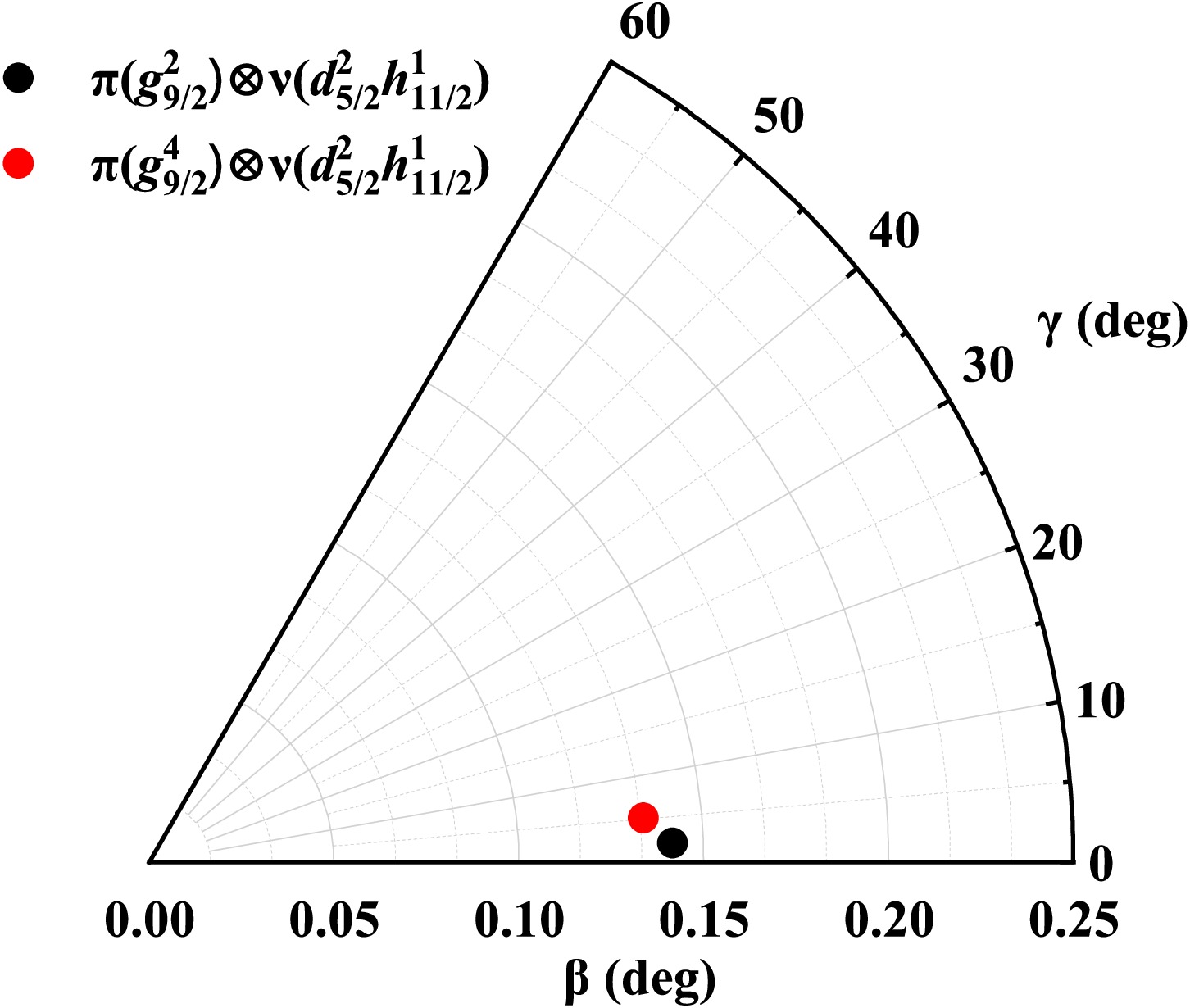
Figure 9. (color online) The quadrupole and triaxial deformation parameter (β, γ) for 95Mo from 3DTAC-CDFT calculations.
-
As mentioned in Sec. IV.A, the level structure built upon the
$ 11/2^- $ state in 95Mo resembles the decoupled bands systematically observed in neighboring nuclei such as 97,99,101Mo [12] and 97Ru [13, 36]. This result suggests that collectivity, similar to that in neighboring odd-A nuclei, may also emerge in 95Mo. In the present study, the nucleus 95Mo is investigated using the 3DTAC-CDFT with the point-coupling interaction PC-PK1. The 3DTAC-CDFT is a fully microscopic and self-consistent method for describing nuclear rotational structures without introducing additional parameters. It has been successfully applied to the study of various rotational phenomena in nuclei, including magnetic rotation and chiral rotation [41–44]. Details of the numerical calculations are reported in Refs. [42, 45].Based on the construction of two configurations for the
$ 11/2^- $ state−$ \pi (g_{9/2}^2)\otimes \nu (d_{5/2}^2h_{11/2}^1) $ and$ \pi (g_{9/2}^4)\otimes \nu (d_{5/2}^2h_{11/2}^1) $ −the deformation of 95Mo is obtained via 3DTAC-CDFT calculations. As shown in Fig. 9, the calculated quadrupole deformation β and triaxiality γ parameters are$ (\beta=0.14, \gamma=2.1^{\circ}) $ and$ (\beta=0.13, \gamma=5.1^{\circ}) $ , respectively. This result indicates that 95Mo undergoes weakly prolate deformation, suggesting the likely existence of a neutron$ h_{11/2} $ decoupled band built on the$ 11/2^- $ state, similar to those in neighboring nuclei. Furthermore, Kumar et al. [12] investigated the aforementioned rotational-like bands (i.e., decoupled bands) in 97,99,101Mo using the cranked shell model, obtaining quadrupole deformation parameters$ \varepsilon_2 $ ($ \varepsilon_2 \approx 0.946 \, \beta $ ) of 0.19, 0.20, and 0.21, respectively. Combining these results with those obtained in the present study reveals a trend of increasing deformation–and consequently enhanced collectivity–along the Mo isotopic chain with increasing neutron number. In contrast, no rotational-like structure is observed in 93Mo. Therefore, 95Mo may represent the critical onset of collectivity in the Mo isotopes.
Figure 9. (color online) Quadrupole and triaxial deformation parameter (β, γ) for 95Mo obtained from 3DTAC-CDFT calculations.
-
As mentioned in Sec. IV.A, the level structure built upon the
$ 11/2^- $ state in 95Mo resembles the decoupled bands systematically observed in neighboring nuclei such as 97,99,101Mo [12] and 97Ru [13, 36]. This result suggests that collectivity, similar to that in neighboring odd-A nuclei, may also emerge in 95Mo. In the present study, the nucleus 95Mo is investigated using the 3DTAC-CDFT with the point-coupling interaction PC-PK1. The 3DTAC-CDFT is a fully microscopic and self-consistent method for describing nuclear rotational structures without introducing additional parameters. It has been successfully applied to the study of various rotational phenomena in nuclei, including magnetic rotation and chiral rotation [41–44]. Details of the numerical calculations are reported in Refs. [42, 45].Based on the construction of two configurations for the
$ 11/2^- $ state−$ \pi (g_{9/2}^2)\otimes \nu (d_{5/2}^2h_{11/2}^1) $ and$ \pi (g_{9/2}^4)\otimes \nu (d_{5/2}^2h_{11/2}^1) $ −the deformation of 95Mo is obtained via 3DTAC-CDFT calculations. As shown in Fig. 9, the calculated quadrupole deformation β and triaxiality γ parameters are$ (\beta=0.14, \gamma=2.1^{\circ}) $ and$ (\beta=0.13, \gamma=5.1^{\circ}) $ , respectively. This result indicates that 95Mo undergoes weakly prolate deformation, suggesting the likely existence of a neutron$ h_{11/2} $ decoupled band built on the$ 11/2^- $ state, similar to those in neighboring nuclei. Furthermore, Kumar et al. [12] investigated the aforementioned rotational-like bands (i.e., decoupled bands) in 97,99,101Mo using the cranked shell model, obtaining quadrupole deformation parameters$ \varepsilon_2 $ ($ \varepsilon_2 \approx 0.946 \, \beta $ ) of 0.19, 0.20, and 0.21, respectively. Combining these results with those obtained in the present study reveals a trend of increasing deformation–and consequently enhanced collectivity–along the Mo isotopic chain with increasing neutron number. In contrast, no rotational-like structure is observed in 93Mo. Therefore, 95Mo may represent the critical onset of collectivity in the Mo isotopes.
Figure 9. (color online) Quadrupole and triaxial deformation parameter (β, γ) for 95Mo obtained from 3DTAC-CDFT calculations.
-
Excited states in 95Mo were populated via the 12C+87Rb fusion-evaporation reaction at a beam energy of 62 MeV. Based on coincidence analysis, the level scheme of 95Mo was extended and revised: 14 γ-ray transitions and 13 new levels were added, and the placements of 6 transitions were reassigned. Furthermore, several transitions, which were not observed simultaneously in two previous studies, were confirmed, and their positions within the scheme were readjusted. To interpret the observed level structure of 95Mo, shell-model calculations were performed using the GWBXG and SNET effective interactions. The lower-lying positive-parity states were well described by the GWBXG interaction. The calculation with the SNET interaction successfully reproduced a significant
$ h_{11/2} $ neutron configuration component for the$ 11/2^- $ state. A systematic analysis of the positive-parity yrast states in the$ N=53 $ isotones 95Mo, 97Ru, and 99Pd revealed that the$ 7/2^+ $ ,$ 11/2^+ $ , and$ 15/2^+ $ energies exhibited a nearly identical decreasing trend with increasing proton number. Combined with the shell-model results, we concluded that this phenomenon likely originated from the weakening interaction between the$ \nu 1g_{7/2} $ and$ \pi 1g_{9/2} $ orbitals with proton addition. Based on the configuration of the$ 11/2^- $ state, the 3DTAC-CDFT calculations showed that 95Mo. underwent weakly prolate deformation. This result suggests that the level structure built upon the$ 11/2^- $ state in 95Mo may constitute a neutron$ h_{11/2} $ decoupled band, similar to those systematically observed in neighboring nuclei. -
Excited states in 95Mo were populated via the 12C+87Rb fusion-evaporation reaction at a beam energy of 62 MeV. Based on coincidence analysis, the level scheme of 95Mo has been extended and revised: 14 γ-ray transitions and 13 new levels were added, and the placements of 6 transitions were reassigned. Furthermore, several transitions, which were not observed simultaneously in the two previous works, have been confirmed and their positions within the scheme have been readjusted. To interpret the observed level structure of 95Mo, shell-model calculations were performed using the GWBXG and SNET effective interactions. The lower-lying positive-parity states are well described by the GWBXG interaction. The calculation with SNET interaction successfully reproduces a significant
$ h_{11/2} $ neutron configuration component for the$ 11/2^- $ state. A systematic analysis of the positive-parity yrast states in the$ N=53 $ isotones 95Mo, 97Ru, and 99Pd reveals that the$ 7/2^+ $ ,$ 11/2^+ $ , and$ 15/2^+ $ energies exhibit a nearly identical decreasing trend with increasing proton number. Combined with shell-model results, this phenomenon is inferred to likely originate from the weakening interaction between the$ \nu 1g_{7/2} $ and$ \pi 1g_{9/2} $ orbitals as protons are added. Based on the configuration of the$ 11/2^- $ state, 3DTAC-CDFT calculations yield a weakly prolate deformation for 95Mo. This suggests that the level structure built upon the$ 11/2^- $ state in 95Mo may constitute a neutron$ h_{11/2} $ decoupled band, similar to those systematically observed in neighboring nuclei. -
Excited states in 95Mo were populated via the 12C+87Rb fusion-evaporation reaction at a beam energy of 62 MeV. Based on coincidence analysis, the level scheme of 95Mo was extended and revised: 14 γ-ray transitions and 13 new levels were added, and the placements of 6 transitions were reassigned. Furthermore, several transitions, which were not observed simultaneously in two previous studies, were confirmed, and their positions within the scheme were readjusted. To interpret the observed level structure of 95Mo, shell-model calculations were performed using the GWBXG and SNET effective interactions. The lower-lying positive-parity states were well described by the GWBXG interaction. The calculation with the SNET interaction successfully reproduced a significant
$ h_{11/2} $ neutron configuration component for the$ 11/2^- $ state. A systematic analysis of the positive-parity yrast states in the$ N=53 $ isotones 95Mo, 97Ru, and 99Pd revealed that the$ 7/2^+ $ ,$ 11/2^+ $ , and$ 15/2^+ $ energies exhibited a nearly identical decreasing trend with increasing proton number. Combined with the shell-model results, we concluded that this phenomenon likely originated from the weakening interaction between the$ \nu 1g_{7/2} $ and$ \pi 1g_{9/2} $ orbitals with proton addition. Based on the configuration of the$ 11/2^- $ state, the 3DTAC-CDFT calculations showed that 95Mo. underwent weakly prolate deformation. This result suggests that the level structure built upon the$ 11/2^- $ state in 95Mo may constitute a neutron$ h_{11/2} $ decoupled band, similar to those systematically observed in neighboring nuclei.
Reinvestigating the level structure of 95Mo: Coexistence of single-particle excitations and collective motions
- Received Date: 2025-12-09
- Available Online: 2026-05-15
Abstract: Excited states of 95Mo have been reinvestigated via the 87Rb(12C,1p3n)95Mo fusion-evaporation reaction at a beam energy of 62 MeV. The level scheme of 95Mo was enriched by the addition of 13 γ-ray transitions and 11 new levels, while the placements of 6 transitions were reassigned. Shell-model calculations with the GWBXG and SNET interactions were performed to reproduce parts of the observed level structure, providing relevant configuration information. Furthermore, a systematic analysis of the low-lying positive-parity yrast states was conducted for 95Mo and its neighboring $ N=53 $ isotones. In addition, three-dimensional tilted axis cranking covariant density functional theory (3DTAC-CDFT) calculations indicated weakly prolate deformation for 95Mo. Combined with systematics, this result suggests that collectivity similar to that in neighboring nuclei such as 97,99,101Mo may be presented in 95Mo.
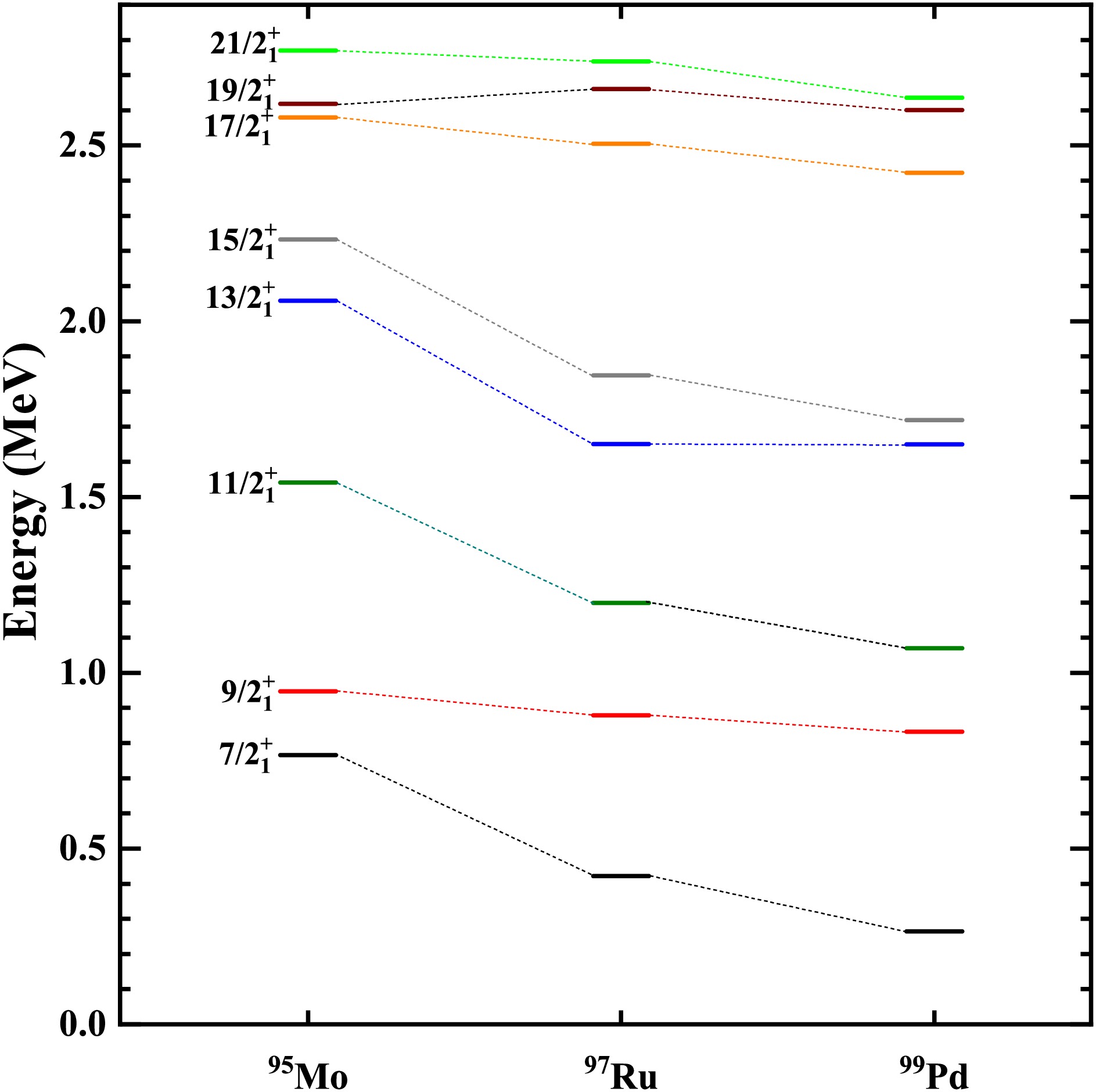



 DownLoad: